
What Is Gay-Lussac's Law?
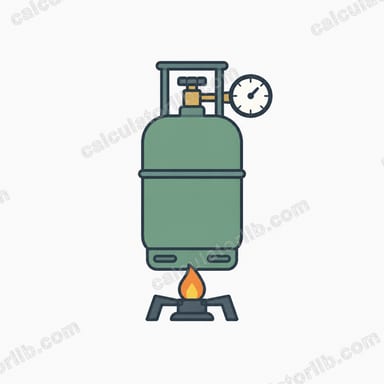
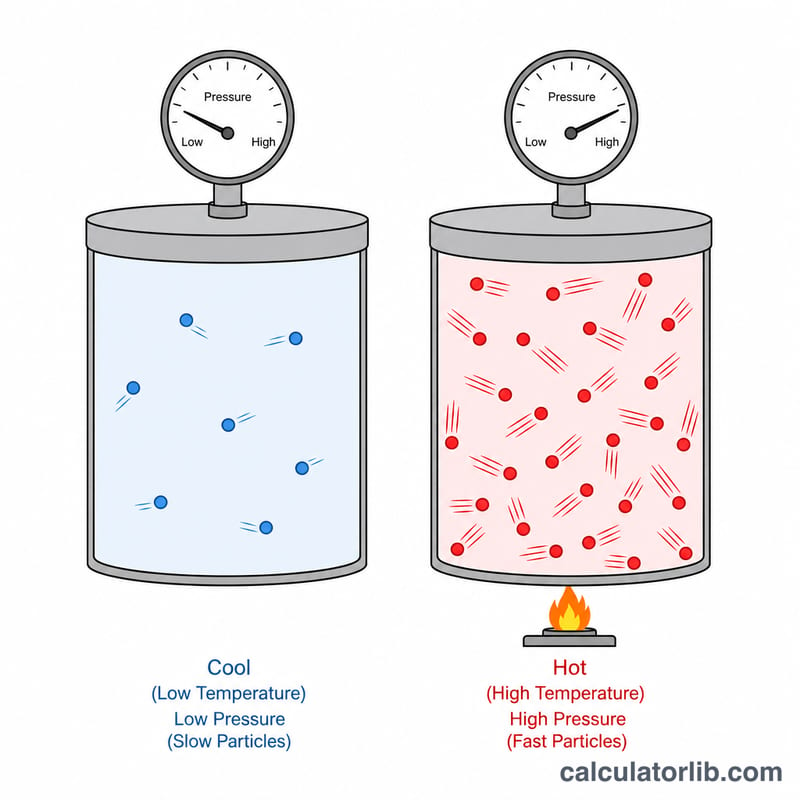
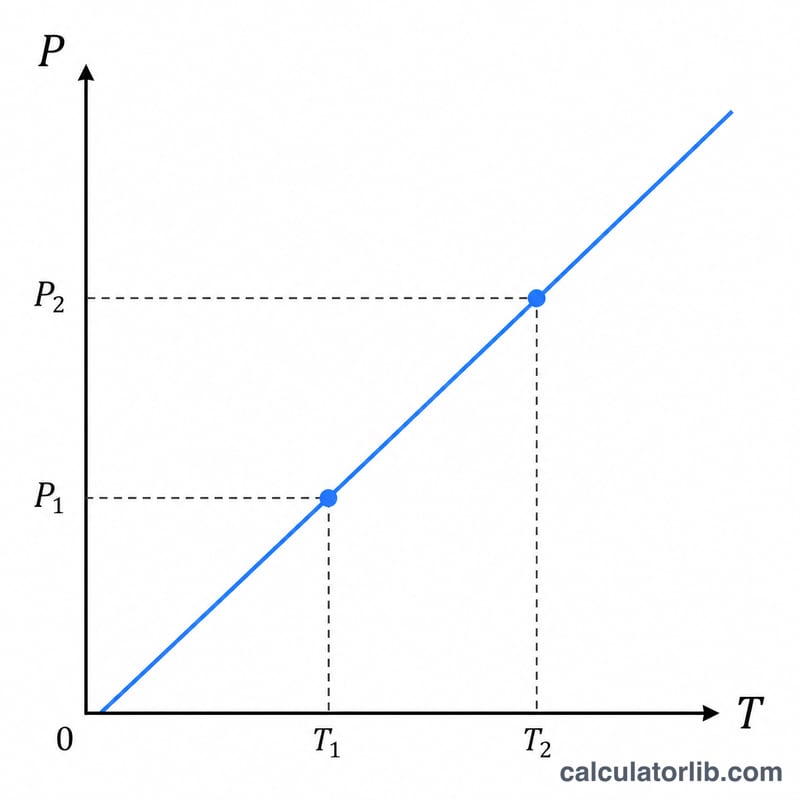
Gay-Lussac's Law describes how the pressure of a fixed amount of gas in a sealed, rigid container changes with temperature. When the volume and the number of gas molecules are held constant, the pressure of the gas is directly proportional to its absolute temperature. In other words, heat the gas and its pressure rises; cool it and the pressure falls. This is why an aerosol can warns against heating and why car tire pressure changes with the seasons.
The Formula
The law is written as \(\frac{\text{P}_1}{\text{T}_1} = \frac{\text{P}_2}{\text{T}_2}\), where \(\text{P}_1\) and \(\text{T}_1\) are the initial pressure and temperature, and \(\text{P}_2\) and \(\text{T}_2\) are the final values. Temperature must be in Kelvin (\(\text{K} = {}^\circ\text{C} + 273.15\)); using Celsius gives wrong answers because the ratio only works on an absolute scale. To find an unknown, rearrange: $$\text{P}_2 = \frac{\text{P}_1 \times \text{T}_2}{\text{T}_1}$$ or $$\text{T}_2 = \frac{\text{T}_1 \times \text{P}_2}{\text{P}_1}$$
How to Use This Calculator
Pick which variable you want to solve for, then enter the other three known values. Pressure can be in any consistent unit (kPa, atm, psi) as long as both pressures use the same unit; the result comes out in that same unit. Temperatures must be in Kelvin. Click calculate to get the missing value instantly.
Worked Example
A gas at 100 kPa and 300 K is heated to 400 K at constant volume. The new pressure is $$\text{P}_2 = \frac{100 \times 400}{300} = \mathbf{133.33\ \text{kPa}}$$ The pressure rose because the temperature increased.
FAQ
Why must temperature be in Kelvin? The proportionality only holds on an absolute temperature scale where 0 means no thermal motion. Celsius has a shifted zero, so ratios are invalid.
Does volume change in this law? No. Gay-Lussac's Law assumes the container is rigid, so volume and moles of gas stay constant. If volume changes, use the Combined Gas Law instead.
Can I use psi or atm? Yes, any pressure unit works as long as both pressures share the same unit. The answer is returned in that unit.