
What is Darcy's Law?
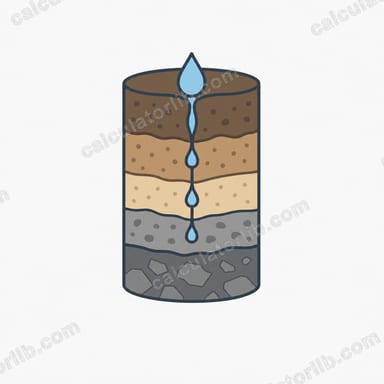
Darcy's law describes the flow of a fluid (most commonly groundwater) through a porous medium such as sand, gravel, or fractured rock. It states that the volumetric flow rate is proportional to the hydraulic conductivity of the material, the cross-sectional area available for flow, and the hydraulic gradient driving the movement. This calculator is a universal physics/hydrogeology tool and applies anywhere SI units are used.
How to use this calculator
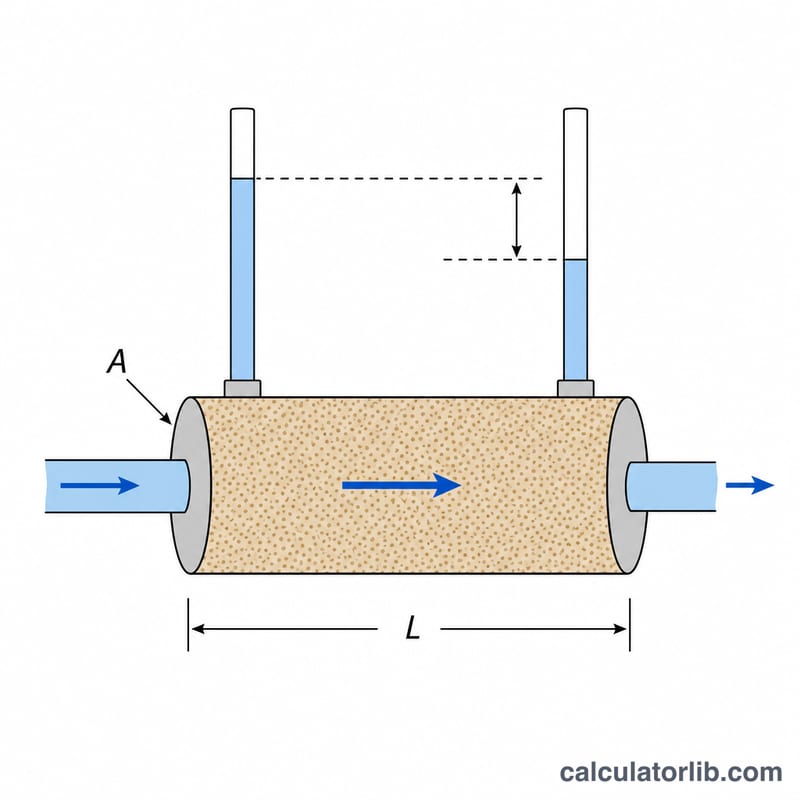
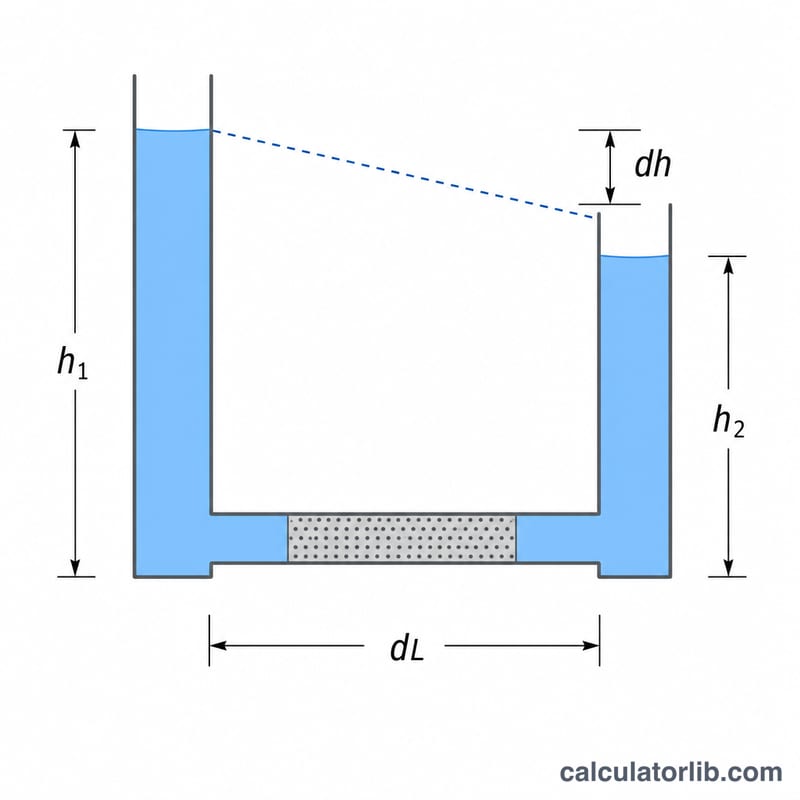
Enter the hydraulic conductivity K (m/s), the cross-sectional area A (m²), the head difference dh (m) across the flow path, and the flow path length dL (m). The calculator returns the volumetric discharge Q in m³/s, along with the hydraulic gradient and the Darcy velocity.
The formula explained
The classic form is \(Q = -K \cdot A \cdot \frac{dh}{dL}\). The minus sign indicates that flow occurs in the direction of decreasing head. When dh is supplied as the head drop along the flow direction (a positive number), the result is a positive discharge:
$$Q = K \cdot A \cdot \frac{dh}{dL}$$The term dh/dL is the dimensionless hydraulic gradient \(i\), and \(q = K \cdot i\) is the Darcy (specific) velocity.
Worked example
Suppose K = 0.01 m/s, A = 10 m², dh = 2 m, dL = 20 m. The gradient \(i = 2/20 = 0.1\). Then
$$Q = 0.01 \times 10 \times 0.1 = 0.01 \ \text{m}^3/\text{s}$$and the Darcy velocity \(q = 0.01 \times 0.1 = 0.001\) m/s.
FAQ
Is Darcy velocity the actual pore velocity? No. Darcy velocity assumes flow across the entire area; the true seepage velocity is q divided by the effective porosity.
What units should I use? Use consistent SI units (m, m², m/s) so Q comes out in m³/s.
Does Darcy's law always apply? It is valid for laminar (low Reynolds number) flow. For very high velocities or turbulent flow in coarse media, non-Darcian corrections are needed.