
What is a broad-crested weir?
A broad-crested weir is a flat-topped hydraulic structure placed across an open channel to measure or control flow. When the crest is long enough relative to the head, critical flow develops over the weir, giving a stable, predictable relationship between the upstream water depth and the discharge. This makes broad-crested weirs popular flow-measurement devices in rivers, irrigation canals, and laboratory flumes.
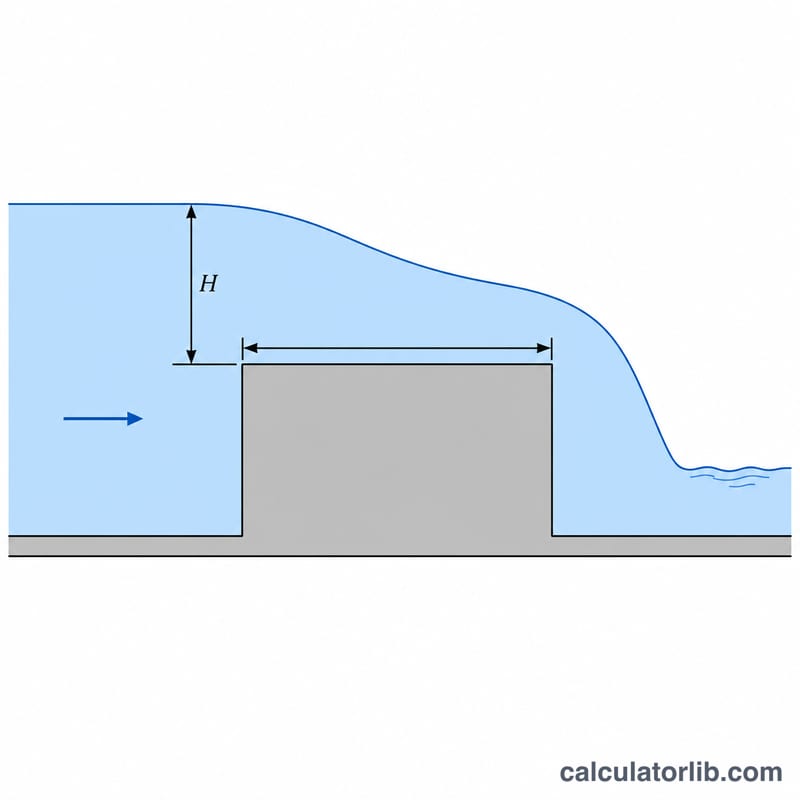
The formula explained
The discharge is given by Q = Cd · b · √g · (2/3)^(3/2) · H^(3/2). Here Cd is a dimensionless discharge coefficient (typically 0.85–0.95) that accounts for energy losses and approach conditions, b is the crest width across the channel, g is gravitational acceleration (9.81 m/s²), and H is the total upstream head measured above the crest. The factor (2/3)^(3/2) ≈ 0.5443 comes from the critical-flow assumption over the crest.
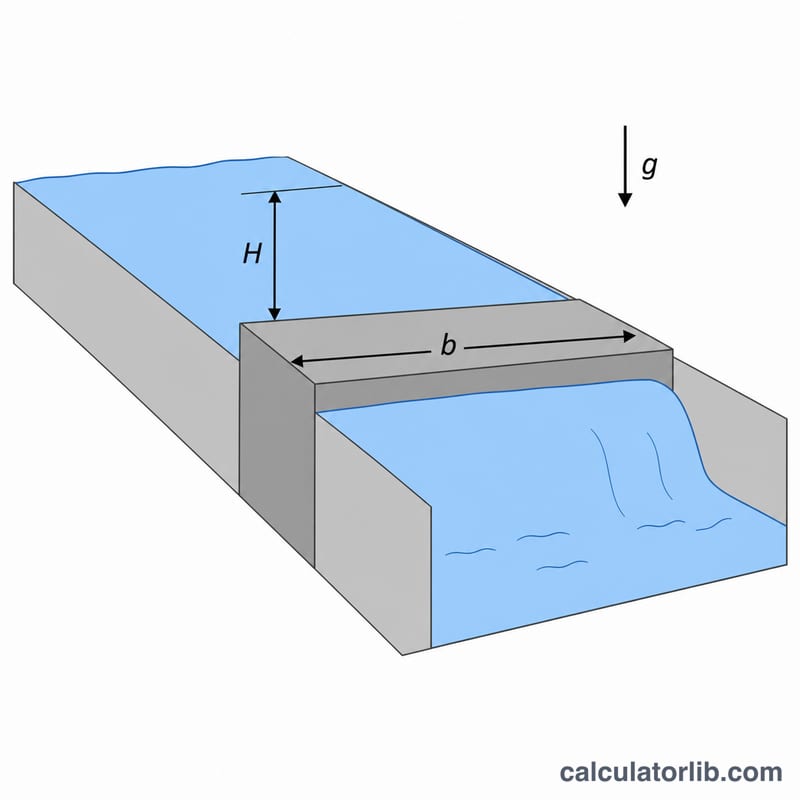
How to use the calculator
Enter the discharge coefficient, crest width, upstream head, and gravity. The tool returns the total discharge Q in cubic metres per second and the unit discharge (flow per unit width) in square metres per second. Keep all length inputs in metres for consistent SI results.
Worked example
For Cd = 0.95, b = 2 m, H = 0.5 m and g = 9.81 m/s²: √9.81 ≈ 3.1321, (2/3)^(3/2) ≈ 0.54433, and H^(3/2) = 0.5^1.5 ≈ 0.35355. So Q = 0.95 × 2 × 3.1321 × 0.54433 × 0.35355 ≈ 1.145 m³/s. Unit discharge = 1.145 / 2 ≈ 0.573 m²/s.
Discharge Coefficient (Cd) Values by Weir Configuration
The discharge coefficient \(C_d\) accounts for energy losses, the position of the critical-flow control on the crest, and the streamlines at the upstream edge. For a broad-crested weir the dimensionless form of the discharge equation is
$$Q = C_d\, b\, \sqrt{g}\,\left(\tfrac{2}{3}\right)^{3/2} H^{3/2}.$$The values below are typical engineering ranges. The crucial constraint is the ratio of head to crest length \(L\) (the streamwise dimension of the crest): a true broad-crested weir requires roughly \(0.08 \lesssim H/L \lesssim 0.50\). Below this the boundary layer dominates and the weir behaves like a long-crested (friction-controlled) weir; above it the flow does not establish parallel critical flow on the crest and the structure behaves more like a sharp-crested weir.
| Upstream-edge geometry / approach | Typical \(C_d\) | Notes |
|---|---|---|
| Sharp / square upstream edge | 0.84 – 0.87 | Flow separates at the corner; a small recirculation zone reduces effective head. Common in concrete sills. |
| Slightly rounded upstream edge | 0.88 – 0.92 | Rounding (radius ≳ 0.1·H) suppresses separation and raises \(C_d\). |
| Well-rounded upstream edge | 0.92 – 0.95 | Smooth contraction; near-ideal critical flow on the crest. |
| Ramped / streamlined entrance | 0.95 – 0.99 | Sloped or faired approach minimises separation losses; approaches the ideal value. |
| Ideal (frictionless, no separation) | 1.00 | Theoretical upper bound used as a reference only. |
Valid broad-crested range: \(0.08 \le H/L \le 0.50\). For \(H/L < 0.08\) friction lowers \(C_d\); for \(H/L > 0.50\) the crest is hydraulically short and the calibration no longer applies. A side-contraction or approach-velocity correction may be needed when the channel is much wider than the weir or the approach velocity is significant.
Key Terms and Variables
- Q — Discharge (m³/s)
- The total volumetric flow rate passing over the weir crest.
- Cd — Discharge coefficient (dimensionless)
- An empirical factor (typically 0.85–0.99) correcting the ideal critical-flow equation for energy losses and the real velocity distribution on the crest.
- b — Crest width (m)
- The transverse width of the weir crest measured perpendicular to the flow; the length of the line over which water spills.
- H — Total upstream head (m)
- The height of the upstream water surface above the weir crest, measured far enough upstream that drawdown is negligible. When approach velocity is significant, the energy head \(H = h + v_a^2/2g\) is used instead of the depth alone.
- g — Gravitational acceleration (m/s²)
- Standard value \(g = 9.81\ \text{m/s}^2\); appears as \(\sqrt{g}\) because the control on the crest is critical flow.
- q — Unit (specific) discharge (m³/s per m)
- Discharge per unit crest width, \(q = Q/b\). For a given head it is independent of width, which makes it convenient for comparing weirs.
- Critical flow
- The flow state of minimum specific energy where the Froude number equals 1. On a broad-crested weir critical depth establishes on the crest, fixing the head–discharge relationship.
- Modular flow
- A free-flow regime in which the downstream (tailwater) level is low enough that it does not affect the discharge. The weir equation is valid only under modular (unsubmerged) conditions; submergence requires a reduction factor.
- Approach velocity head — \(v_a^2/2g\) (m)
- The kinetic-energy contribution of the water approaching the weir. Adding it to the measured depth gives the total energy head H; it is often negligible in a wide, slow approach channel but important at high unit discharge.
FAQ
What value should I use for Cd? Typical broad-crested weir coefficients range from 0.85 to 0.95; 0.95 is common for well-rounded upstream edges. Calibrate against field data when accuracy matters.
Does H include approach velocity? H here is the total upstream head above the crest. For high precision, add the approach velocity head (v²/2g) to the measured depth.
What units does this use? SI units: width and head in metres, gravity in m/s², giving discharge in m³/s.