
What is a Gear Ratio?
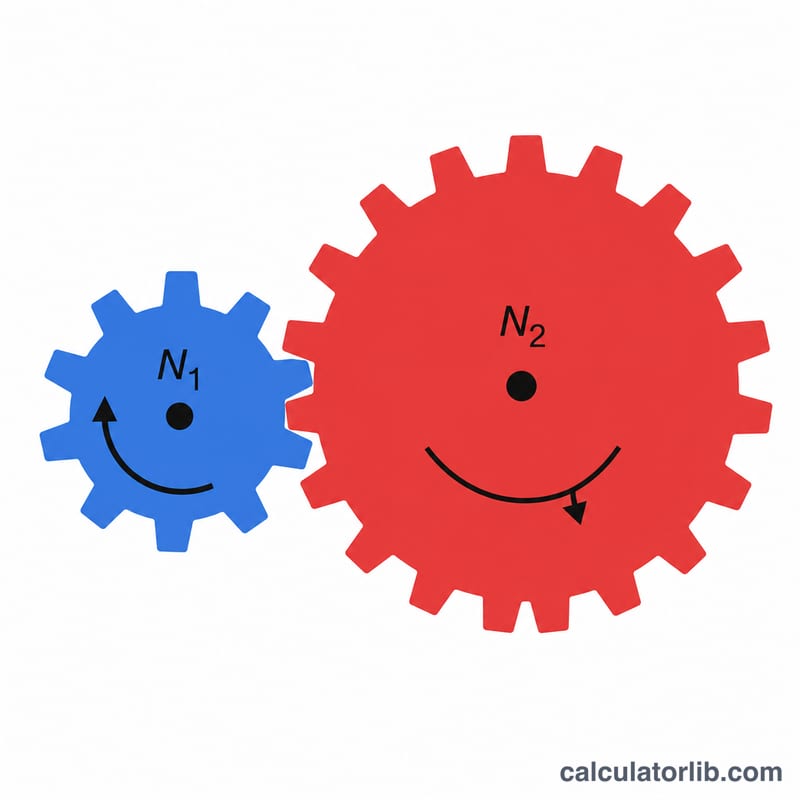
A gear ratio describes how rotational speed and torque are transformed when two meshing gears turn together. It is the ratio of the number of teeth on the driven (output) gear to the number of teeth on the driver (input) gear. A ratio greater than 1 means the output turns slower than the input but with more torque (a reduction); a ratio less than 1 means the output turns faster with less torque (an overdrive).
How to Use This Calculator
Enter the number of teeth on the driver gear (connected to the power source) and on the driven gear (connected to the load). Optionally enter the input speed in RPM and input torque in Nm. The calculator returns the gear ratio plus the resulting output speed and output torque.
The Formula Explained
The core relationship is \( \text{GR} = N_{\text{driven}} / N_{\text{driver}} \). Because power is conserved (ignoring friction losses), speed and torque trade off inversely: \( \text{Output Speed} = \text{Input Speed} \div \text{GR} \) and \( \text{Output Torque} = \text{Input Torque} \times \text{GR} \). So a 3:1 reduction cuts speed to one-third while tripling torque.
$$\text{Gear Ratio} = \frac{\text{Driven teeth}}{\text{Driver teeth}}$$$$\text{Output Speed} = \frac{\text{Input RPM}}{\text{Gear Ratio}} \qquad \text{Output Torque} = \text{Input Torque} \times \text{Gear Ratio}$$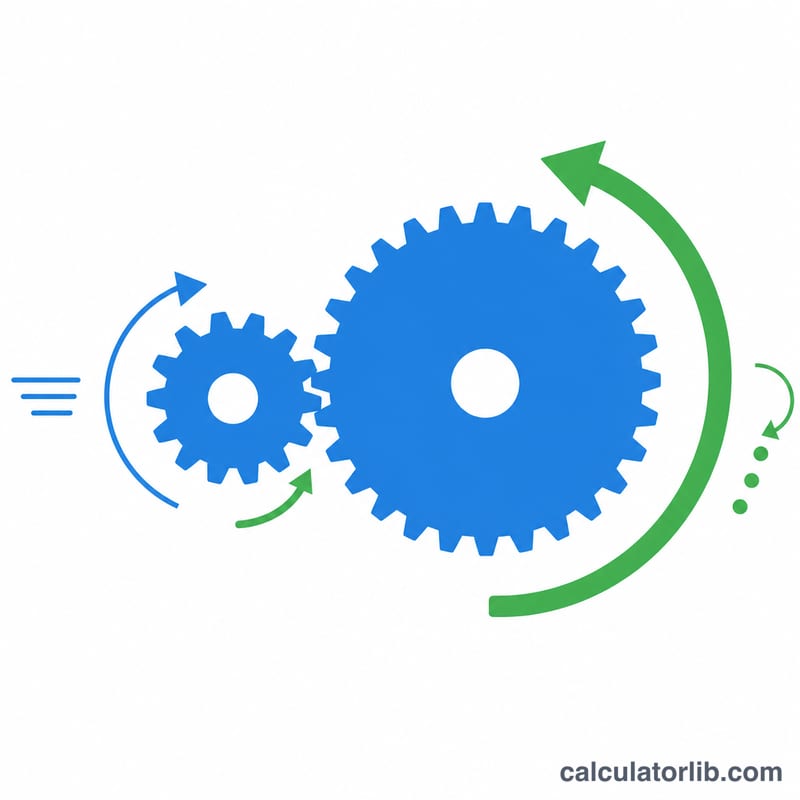
Worked Example
Suppose a 12-tooth driver gear meshes with a 36-tooth driven gear, with an input of 3000 RPM and 50 Nm. The gear ratio is \( 36 \div 12 = 3 \). Output speed = \( 3000 \div 3 = 1000 \) RPM, and output torque = \( 50 \times 3 = 150 \) Nm. The system runs slower but with three times the turning force.
FAQ
What is a "good" gear ratio? It depends on the goal — high ratios maximize torque (e.g. for climbing or lifting), while low ratios maximize top speed.
Does friction reduce the output torque? Yes. Real gears have efficiency losses (typically 95–99% per stage), so actual output torque is slightly lower than the ideal value shown here.
Can I chain multiple gears? For a gear train, multiply the individual ratios together to get the overall ratio.