
What is the Fulcrum Calculator?
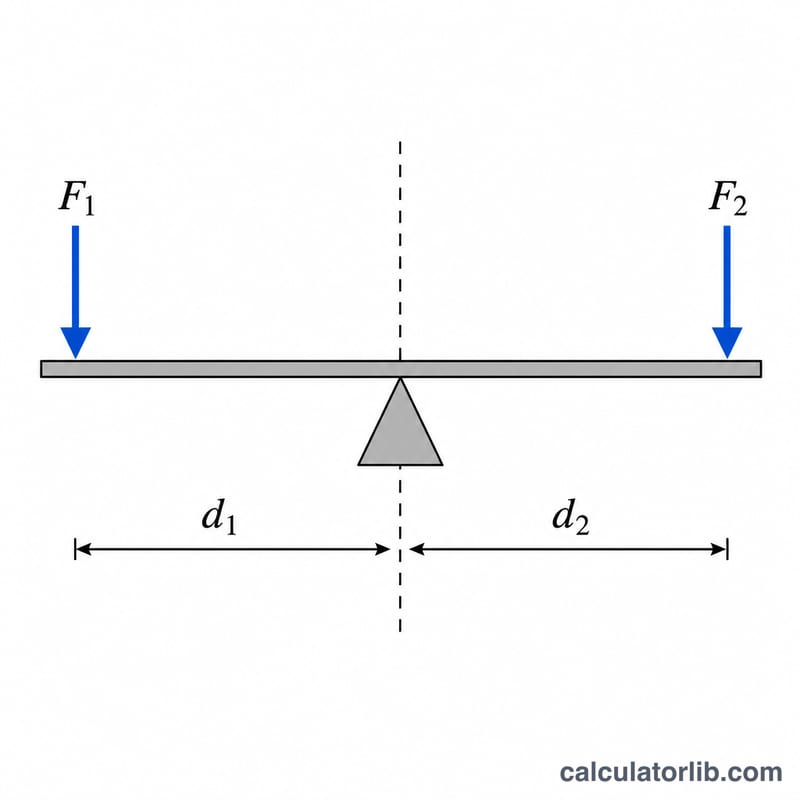
A fulcrum is the fixed pivot point that a lever turns about. The Fulcrum Calculator applies the law of the lever, which states that a lever is balanced when the turning effect (moment) on one side equals the moment on the other. Each moment is simply a force multiplied by its distance from the fulcrum, giving the classic equation \( \text{F1} \times \text{d1} = \text{F2} \times \text{d2} \). This tool is universal physics and applies anywhere — to seesaws, crowbars, wheelbarrows, balance scales and machine design.
How to use it
Pick which value you want to solve for (F1, d1, F2 or d2). Enter the three known values and leave the unknown blank. The calculator rearranges the lever equation and returns the missing quantity, along with the full balanced set of forces and distances and the resulting moment.
The formula explained
The balance condition is \( \text{F1} \times \text{d1} = \text{F2} \times \text{d2} \). Rearranging gives the four possible solutions:
$$\text{F2} = \frac{\text{F1} \times \text{d1}}{\text{d2}}, \quad \text{d2} = \frac{\text{F1} \times \text{d1}}{\text{F2}}, \quad \text{F1} = \frac{\text{F2} \times \text{d2}}{\text{d1}}, \quad \text{d1} = \frac{\text{F2} \times \text{d2}}{\text{F1}}$$ — in practice each unknown is found by isolating it. Forces use any consistent unit (N, kg-force, lb) and distances any consistent length unit, since the units cancel on both sides.
Worked example
Suppose a child weighing a force of 10 (units) sits 2 m from the fulcrum (\( \text{F1} = 10 \), \( \text{d1} = 2 \)). A second child sits 4 m away. What force balances the seesaw? $$\text{F2} = \frac{10 \times 2}{4} = \frac{20}{4} = \textbf{5}$$ A lighter force balances because it sits farther from the pivot.
FAQ
What units should I use? Any units are fine as long as both forces use the same unit and both distances use the same unit; they cancel out.
Where do I measure distance from? Always measure the perpendicular distance from the fulcrum (pivot) to the point where each force acts.
What does the moment value mean? The moment is force × distance — the turning effect. On a balanced lever both sides share the same moment value shown in the results.