
What is the Softplus First Derivative Calculator?
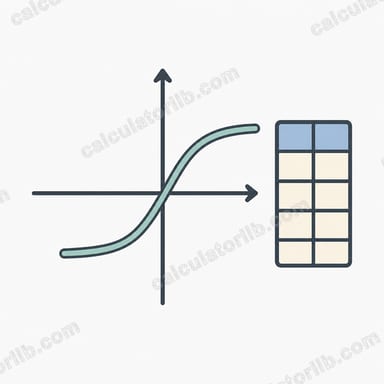
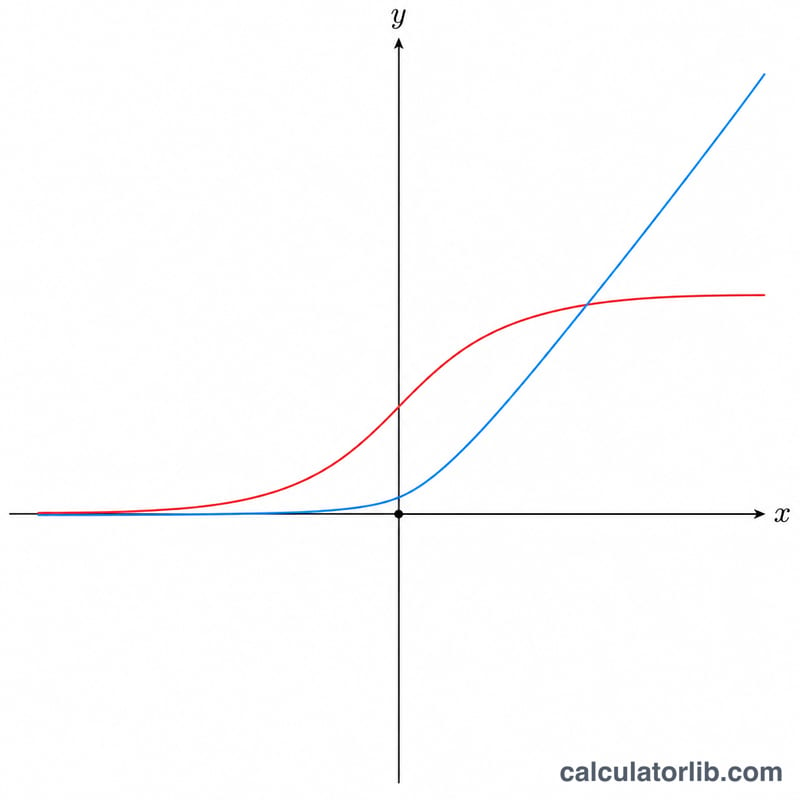
This tool computes the first derivative of the Softplus activation function at any real input value x. The Softplus function, defined as \(\phi(x) = \ln(1 + e^x)\), is a smooth, differentiable approximation of the ReLU (Rectified Linear Unit) function used widely in neural networks. Its derivative is exactly the logistic sigmoid function, which makes it especially convenient in gradient-based training.
How to use it
Enter the value of x at which you want to evaluate the derivative and submit. The calculator returns \(\phi'(x)\), a number that always lies strictly between 0 and 1. Positive inputs push the result toward 1, negative inputs push it toward 0, and an input of exactly 0 yields 0.5.
The formula explained
Differentiating the Softplus function gives:
$$\frac{d}{dx}\ln\!\left(1 + e^{x}\right) = \frac{e^{x}}{1 + e^{x}} = \frac{1}{1 + e^{-x}}.$$
This is the logistic sigmoid \(\sigma(x)\). To keep the computation numerically stable, the calculator uses \(\frac{1}{1 + e^{-x}}\) for \(x \geq 0\) and the equivalent \(\frac{e^{x}}{1 + e^{x}}\) for \(x < 0\), avoiding overflow of the exponential for large-magnitude inputs.
Worked example
Let \(x = 0.5\). Then \(e^{-0.5} = 0.6065306597\), so \(1 + e^{-0.5} = 1.6065306597\). Therefore $$\phi'(0.5) = \frac{1}{1.6065306597} = 0.622459.$$ The derivative is just above 0.5 because the input is slightly positive.
FAQ
Why is the derivative the sigmoid function? Because the chain rule applied to \(\ln(1 + e^x)\) simplifies algebraically to \(\frac{1}{1 + e^{-x}}\), the standard logistic sigmoid.
What is the range of phi'(x)? It is the open interval \((0, 1)\). The value approaches 0 as x goes to negative infinity and 1 as x goes to positive infinity, but never reaches either bound.
Is there any divide-by-zero risk? No. Since \(1 + e^{-x}\) is always greater than zero for every real x, the denominator can never be zero.