
What Is Mechanical Advantage?
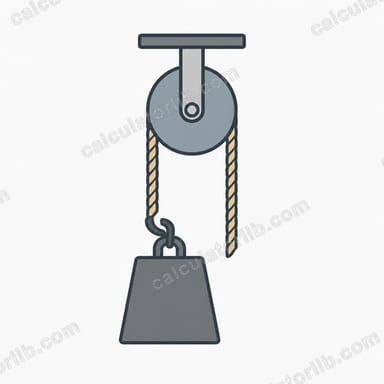
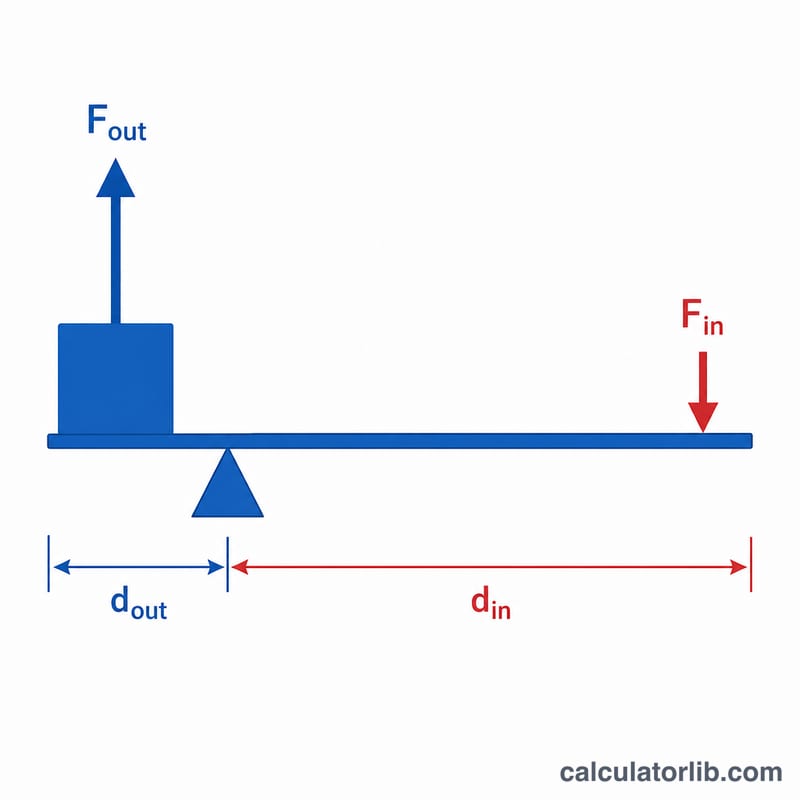
Mechanical advantage (MA) measures how much a simple machine — such as a lever, pulley, gear, ramp or wheel and axle — multiplies the force you apply. It is the ratio of the output force (the load moved) to the input force (the effort you supply). An MA greater than 1 means the machine multiplies your force; an MA less than 1 means it trades force for speed or distance.
How to Use the Calculator
Enter the output force (the load the machine moves, in newtons) and the input force (the effort you apply). The calculator divides output by input to give the mechanical advantage as a unitless ratio. Use consistent units for both forces — the units cancel out.
The Formula Explained
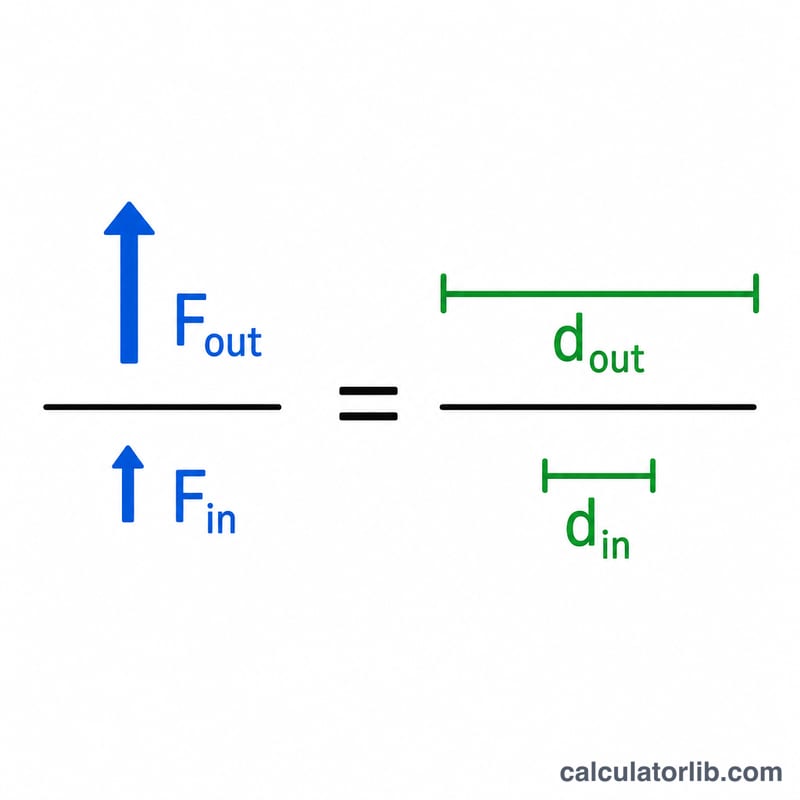
The core equation is:
$$\text{MA} = \frac{F_{\text{out}}}{F_{\text{in}}}$$
Because of the conservation of work in an ideal (frictionless) machine, this also equals the ratio of distances: $$\text{MA} = \frac{d_{\text{in}}}{d_{\text{out}}}$$ A machine that lets you push a small force through a long distance can move a large load a short distance.
Worked Example
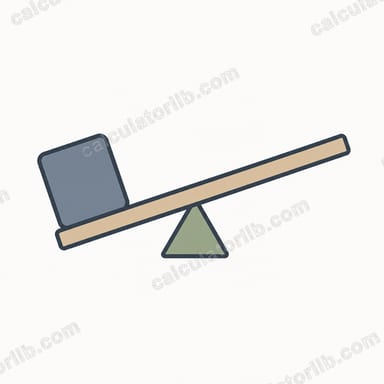
Suppose a lever lets you lift a 200 N load while you push down with only 50 N of effort. Then $$\text{MA} = \frac{200}{50} = 4$$ The lever multiplies your force four times — but you must move your end four times as far as the load rises.
FAQ
Is mechanical advantage always greater than 1? No. Tools like tweezers or a fishing rod have an MA below 1: they sacrifice force to gain speed or range of motion.
What is the difference between ideal and actual MA? Ideal MA assumes no friction and is found from distances. Actual MA uses real measured forces and is always lower because some effort is lost to friction.
Does MA have units? No — it is a pure ratio because both forces (or distances) share the same units, which cancel.