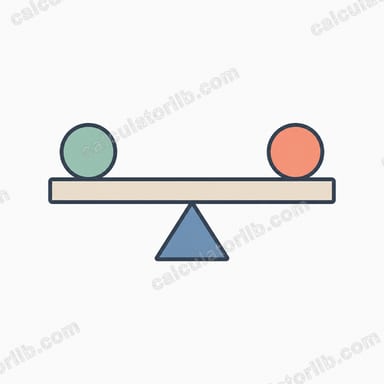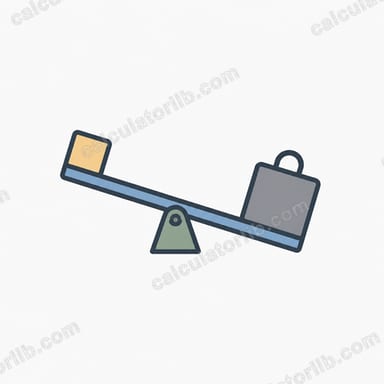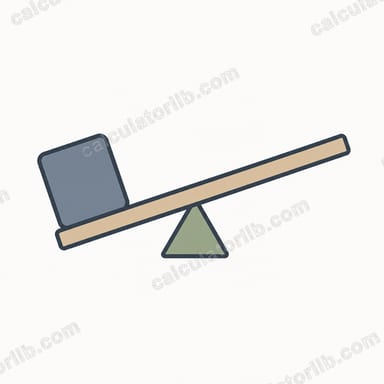

What is a lever calculator?
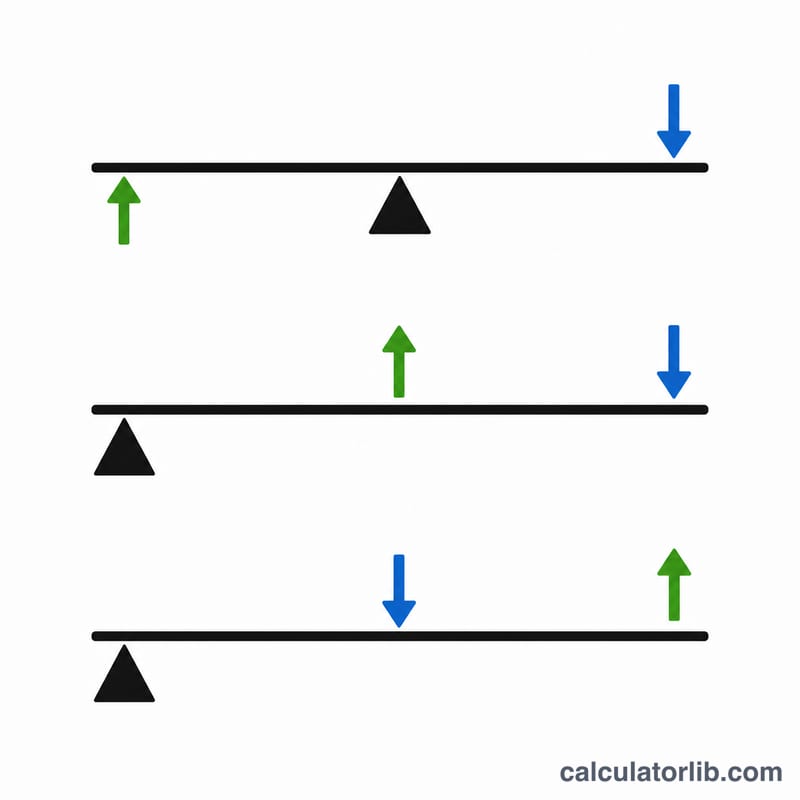
A lever is one of the six classic simple machines: a rigid bar that pivots on a fulcrum. This calculator applies the law of the lever to find the mechanical advantage (MA) of any lever and the output (load) force it can produce. It works for class 1, 2 and 3 levers as long as you enter the effort arm and load arm measured from the fulcrum.
How to use it
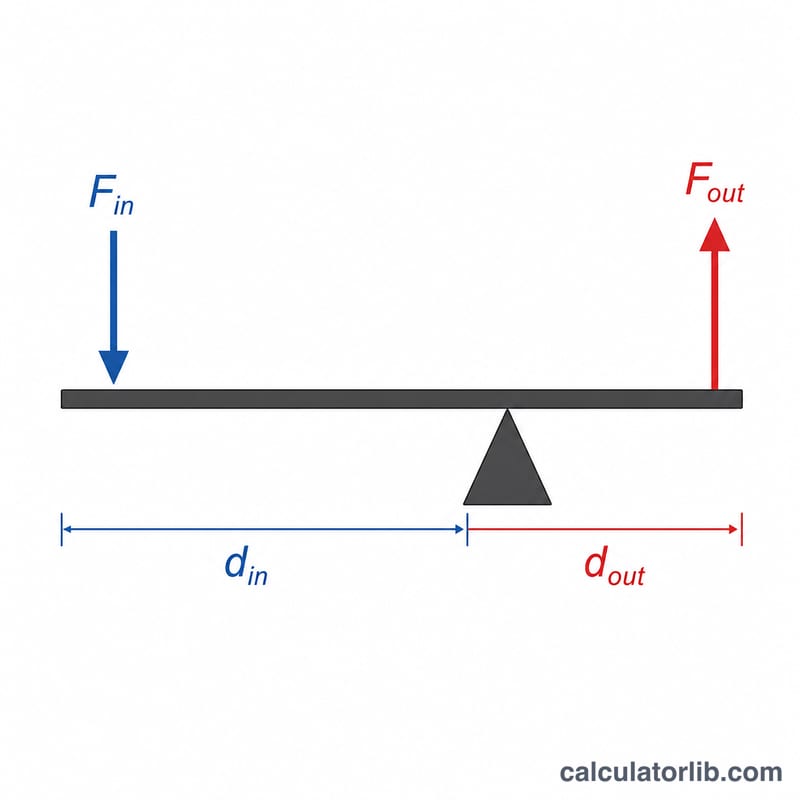
Enter the effort arm — the distance from the fulcrum to where you push (\(d_{in}\)) — and the load arm — the distance from the fulcrum to the load (\(d_{out}\)). Use any consistent length unit. Optionally enter the effort force you apply (\(F_{in}\)) to see the resulting load force. The mechanical advantage tells you how many times the lever multiplies your force.
The formula explained
The principle of moments states that a balanced lever satisfies $$F_{in} \cdot d_{in} = F_{out} \cdot d_{out}$$ Rearranging gives mechanical advantage $$MA = \frac{d_{in}}{d_{out}} = \frac{F_{out}}{F_{in}}$$ An MA greater than 1 means the lever multiplies force (you trade distance for force); less than 1 means it multiplies distance and speed instead.
Worked example
A crowbar has an effort arm of 100 cm and a load arm of 25 cm. $$MA = \frac{100}{25} = 4$$ If you push with 50 N of effort force, the load force becomes $$50 \times 4 = 200 \text{ N}$$ — the bar quadruples your effort.
FAQ
What units should I use? Any consistent units. Arm lengths just need to match each other; force is in whatever unit you enter (N, lbf, kg-force, etc.).
What does MA below 1 mean? The lever reduces force but increases speed and range of motion — typical of class 3 levers like the human forearm or a fishing rod.
Does this account for friction or bar weight? No. It is an ideal model assuming a rigid, weightless bar and frictionless fulcrum, which is accurate enough for most design and homework problems.