
What is the Moles to Molecules Calculator?
This calculator converts an amount of substance, measured in moles, into the actual number of molecules (or atoms, ions, or other representative particles). It relies on Avogadro's number, one of the cornerstones of chemistry, which tells us how many particles are contained in exactly one mole of any substance.
How to use it
Enter the amount of substance in moles and the calculator instantly returns the corresponding number of molecules. The result is shown in scientific notation because the values are extremely large. You can enter whole numbers or decimals, including very small fractional amounts of substance.
The formula explained
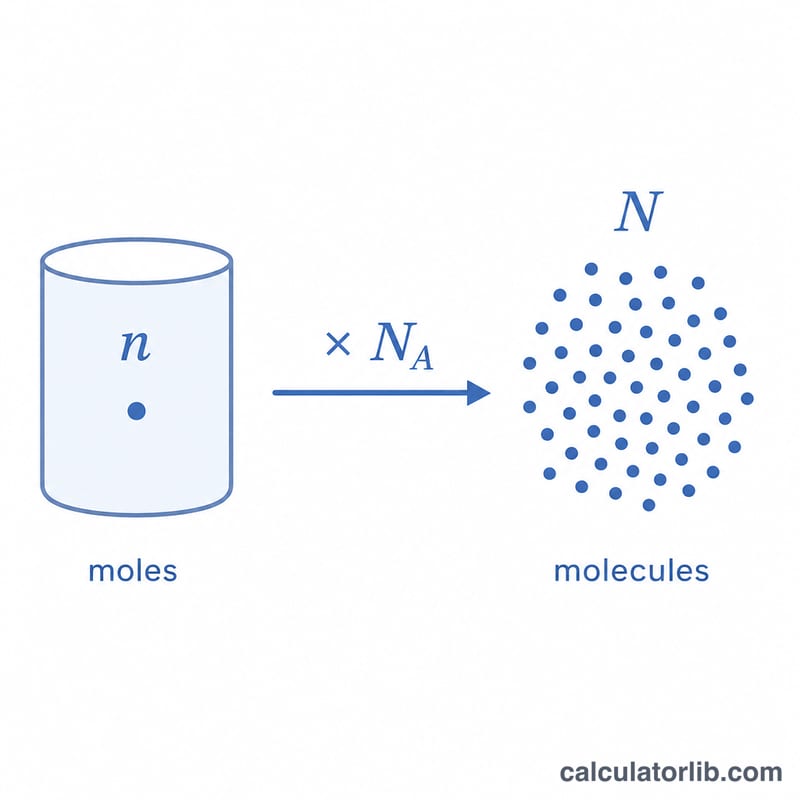
The conversion uses the simple relationship:
$$N = n \times N_A$$
where N is the number of molecules, n is the number of moles, and \(N_A\) is Avogadro's number, defined exactly as \(6.02214076 \times 10^{23}\) per mole since the 2019 SI redefinition. Multiplying the moles by this constant gives the particle count.
Worked example
Suppose you have 2 moles of water (H₂O). Multiply 2 by Avogadro's number: $$N = 2 \times 6.02214076 \times 10^{23} = 1.2044 \times 10^{24} \text{ molecules of water.}$$ So two moles contain roughly 1.2 septillion molecules.
FAQ
What is Avogadro's number? It is the number of constituent particles (usually molecules or atoms) in one mole of a substance: \(6.02214076 \times 10^{23}\) per mole.
Does this work for atoms and ions too? Yes. The mole counts any "representative particle," so the same formula gives the number of atoms, ions, or formula units depending on the substance.
How do I convert molecules back to moles? Divide the number of molecules by Avogadro's number: \(n = N \div N_A\).