
What is the pH and pOH relationship?
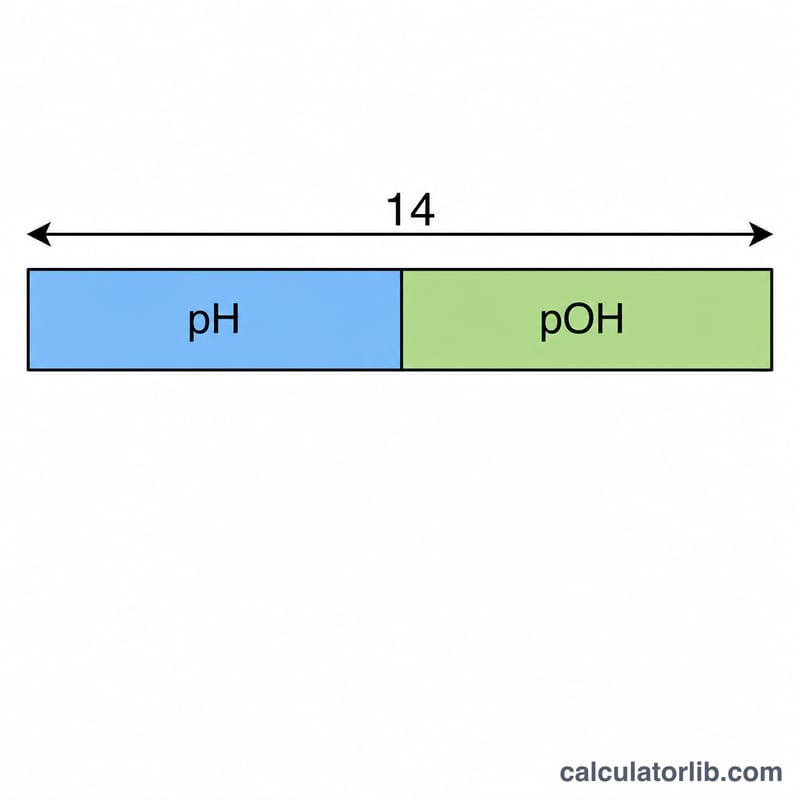
In any aqueous solution at 25 °C, the acidity (pH) and basicity (pOH) are linked by a simple, exact rule: \(\text{pH} + \text{pOH} = 14\). This comes from the self-ionization of water, where the ion product \(K_w = [\text{H}^+][\text{OH}^-] = 1 \times 10^{-14}\). Taking the negative logarithm of both sides gives \(\text{pH} + \text{pOH} = 14\). This calculator lets you enter either value and instantly returns the other, along with the corresponding hydrogen and hydroxide ion concentrations.
How to use it
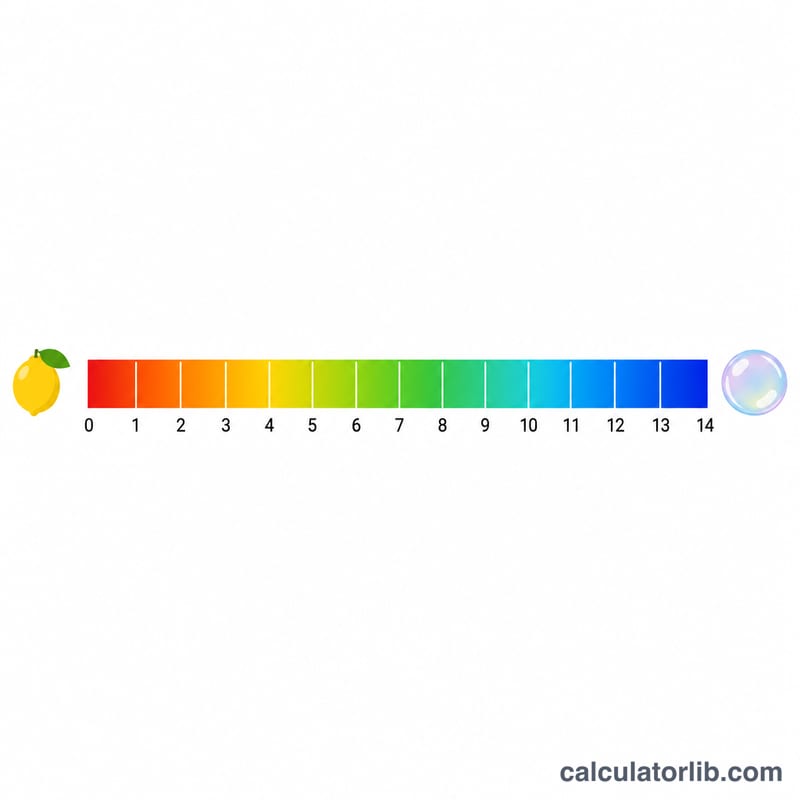
Choose whether you know the pH or the pOH, type the value (between 0 and 14), and read the result. A pH below 7 is acidic, exactly 7 is neutral, and above 7 is basic. The tool also reports \([\text{H}^+] = 10^{-\text{pH}}\) and \([\text{OH}^-] = 10^{-\text{pOH}}\) in mol/L.
The formula explained
Because water dissociates slightly into H⁺ and OH⁻ ions, their product is constant at a fixed temperature. At 25 °C that constant is \(10^{-14}\). Defining \(\text{pH} = -\log_{10}[\text{H}^+]\) and \(\text{pOH} = -\log_{10}[\text{OH}^-]\), the logarithm of the constant gives the clean sum of 14. Note this exact value of 14 assumes standard temperature; \(K_w\) rises at higher temperatures, shifting the sum below 14.
Worked example
Suppose a solution has a pOH of 4. Then $$\text{pH} = 14 - 4 = 10,$$ meaning the solution is basic. The hydrogen ion concentration is \([\text{H}^+] = 10^{-10} = 1 \times 10^{-10}\) mol/L, while \([\text{OH}^-] = 10^{-4} = 1 \times 10^{-4}\) mol/L.
FAQ
Does pH + pOH always equal 14? Only at 25 °C. At other temperatures the sum equals \(pK_w\), which changes with temperature.
Can pH be negative or above 14? Yes, for very concentrated strong acids or bases, though such values fall outside this calculator's standard 0–14 range.
What is neutral pH? At 25 °C neutral is pH 7, where \([\text{H}^+] = [\text{OH}^-] = 10^{-7}\) mol/L.