
What is the Two-Temperature Activation Energy Calculator?
This tool computes the activation energy (\(E_a\)) of a chemical reaction from two measured rate constants at two different absolute temperatures. It is based on the integrated, two-point form of the Arrhenius equation, a cornerstone of chemical kinetics that describes how reaction rates depend on temperature.
How to use it
Enter the first rate constant k₁ with its temperature T₁, and the second rate constant k₂ with its temperature T₂. Temperatures must be in kelvin (K) — add 273.15 to a Celsius value if needed. The calculator returns the activation energy in both kJ/mol and J/mol. The units of k₁ and k₂ must match, but only their ratio matters, so any consistent unit works.
The formula explained
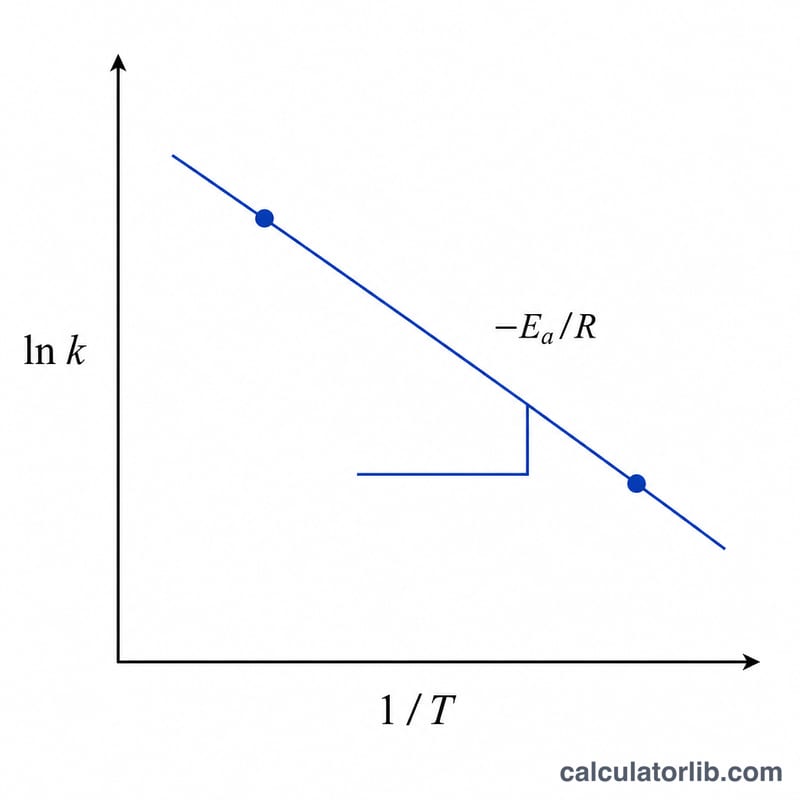
The Arrhenius equation is \(k = A \cdot e^{-E_a/RT}\). Writing it at two temperatures and dividing eliminates the pre-exponential factor \(A\), giving:
$$E_a = \frac{R \cdot \ln(k_2/k_1)}{\frac{1}{T_1} - \frac{1}{T_2}}$$
where \(R = 8.314462618 \ \text{J/(mol}\cdot\text{K)}\). A larger temperature sensitivity of the rate constant implies a larger activation energy.
Worked example
Suppose k₁ = 0.001 s⁻¹ at T₁ = 298 K and k₂ = 0.01 s⁻¹ at T₂ = 320 K. Then \(\ln(k_2/k_1) = \ln(10) = 2.302585\). The temperature term is $$\frac{1}{298} - \frac{1}{320} = 0.0033557 - 0.0031250 = 0.00023070 \ \text{K}^{-1}.$$ So $$E_a = \frac{8.314462618 \times 2.302585}{0.00023070} \approx 82{,}985 \ \text{J/mol} \approx \mathbf{82.99 \ \text{kJ/mol}}.$$
Typical Activation Energies of Common Reactions
Activation energy (\(E_a\)) is the minimum energy barrier that reacting molecules must overcome for a reaction to proceed. The values below are approximate, well-documented ranges expressed in kilojoules per mole (kJ/mol). Catalysts (including enzymes) lower \(E_a\), which dramatically increases the reaction rate at a given temperature.
| Reaction / Process | Approximate \(E_a\) (kJ/mol) |
|---|---|
| Diffusion-controlled reactions in water (near the upper rate limit) | ~8–20 |
| Many enzyme-catalyzed biological reactions | ~20–50 |
| Typical uncatalyzed reactions in solution | ~50–100 |
| Decomposition of hydrogen iodide, \(2\,\mathrm{HI} \rightarrow \mathrm{H_2 + I_2}\) | ~180 |
| Decomposition of nitrogen dioxide, \(2\,\mathrm{NO_2} \rightarrow 2\,\mathrm{NO + O_2}\) | ~110 |
| Decomposition of dinitrogen pentoxide, \(2\,\mathrm{N_2O_5} \rightarrow 4\,\mathrm{NO_2 + O_2}\) | ~100–103 |
| Decomposition of hydrogen peroxide (uncatalyzed) | ~75 |
| Decomposition of hydrogen peroxide (catalase enzyme) | ~8 |
| Decomposition of hydrogen peroxide (colloidal platinum) | ~50 |
| Inversion (hydrolysis) of sucrose | ~108 |
As a rule of thumb, a higher \(E_a\) means the rate constant is more sensitive to temperature: small temperature increases produce large jumps in rate.
Key Terms & Variables
- Activation energy (\(E_a\))
- The minimum energy barrier that reactant molecules must surmount for a successful reaction, usually reported in kJ/mol (or J/mol in SI calculations). A larger \(E_a\) gives a slower reaction and a stronger dependence of rate on temperature.
- Rate constant (\(k\))
- The proportionality constant in a rate law that links reaction rate to reactant concentrations at a fixed temperature. Its units depend on the overall reaction order, and it increases as temperature rises.
- Pre-exponential / frequency factor (\(A\))
- A constant in the Arrhenius equation that reflects the frequency of collisions and the fraction with correct orientation. It has the same units as \(k\) and is approximately temperature-independent over modest ranges.
- Gas constant (\(R\))
- The universal gas constant, \(R = 8.314\ \mathrm{J\,mol^{-1}K^{-1}}\). Using \(R\) in J/mol·K yields \(E_a\) in J/mol; divide by 1000 for kJ/mol.
- Absolute temperature (\(T\))
- Temperature on the Kelvin scale. Always convert Celsius to kelvin with \(T(\mathrm{K}) = T(^{\circ}\mathrm{C}) + 273.15\) before using the Arrhenius equation.
- Arrhenius equation
- The relationship \(k = A\,e^{-E_a/RT}\). Taking the natural log at two temperatures and subtracting gives the two-point form used here: $$E_a = \frac{R\,\ln\!\left(\dfrac{k_2}{k_1}\right)}{\dfrac{1}{T_1} - \dfrac{1}{T_2}}$$
FAQ
Do temperatures have to be in kelvin? Yes. The Arrhenius relationship uses absolute temperature, so always convert from Celsius by adding 273.15.
What units should the rate constants be in? Any units, as long as k₁ and k₂ use the same units — only their ratio enters the formula.
Can the answer be negative? If k decreases with increasing temperature (unusual), the formula returns a negative value. For typical reactions where rate rises with temperature, \(E_a\) is positive.