
What is the Gibbs Free Energy Calculator?
This calculator finds the change in Gibbs free energy (\(\Delta G\)) of a chemical reaction from its enthalpy change (\(\Delta H\)), absolute temperature (\(T\)), and entropy change (\(\Delta S\)). \(\Delta G\) tells you whether a reaction can occur spontaneously under constant temperature and pressure: a negative \(\Delta G\) means the process is thermodynamically favorable (exergonic), a positive \(\Delta G\) means it is non-spontaneous (endergonic), and \(\Delta G = 0\) means the system is at equilibrium.
How to use it
Enter the enthalpy change \(\Delta H\) in kJ/mol, the temperature \(T\) in kelvin (K), and the entropy change \(\Delta S\) in J/mol·K. Because \(\Delta H\) is in kilojoules and \(\Delta S\) in joules, the calculator automatically converts \(\Delta S\) to kJ/mol·K (dividing by 1000) before combining the terms, so your result is consistent in kJ/mol.
The formula explained
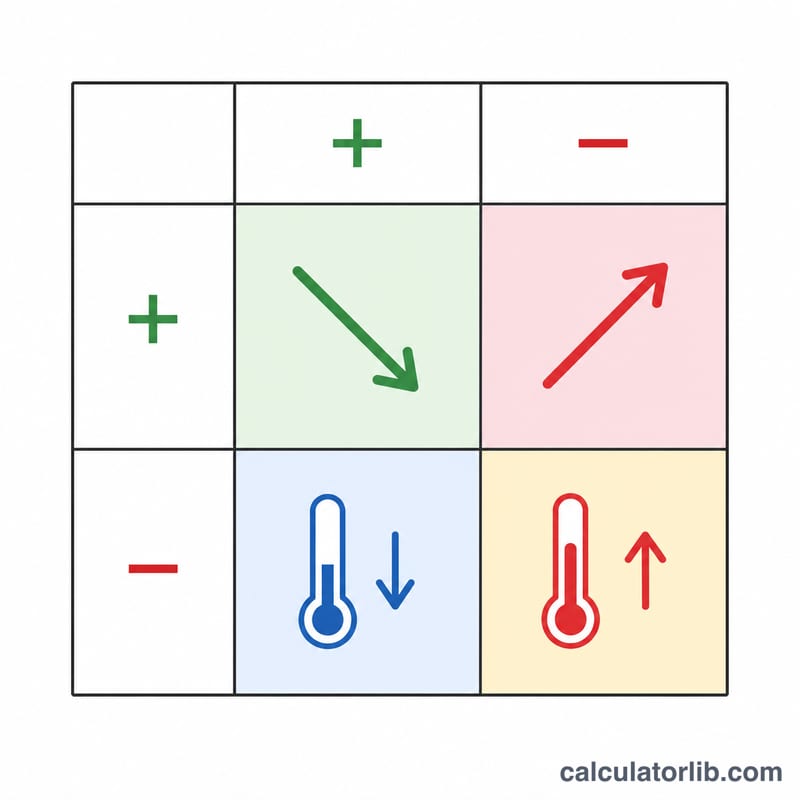
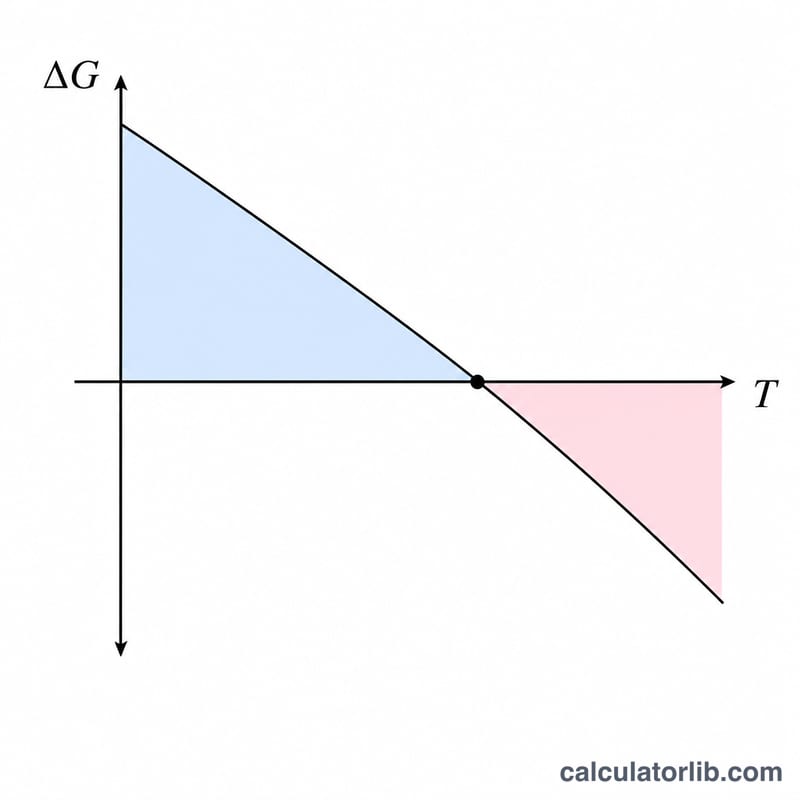
The governing equation is $$\Delta G = \Delta H - T\,\Delta S$$ The enthalpy term reflects heat exchange (bond making/breaking), while the entropy term \(T\,\Delta S\) reflects how disorder changes, scaled by temperature. As temperature rises, the entropy contribution grows, which can flip the sign of \(\Delta G\) and change whether a reaction is spontaneous.
Worked example
For the formation of liquid water, \(\Delta H \approx -285.8\) kJ/mol, \(\Delta S \approx -163.2\) J/mol·K, at \(T = 298.15\) K. Convert \(\Delta S\): \(-163.2 / 1000 = -0.1632\) kJ/mol·K. Then $$\Delta G = -285.8 - (298.15 \times -0.1632) = -285.8 + 48.658 = -237.14 \text{ kJ/mol}$$ Since \(\Delta G\) is negative, the reaction is spontaneous.
FAQ
Why divide \(\Delta S\) by 1000? \(\Delta S\) is usually tabulated in J/mol·K while \(\Delta H\) is in kJ/mol; dividing converts \(\Delta S\) to kJ/mol·K so both terms share units.
What does negative \(\Delta G\) mean? The reaction releases free energy and is spontaneous in the forward direction at the given temperature.
Can \(\Delta G\) change sign with temperature? Yes. When \(\Delta H\) and \(\Delta S\) have the same sign, the \(T\,\Delta S\) term can dominate at high or low temperatures, switching spontaneity.