
What Is Ionic Strength?
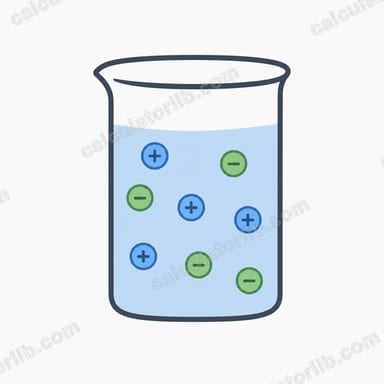
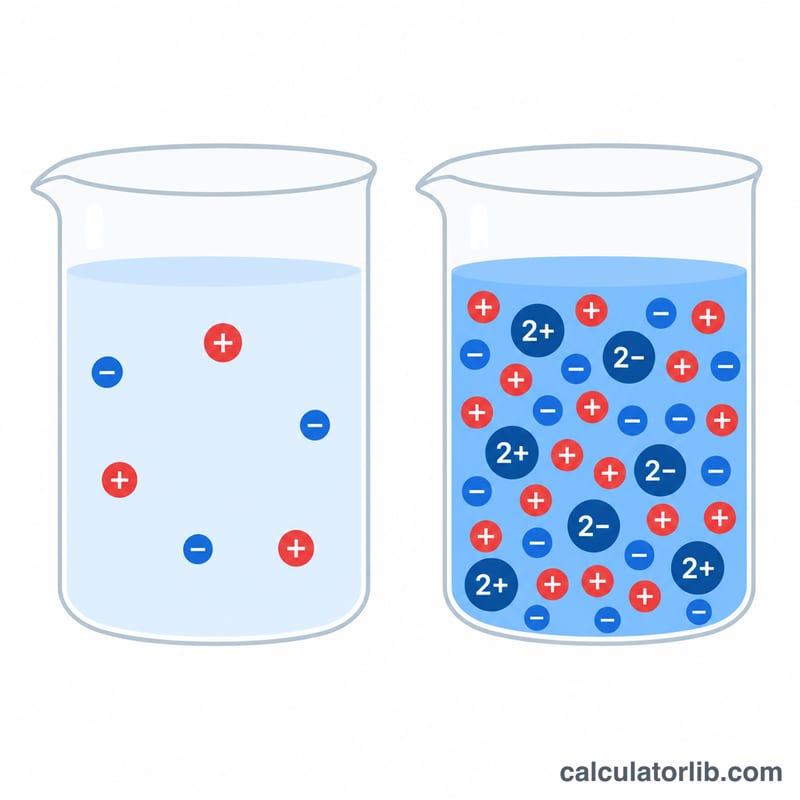
Ionic strength (I) is a measure of the total concentration of ions in a solution, weighted by the square of each ion's charge. It is a key quantity in electrochemistry, analytical chemistry, and the Debye–Hückel theory of activity coefficients. Because higher-charged ions influence solution behavior far more strongly than monovalent ions, the charge appears squared in the formula.
The Formula Explained
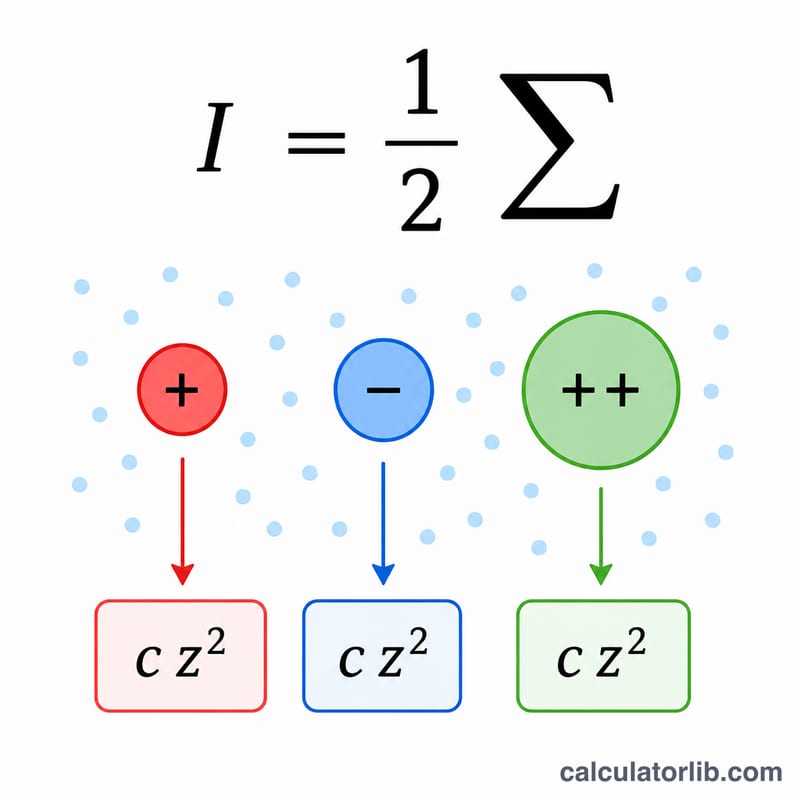
The ionic strength is given by:
$$I = \frac{1}{2} \sum_{i} c_i z_i^2$$
where the sum runs over every ion species in solution. For each species, \(c_i\) is its molar concentration (mol/L) and \(z_i\) is its charge number (e.g. +1 for Na⁺, −1 for Cl⁻, +2 for Ca²⁺). Each term is the concentration times the charge squared; the total is halved. Note that the sign of the charge does not matter since it is squared.
How to Use This Calculator
Enter the molar concentration and integer charge for each ion present (up to four species). Leave unused rows at zero concentration. The calculator returns the ionic strength in mol/L along with the summed term \(\sum c_i z_i^2\).
Worked Example
Consider 0.1 M NaCl. It dissociates into 0.1 M Na⁺ (\(z = +1\)) and 0.1 M Cl⁻ (\(z = -1\)). Then $$I = \frac{1}{2} (0.1 \cdot 1^2 + 0.1 \cdot 1^2) = \frac{1}{2} (0.1 + 0.1) = 0.1 \text{ mol/L}.$$ For a 1:1 electrolyte, the ionic strength equals the concentration. For 0.1 M CaCl₂ you would have 0.1 M Ca²⁺ and 0.2 M Cl⁻, giving $$I = \frac{1}{2} (0.1 \cdot 4 + 0.2 \cdot 1) = 0.3 \text{ mol/L}.$$
FAQ
Does the sign of the charge matter? No. Because the charge is squared, a +2 and a −2 ion contribute identically.
What units should I use? Use molar concentration (mol/L). The result is then in mol/L.
Why is ionic strength important? It determines activity coefficients via the Debye–Hückel equation, affecting solubility, reaction rates, and equilibrium constants in real (non-ideal) solutions.