
What Is Osmotic Pressure?
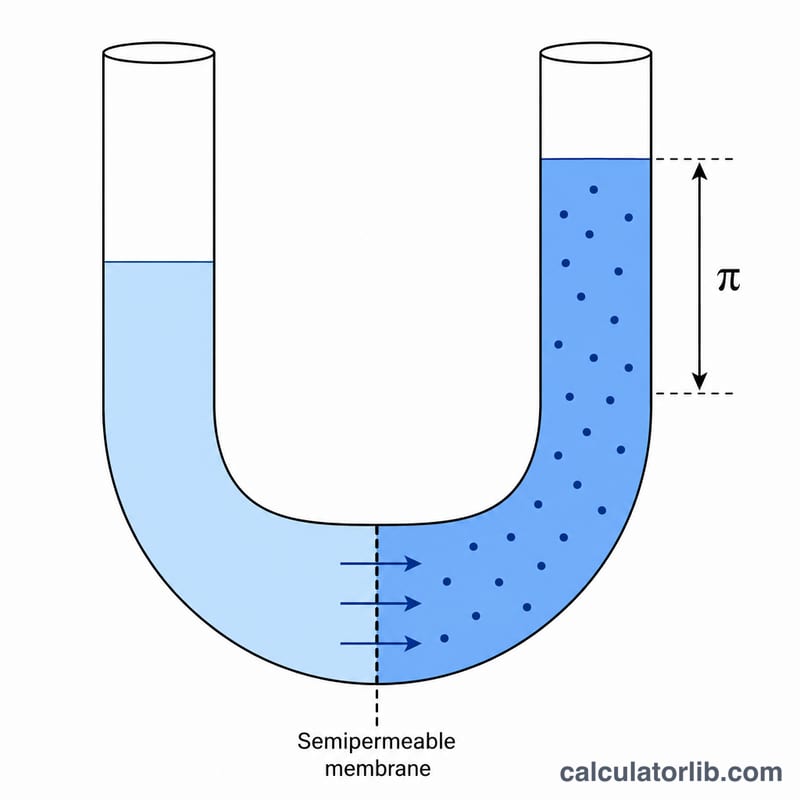
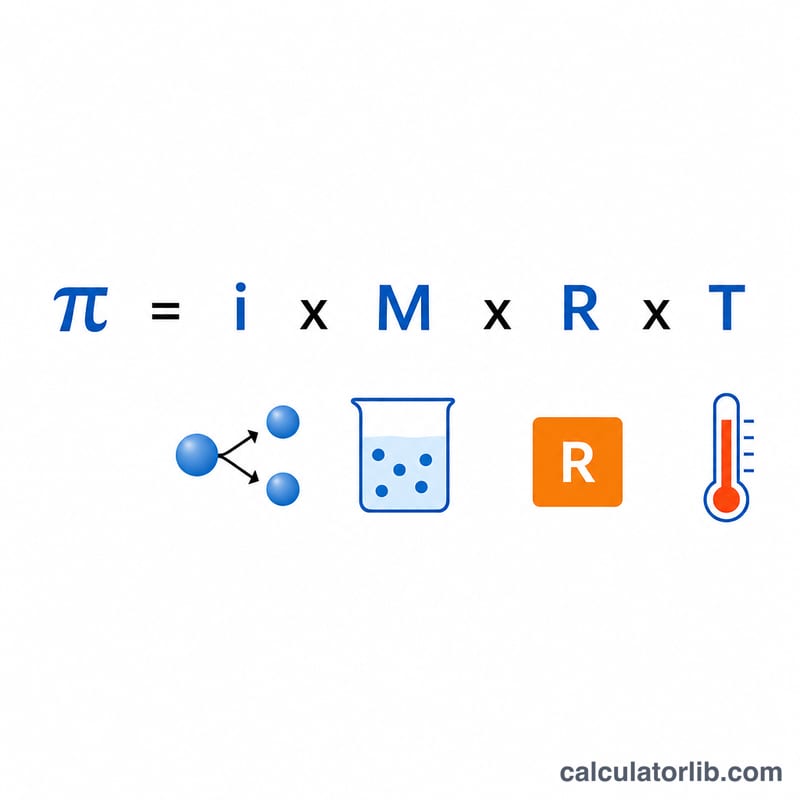
Osmotic pressure (\(\Pi\)) is the pressure that must be applied to a solution to prevent the inward flow of pure solvent across a semipermeable membrane. It is one of the four colligative properties, meaning it depends on the number of dissolved solute particles rather than their chemical identity. This calculator uses the van't Hoff equation, $$\Pi = i \cdot M \cdot R \cdot T$$ to estimate the osmotic pressure of a dilute solution.
How to Use This Calculator
Enter three values: the van't Hoff factor (\(i\)), which is the number of particles a formula unit dissociates into; the molar concentration (\(M\)) in moles per liter; and the absolute temperature (\(T\)) in kelvin. The tool multiplies these together with the ideal gas constant \(R = 0.08206 \ \text{L}\cdot\text{atm/(mol}\cdot\text{K)}\) and returns the osmotic pressure in atmospheres, with conversions to kPa and mmHg.
The Formula Explained
The equation \(\Pi = i \cdot M \cdot R \cdot T\) closely mirrors the ideal gas law (\(PV = nRT\)), because dissolved particles behave somewhat like gas molecules exerting pressure. The factor \(i\) accounts for dissociation: \(i \approx 1\) for non-electrolytes like glucose, \(i \approx 2\) for NaCl, and \(i \approx 3\) for CaCl₂. Remember to convert Celsius to kelvin by adding 273.15.
Worked Example
For a 0.10 mol/L NaCl solution (\(i = 2\)) at 298.15 K: $$\Pi = 2 \times 0.10 \times 0.08206 \times 298.15 \approx 4.894 \ \text{atm}$$ That equals roughly 495.8 kPa or about 3719 mmHg — illustrating why even modest salt concentrations create large osmotic effects.
FAQ
What is the van't Hoff factor? It is the ratio of moles of particles in solution to moles of solute dissolved. Strong electrolytes have factors near their ion count; weak or non-electrolytes are near 1.
Why use kelvin? The gas-law-derived formula requires absolute temperature. Using Celsius gives wrong (even negative) results.
Is this accurate for concentrated solutions? The van't Hoff equation is most accurate for dilute, ideal solutions. Concentrated or strongly interacting solutions may deviate and require an osmotic coefficient correction.