
What this calculator does
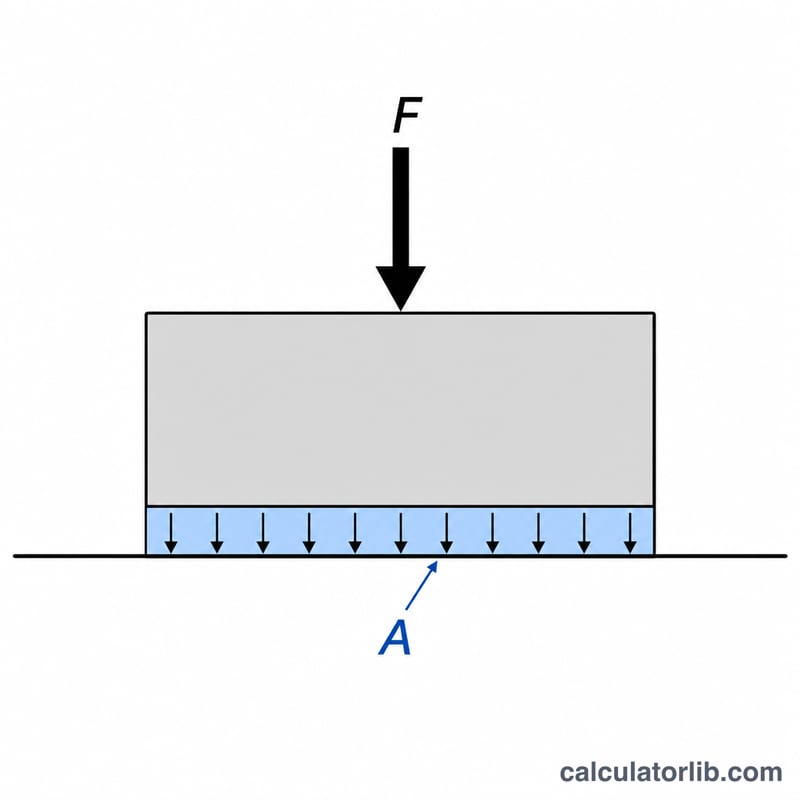
Pressure is the amount of force applied perpendicular to a surface per unit area. This calculator uses the fundamental relation \(P = F / A\) to solve for whichever quantity you need: pressure, force, or area. Pick the variable to solve for, enter the other two known values (each with its own unit), and the answer is returned in the unit you select. It works for any consistent set of units because every value is converted to SI base units (pascal, newton, square meter) internally before the math.
How to use it
First choose a calculation mode. In the default mode the tool finds pressure from a force and an area. Switch the dropdown to solve for force (from pressure and area) or for area (from force and pressure). Enter the two known values and select their units from the dropdowns next to each field. Optionally set the significant figures for the displayed answer, or leave it on Auto for full precision.
The formula explained
The SI definition is simple: one pascal equals one newton spread over one square meter, so $$P \text{ (Pa)} = \frac{F \text{ (N)}}{A \text{ (m}^2\text{)}}$$ Rearranging gives \(F = P \times A\) and \(A = F / P\). Because pressure scales inversely with area, the same force produces far higher pressure on a small contact patch than on a large one — which is why a sharp knife or a high-heeled shoe concentrates force.
Worked example
A 100 N force pressing on a 2 m² plate produces $$P = \frac{100}{2} = \textbf{50 Pa}$$ In a unit-conversion example, solving for force with \(P = 1 \text{ atm}\) and \(A = 10 \text{ in}^2\): \(P = 101325 \text{ Pa}\), \(A = 0.0064516 \text{ m}^2\), so $$F = 101325 \times 0.0064516 \approx 653.7 \text{ N}$$ or about 146.96 lbf.
FAQ
Why convert to SI first? Mixing units (say psi with square inches) is error-prone. Normalizing every input to Pa, N and m² guarantees the arithmetic is dimensionally correct, then we convert back to your chosen output unit.
What if I divide by zero? Pressure needs a non-zero area, and solving for area needs a non-zero pressure. The tool returns a clear message instead of an infinite or undefined result.
Can I use bar, psi, or atm? Yes. The pressure dropdown supports atm, bar, mbar, psi, torr, mmHg, inHg, kPa, MPa and more, with exact conversion factors.