
What is hydrostatic pressure?
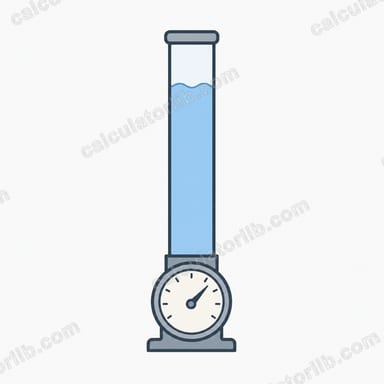
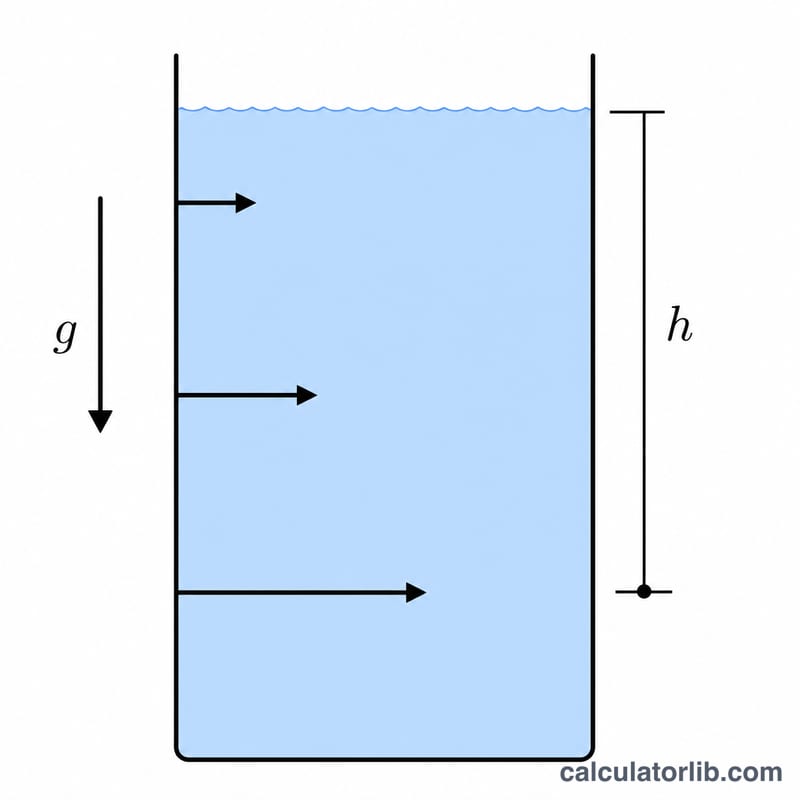
Hydrostatic pressure is the pressure exerted by a fluid at rest due to the weight of the fluid above a given point. It depends only on the fluid density, the local gravitational acceleration and the vertical depth — not on the shape or total volume of the container. This calculator applies the classic relation \(P = \rho \cdot g \cdot h\) and also reports the absolute pressure by adding atmospheric pressure at the surface.
How to use this calculator
Enter the fluid density (\(\rho\)) in kg/m³ — fresh water is about 1000, seawater about 1025, mercury about 13534. Set gravity (\(g\)), which defaults to 9.80665 m/s² for Earth at sea level. Enter the depth or height (\(h\)) of the fluid column in metres, and the atmospheric pressure at the surface (default 101325 Pa = 1 atm). The tool returns gauge pressure in pascals, kilopascals, bar and atmospheres, plus the total absolute pressure.
The formula explained
Gauge pressure is \(P = \rho g h\), where \(\rho\) is density, \(g\) is gravity and \(h\) is depth. This is the pressure relative to the surrounding atmosphere. To get the total pressure that a sensor would actually experience, add the atmospheric pressure pushing down on the fluid surface:
$$P_{abs} = \text{P}_{atm} + \rho \cdot g \cdot h$$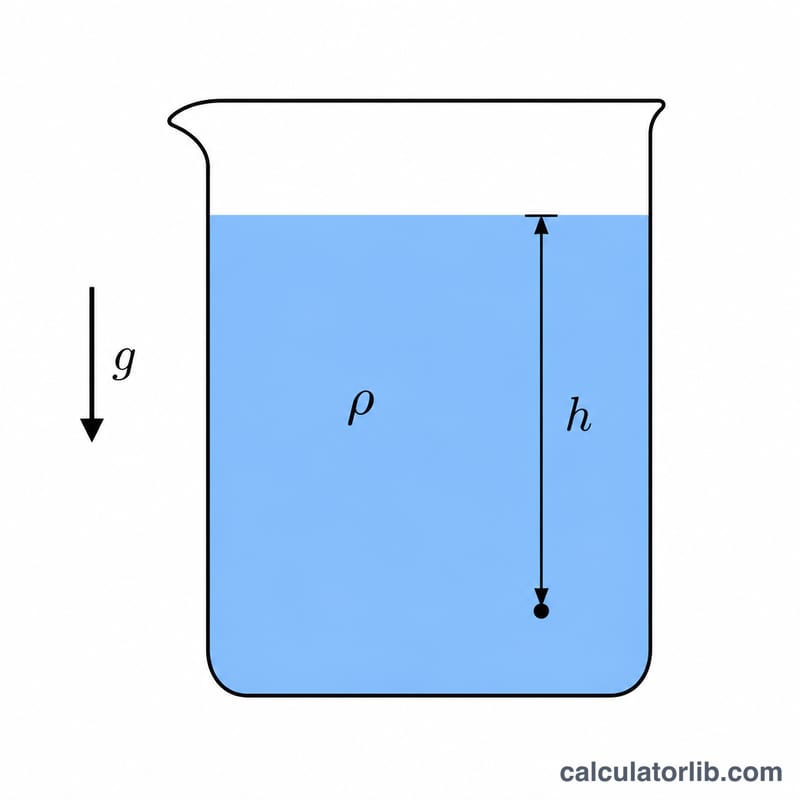
Worked example
For water (\(\rho = 1000\) kg/m³) at a depth of 10 m with \(g = 9.80665\) m/s²: gauge pressure =
$$1000 \times 9.80665 \times 10 = 98{,}066.5 \text{ Pa} \approx 98.07 \text{ kPa} \approx 0.98 \text{ bar}$$Adding atmospheric pressure of 101,325 Pa gives an absolute pressure of about 199,391.5 Pa, roughly 1.97 atm.
FAQ
Does the container shape matter? No. Hydrostatic pressure depends only on vertical depth, density and gravity — this is the hydrostatic paradox.
Why does pressure roughly double at 10 m underwater? Every ~10 m of water adds about 1 atm of gauge pressure, so absolute pressure at 10 m is about 2 atm.
What units does it use? SI base units: density in kg/m³, depth in metres, gravity in m/s², giving pressure in pascals (Pa), with kPa, bar and atm conversions provided.