
What Is Battery State of Charge?
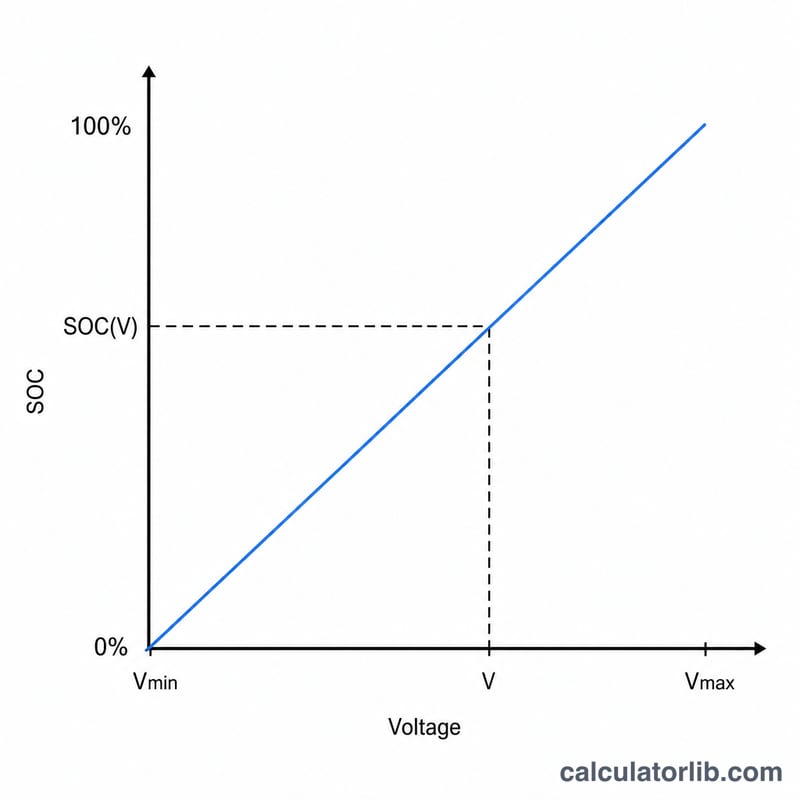
State of Charge (SOC) is the percentage of capacity remaining in a battery relative to its full capacity — like a fuel gauge for a battery pack. This calculator gives a quick voltage-based estimate by linearly interpolating between the battery empty voltage (Vmin) and full voltage (Vmax). It works for any chemistry as long as you supply the correct voltage limits, including lead-acid, LiFePO4, and lithium-ion cells or packs.
How to Use It
Enter the measured resting voltage of your battery, then the voltage you consider empty (0% SOC) and full (100% SOC). For best accuracy, measure the open-circuit voltage after the battery has rested with no load or charge for 30 minutes or more, since voltage sags under load and rises while charging.
The Formula Explained
The estimate uses simple linear interpolation: $$\text{SOC} = \frac{\text{V} - \text{V}_{\min}}{\text{V}_{\max} - \text{V}_{\min}} \times 100\%$$. The numerator is how far the measured voltage sits above empty; the denominator is the total usable voltage span. Multiplying by 100 converts the fraction to a percentage. The result is clamped to the 0–100% range so out-of-range voltages do not produce nonsensical values.
Worked Example
Suppose a 12 V lead-acid battery reads 12.4 V, with Vmin = 11.8 V (empty) and Vmax = 12.7 V (full). Then $$\text{SOC} = \frac{12.4 - 11.8}{12.7 - 11.8} \times 100 = \frac{0.6}{0.9} \times 100 \approx 66.7\%$$
SOC at Different Voltage Readings
The table below applies the linear interpolation formula to a 12V flooded lead-acid battery using \(\text{V}_{\min}=11.8\) and \(\text{V}_{\max}=12.7\). The span between empty and full is only \(12.7-11.8=0.9\,\text{V}\), so each 0.1 V change represents roughly 11% of charge.
| Resting voltage (V) | SOC (%) | State |
|---|---|---|
| 11.8 | 0% | Empty (cut-off) |
| 12.0 | 22% | Low |
| 12.2 | 44% | Below half |
| 12.4 | 67% | Healthy |
| 12.6 | 89% | Near full |
| 12.7 | 100% | Full |
Note: Real battery discharge curves are non-linear. A true lead-acid SOC-vs-voltage curve sags more quickly near the top and bottom, so straight-line interpolation is an approximation. Use it as a rough field estimate rather than a precise fuel gauge.
Interpreting Your SOC Result
The calculator returns a percentage between 0% and 100% (values outside your measured range will fall below 0 or above 100, indicating the reading is past your defined limits). As a general guide:
- 90–100% — Full: Recently or fully charged; resting at or near \(\text{V}_{\max}\).
- 50–90% — Healthy: Comfortable working range for most batteries.
- 20–50% — Low: Consider recharging soon; for lead-acid, frequent deep cycling here shortens life.
- 0–20% — Deeply discharged: Recharge promptly. Sustained operation here can permanently damage many chemistries.
Why voltage-based SOC is approximate: Resting voltage only correlates with charge after the battery has settled with no load and no charge current. Temperature, age, internal resistance, and recent activity all shift the reading. A measurement taken under load reads low; one taken just after charging reads high.
The flat LiFePO4 curve caveat: LiFePO4 cells hold a nearly constant voltage (around 3.2–3.3 V per cell) across roughly 20–90% SOC. Because the voltage barely changes through most of the usable range, voltage-based SOC is especially unreliable for LiFePO4 — a tiny voltage error can translate into a large SOC error.
Coulomb counting is more precise: A battery monitor that integrates current in and out over time (coulomb counting) tracks SOC far more accurately than a voltage snapshot, particularly for flat-curve chemistries. Treat the voltage method as a quick estimate, not a calibrated gauge.
This is general technical information, not professional advice. Follow your battery and charger manufacturer's specifications for safe voltage limits.
FAQ
Is voltage an accurate way to measure SOC? It is a rough estimate. Real batteries have a non-linear voltage curve, and LiFePO4 in particular has a very flat curve, so a coulomb-counting battery monitor is more accurate.
Why must I rest the battery first? Charging raises voltage and loads lower it. Only the open-circuit (rested) voltage reflects true SOC.
What Vmin/Vmax should I use? Use your chemistry and manufacturer specs — e.g. roughly 11.8 V / 12.7 V for a 12 V lead-acid battery, or 10.0 V / 14.6 V for a 12 V (4S) LiFePO4 pack.