
What Is the Reynolds Number?
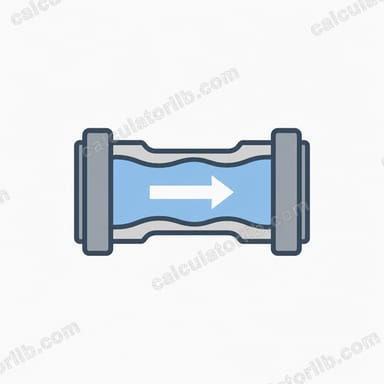
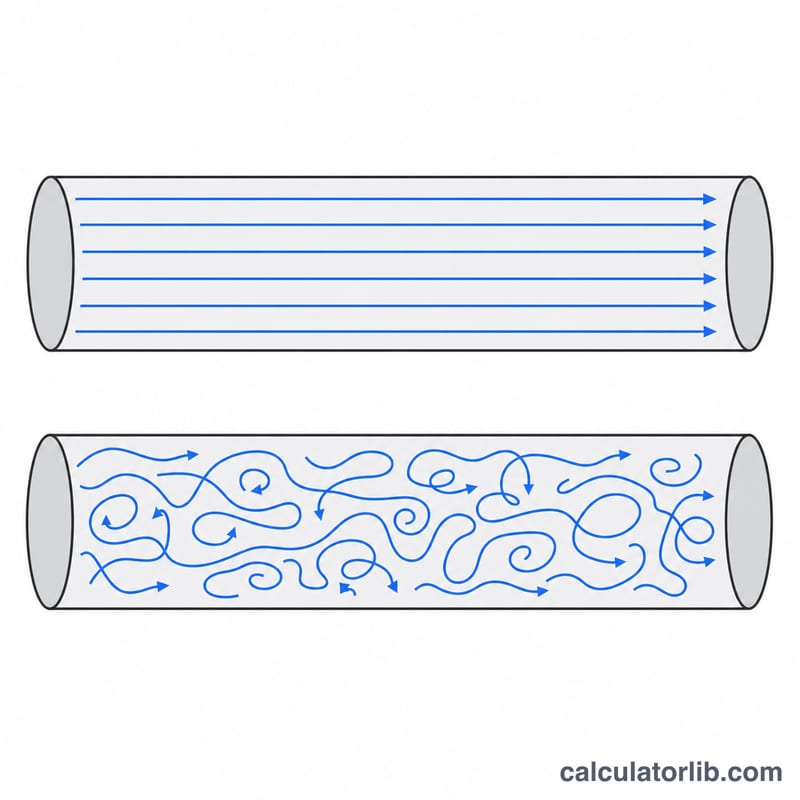
The Reynolds number (Re) is a dimensionless quantity that predicts whether fluid flow in a pipe will be smooth and orderly (laminar) or chaotic and mixing (turbulent). It represents the ratio of inertial forces to viscous forces within the moving fluid. Engineers use it constantly when designing piping, pumps, heat exchangers and HVAC systems because the flow regime determines pressure drop, heat transfer and mixing behaviour.
How to Use This Calculator
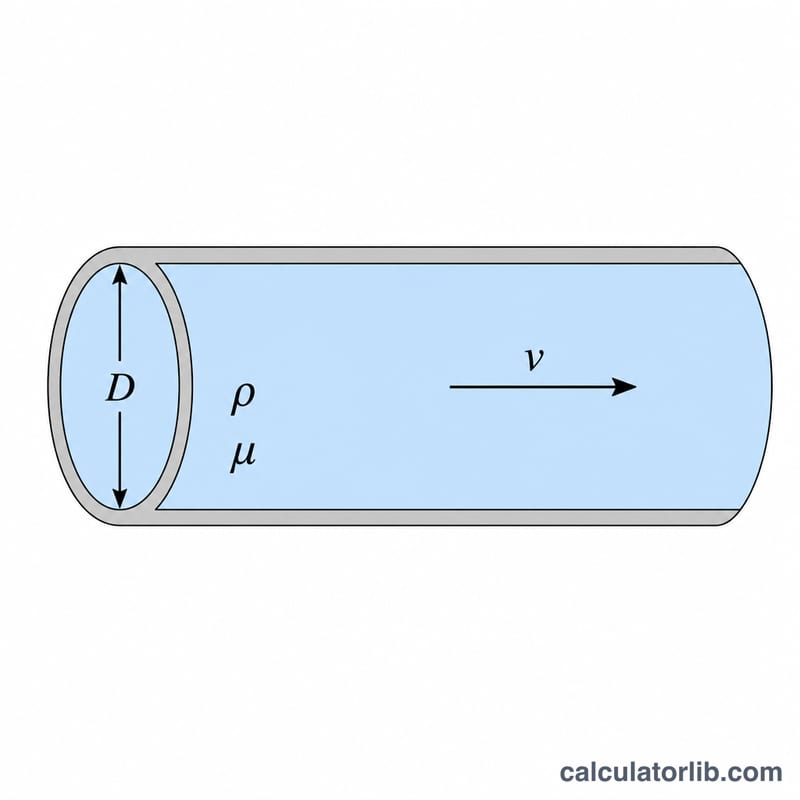
Enter four values: the fluid density ρ (kg/m³), the average flow velocity v (m/s), the inside pipe diameter D (m), and the dynamic viscosity μ (Pa·s). The calculator returns the Reynolds number and classifies the flow regime. For water at room temperature, \(\rho \approx 1000\) kg/m³ and \(\mu \approx 0.001\) Pa·s.
The Formula Explained
The governing equation is $$Re = \frac{\text{Density }\rho \cdot \text{Velocity }v \cdot \text{Diameter }D}{\text{Viscosity }\mu}$$ The numerator captures inertial momentum (heavier, faster fluid in a wider pipe resists deflection), while the denominator captures viscous damping. The conventional regime boundaries for flow in a circular pipe are: \(Re < 2300\) laminar, 2300–4000 transitional, and \(Re > 4000\) turbulent.
Worked Example
Water (\(\rho = 1000\) kg/m³, \(\mu = 0.001\) Pa·s) flows at \(v = 2\) m/s through a pipe of \(D = 0.05\) m. Then $$Re = \frac{1000 \times 2 \times 0.05}{0.001} = \frac{100}{0.001} = 100{,}000$$ Since \(100{,}000 > 4000\), the flow is firmly turbulent.
FAQ
Why is the Reynolds number dimensionless? The units of \(\rho v D\) (kg/m³ × m/s × m) cancel exactly against μ (Pa·s = kg/m·s), leaving a pure number.
What diameter should I use for a non-circular duct? Use the hydraulic diameter, \(D_h = \frac{4A}{P}\), where A is the cross-sectional area and P the wetted perimeter.
Can I use kinematic viscosity instead? Yes. If you know \(\nu = \mu/\rho\), use \(Re = \frac{vD}{\nu}\), which gives the same result.