What Is the GPM Flow Rate Calculator?
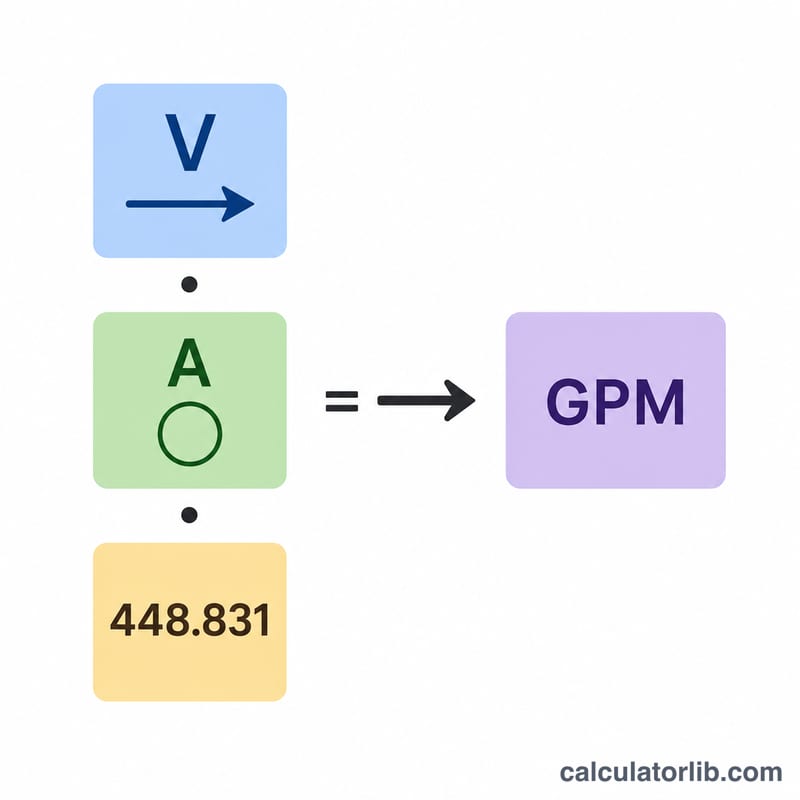
This calculator finds the volumetric flow rate through a round pipe in gallons per minute (GPM) using the flow velocity and the pipe's inside diameter. It applies the standard relationship that flow rate equals velocity multiplied by the pipe's cross-sectional area, then converts cubic feet per minute into US gallons per minute with the factor 448.831.
How to Use It
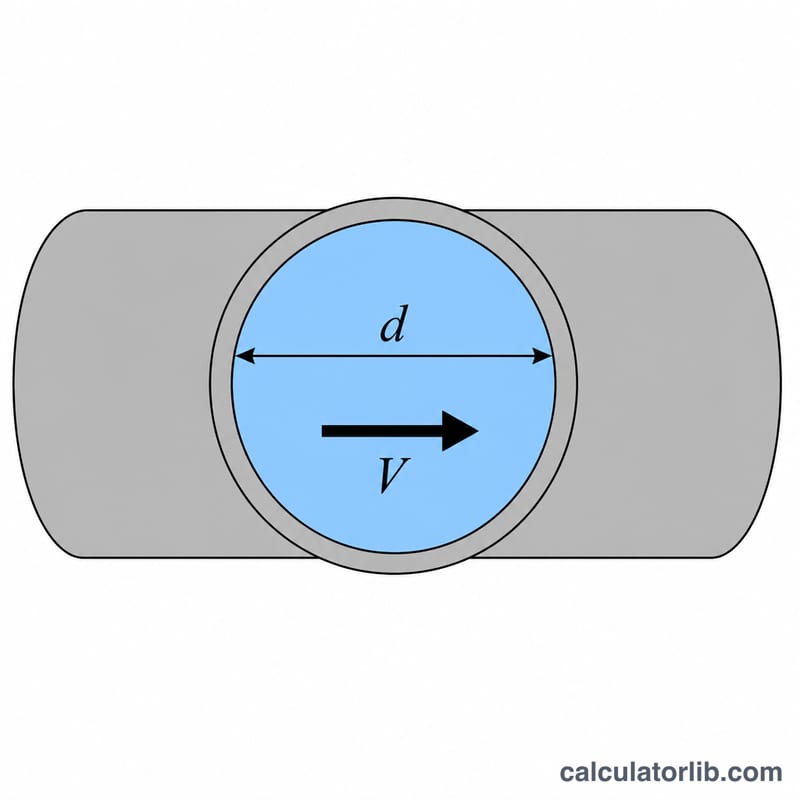
Enter the flow velocity in feet per second (ft/s) and the inside diameter of the pipe in inches. The calculator converts the diameter to feet, computes the circular cross-sectional area, and returns the flow rate in GPM along with the area used.
The Formula Explained
The core equation is $$\text{GPM} = V \times A \times 448.831$$ where V is velocity in ft/s and A is the pipe area in square feet. The area comes from \(A = \pi \times r^2\), with \(r\) being the inside radius in feet. Because diameter is entered in inches, it is divided by 12 to convert to feet before halving. The constant 448.831 converts cubic feet per minute (ft³/min) to US gallons per minute, since 1 ft³ = 7.48052 gallons and there are 60 seconds in a minute (\(7.48052 \times 60 = 448.831\)).
Worked Example
Suppose water moves at 5 ft/s through a 2-inch inside-diameter pipe. The radius is \((2 \div 12) \div 2 = 0.08333\) ft, so the area is \(\pi \times 0.08333^2 \approx 0.021817\) ft². Then $$\text{GPM} = 5 \times 0.021817 \times 448.831 \approx 48.96 \text{ gallons per minute}.$$
Typical Flow Velocity Ranges in Piping
Designers usually choose a pipe size by picking a target velocity and then checking the resulting flow, pressure drop, noise and erosion. The ranges below are commonly cited rules of thumb in feet per second (ft/s), not fixed limits.
| Application | Typical velocity (ft/s) |
|---|---|
| Water supply / distribution mains | about 3–8 |
| Pump suction piping | about 1–5 |
| Pump discharge piping | about 4–10 |
| Building domestic copper piping | often limited to about 5–8 |
These are general engineering guidelines. The right value depends on the pipe material, the fluid (viscosity, solids, temperature), noise limits, erosion and corrosion concerns, and allowable pressure drop. Typical sources are plumbing and mechanical codes, pipe and pump manufacturer guidance, and engineering handbooks. Check the rules that apply to your jurisdiction and project before you size real piping.
GPM by Pipe Size and Velocity
Values use \(\text{GPM} = V \times \pi \left(\frac{d}{24}\right)^{2} \times 448.831\), where \(V\) is in ft/s and \(d\) is the inside diameter in inches. This simplifies to about \(\text{GPM} \approx 2.448 \times V \times d^{2}\). For example, a 2 in pipe at 5 ft/s: \(5 \times \pi \times (2/24)^2 \times 448.831 \approx 48.96\) GPM.
| Inside diameter (in) | 3 ft/s | 5 ft/s | 8 ft/s |
|---|---|---|---|
| 0.5 | 1.84 | 3.06 | 4.90 |
| 0.75 | 4.13 | 6.89 | 11.02 |
| 1 | 7.34 | 12.24 | 19.58 |
| 1.5 | 16.52 | 27.54 | 44.06 |
| 2 | 29.38 | 48.96 | 78.34 |
| 3 | 66.10 | 110.16 | 176.26 |
| 4 | 117.50 | 195.84 | 313.34 |
| 6 | 264.38 | 440.64 | 705.02 |
Flow scales with the square of the diameter and linearly with velocity. Doubling the diameter at the same velocity quadruples the GPM, and doubling the velocity in the same pipe doubles it. Use the actual inside diameter, which differs from the nominal size and depends on the pipe schedule or tube type.
Flow Rate Unit Conversions
Multiply a flow in US gallons per minute (GPM) by the factor below. These factors are for the US liquid gallon.
| 1 US GPM equals | Unit |
|---|---|
| 3.78541 | L/min |
| 0.227125 | m³/h |
| 0.0630902 | L/s |
| 0.002228 | ft³/s |
| 0.133681 | ft³/min |
| 0.832674 | Imperial GPM |
| 34.2857 | barrels per day (42-gallon US barrel) |
Example rows for 100 US GPM:
| Unit | Value for 100 GPM |
|---|---|
| L/min | 378.541 |
| m³/h | 22.7125 |
| L/s | 6.30902 |
| ft³/min | 13.3681 |
| Imperial GPM | 83.2674 |
| Barrels per day | 3,428.57 |
FAQ
Does this work for any liquid? Yes. The geometry-based calculation is fluid-independent; it depends only on velocity and pipe size, not on the fluid's density or viscosity.
Is the diameter inside or outside? Use the inside (internal) diameter of the pipe, since that is the actual flow path. Nominal pipe sizes can differ from the true internal diameter.
What units does GPM use here? The result is in US gallons per minute. For Imperial (UK) gallons, multiply the result by approximately 0.8327.