
What Is the PSI to GPM Calculator?
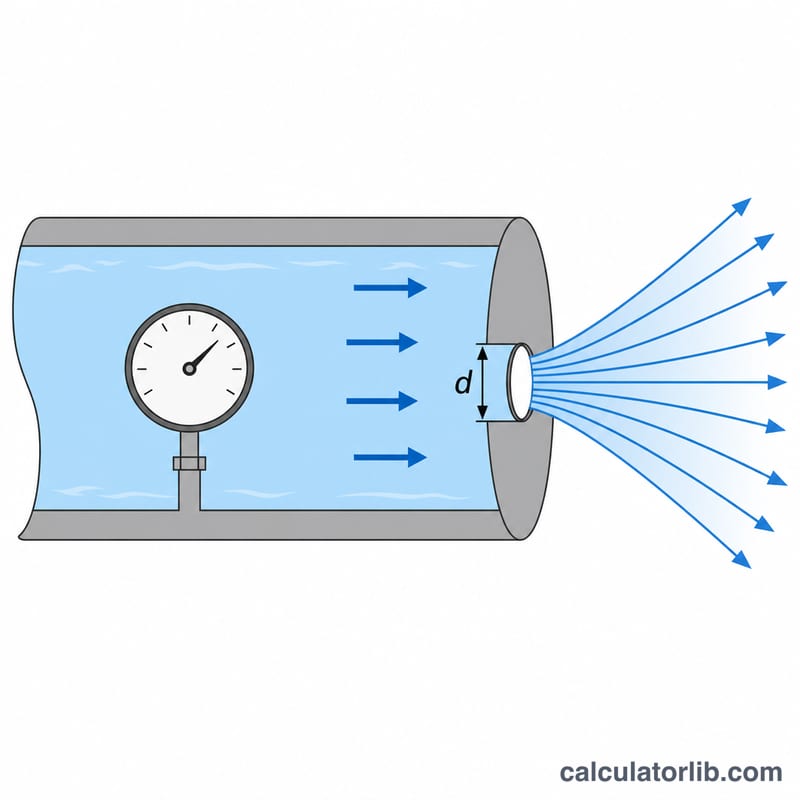
This calculator estimates the volumetric flow rate in gallons per minute (GPM) of water passing through a circular orifice, based on the upstream pressure in pounds per square inch (PSI), the diameter of the opening, and a discharge coefficient. It is widely used in fire protection, irrigation, plumbing, and hydraulic system design to predict how much water will flow when pressure pushes it through a nozzle or hole.
How to Use It
Enter three values: the water pressure (PSI), the orifice diameter in inches, and the discharge coefficient (Cd). The discharge coefficient accounts for energy losses and contraction at the opening — a smooth, rounded nozzle is close to 0.97–0.99, while a sharp-edged orifice is nearer 0.62. Click calculate to see the estimated flow rate.
The Formula Explained
The standard orifice flow equation is:
$$\text{GPM} = 29.84 \times \text{C}_d \times d^2 \times \sqrt{\text{PSI}}$$
Here 29.84 is a unit constant that combines gravity, fluid density, and conversion factors for US units; Cd is the dimensionless discharge coefficient; d is the orifice diameter in inches; and PSI is the differential pressure. Flow scales with the square of diameter and the square root of pressure — so doubling pressure raises flow by only about 41%, while doubling diameter quadruples it.
Worked Example
Suppose water at 40 PSI flows through a 0.5-inch orifice with a discharge coefficient of 0.97. Then
$$\text{GPM} = 29.84 \times 0.97 \times 0.5^2 \times \sqrt{40} = 29.84 \times 0.97 \times 0.25 \times 6.3246 \approx 45.76 \text{ GPM}.$$FAQ
What discharge coefficient should I use? Use ~0.97 for a smooth nozzle, ~0.80 for a typical short tube, and ~0.62 for a sharp-edged orifice.
Does this work for any liquid? The 29.84 constant assumes water at standard conditions. For other fluids the result will be approximate due to differing density and viscosity.
Why is flow proportional to the square root of pressure? Pressure converts to velocity through Bernoulli's principle, where velocity is proportional to the square root of the pressure head.