
What this calculator does
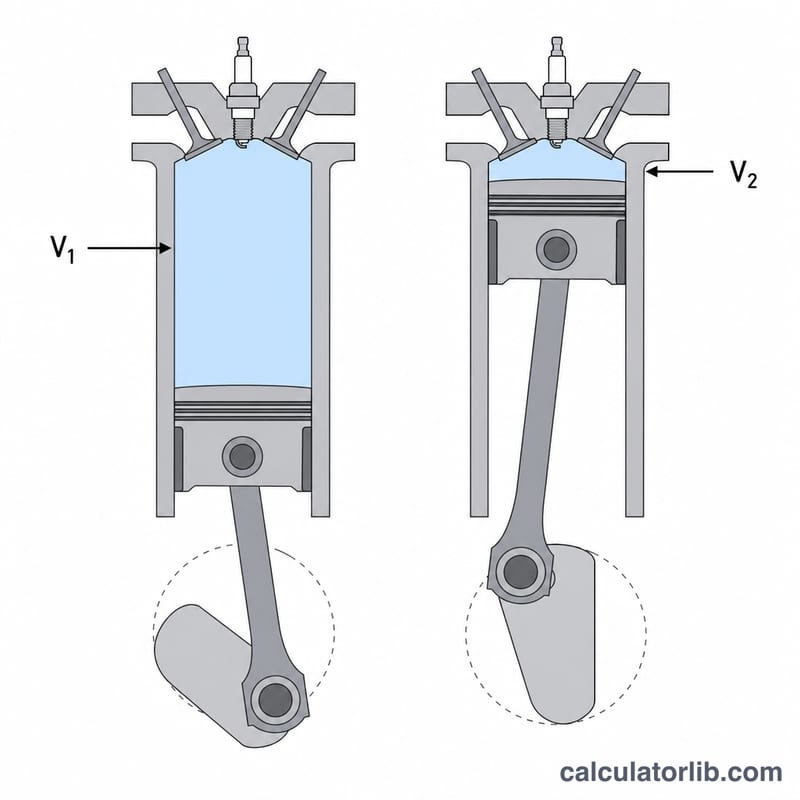
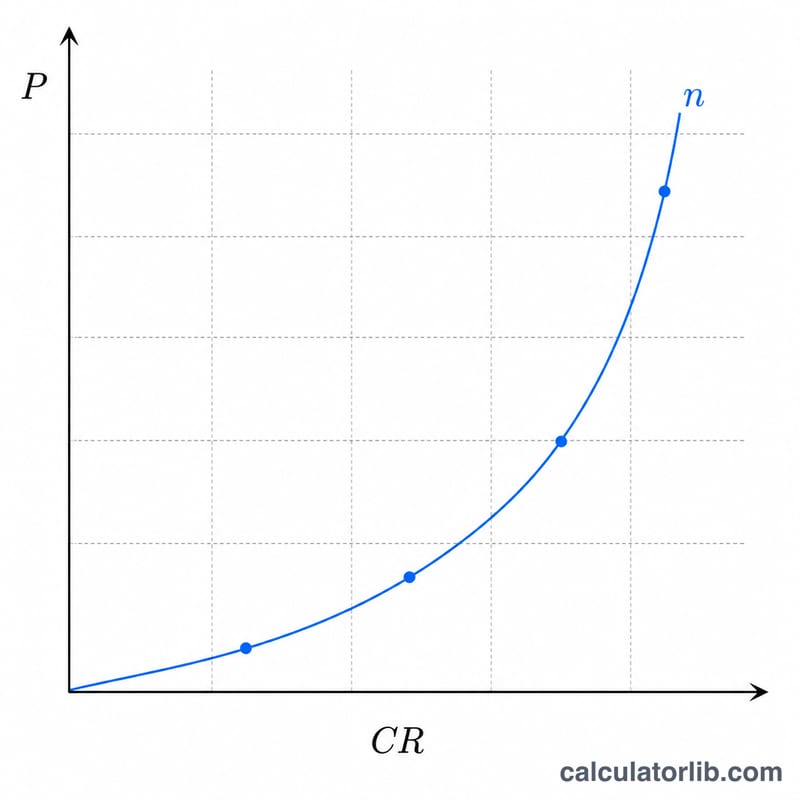
This tool converts an engine's static compression ratio (CR) into an estimated cylinder cranking pressure in PSI. Because the air-fuel charge is compressed quickly, the process is closer to polytropic than isothermal, so pressure rises faster than the raw ratio. The default polytropic exponent of \(n = 1.3\) gives realistic cranking numbers; \(n = 1.4\) is the ideal adiabatic value.
How to use it
Enter your compression ratio (for example 9 for a 9:1 engine), the atmospheric pressure (14.7 psi at sea level), and a polytropic exponent. The calculator returns both absolute pressure and gauge pressure — gauge pressure is what a compression tester actually displays since it reads zero at atmospheric.
The formula explained
The core equation is $$P_{\text{abs}} = \text{P}_{\text{atm}} \times \text{CR}^{\,\text{n}}$$ \(\text{P}_{\text{atm}}\) is ambient pressure, \(\text{CR}\) is the compression ratio, and \(n\) is the polytropic exponent (1.0 isothermal, 1.3 realistic, 1.4 adiabatic). Subtracting atmospheric pressure converts the absolute value to gauge: $$P_{\text{gauge}} = P_{\text{abs}} - \text{P}_{\text{atm}}$$
Worked example
For a 9:1 engine with \(n = 1.3\) and \(\text{P}_{\text{atm}} = 14.7\) psi: \(9^{1.3} \approx 17.347\), so $$P_{\text{abs}} = 14.7 \times 17.347 \approx 255.0 \text{ psi absolute}$$ and gauge \(\approx 255.0 - 14.7 \approx 240.3\) psi. Real engines read lower due to valve timing, ring blow-by and altitude.
FAQ
Why is real cranking pressure lower? Intake valve closing timing, leakage, and a cold engine all reduce the effective trapped volume and pressure.
Which exponent should I use? Use 1.3 for a practical estimate; 1.4 for theoretical adiabatic maximum.
Does altitude matter? Yes — at higher elevation \(\text{P}_{\text{atm}}\) drops below 14.7, lowering the predicted pressure proportionally.