
What It Is
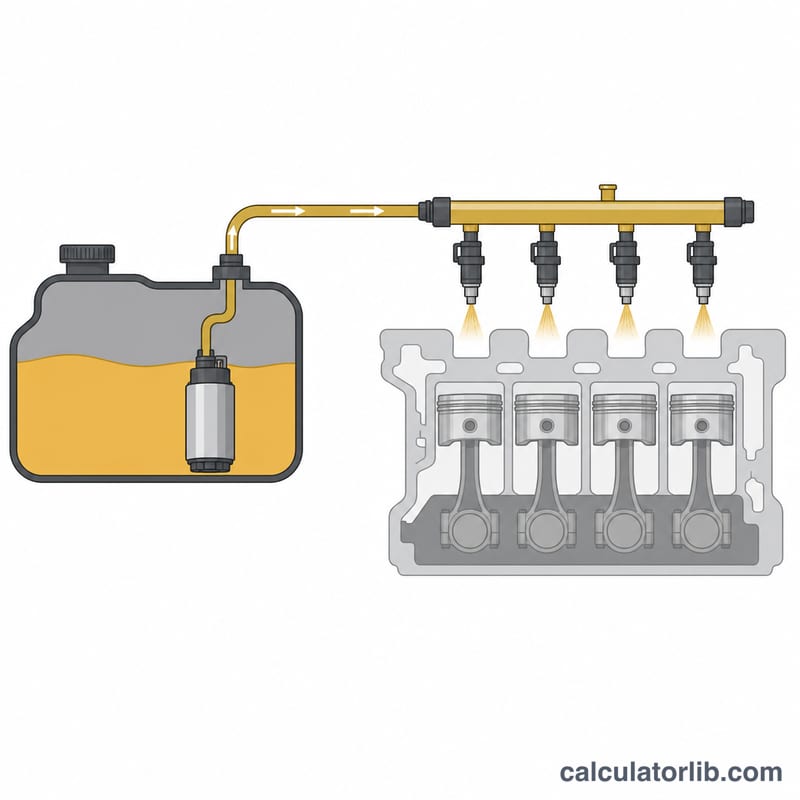
The Fuel Pump Calculator estimates how much fuel flow your engine demands at a target power level and converts that demand into the units pump and injector manufacturers actually publish: liters per hour (LPH), pounds per hour (lb/hr), gallons per hour, and cc/min. It is designed for gasoline-powered street and motorsport builds and helps you avoid sizing a pump that runs out of headroom at peak load.
How To Use It
Enter your target crank horsepower, choose a BSFC value, select naturally aspirated or forced induction (a reference for which BSFC to use), and set the maximum duty cycle you want the pump to run at. A safety margin of 80–85% duty cycle is common so the pump is never maxed out. The result is the minimum pump flow you should buy.
The Formula Explained
BSFC (Brake Specific Fuel Consumption) is how many pounds of fuel an engine burns per horsepower per hour. Typical values are about 0.50 for naturally aspirated engines and 0.55–0.65 for boosted engines, which run richer. Required flow = \(\dfrac{\text{HP} \times \text{BSFC}}{\text{duty cycle}}\). Dividing by duty cycle inflates the requirement so the pump has reserve. We then convert lb/hr to LPH assuming gasoline weighs roughly 6 lb/gal and 3.785 L/gal.
$$\text{LPH} = \frac{\dfrac{\text{HP} \times \text{BSFC}}{\text{Duty}/100}}{6} \times 3.785411784$$$$\begin{gathered} \text{LPH} = \frac{F_{lb/hr}}{6} \times 3.785411784 \\[1.5em] \text{where}\quad \left\{ \begin{aligned} F_{lb/hr} &= \frac{\text{HP} \times \text{BSFC (lb/hp/hr)}}{\text{Duty}/100} \\ \text{cc/min} &= \frac{\text{LPH} \times 1000}{60} \end{aligned} \right. \end{gathered}$$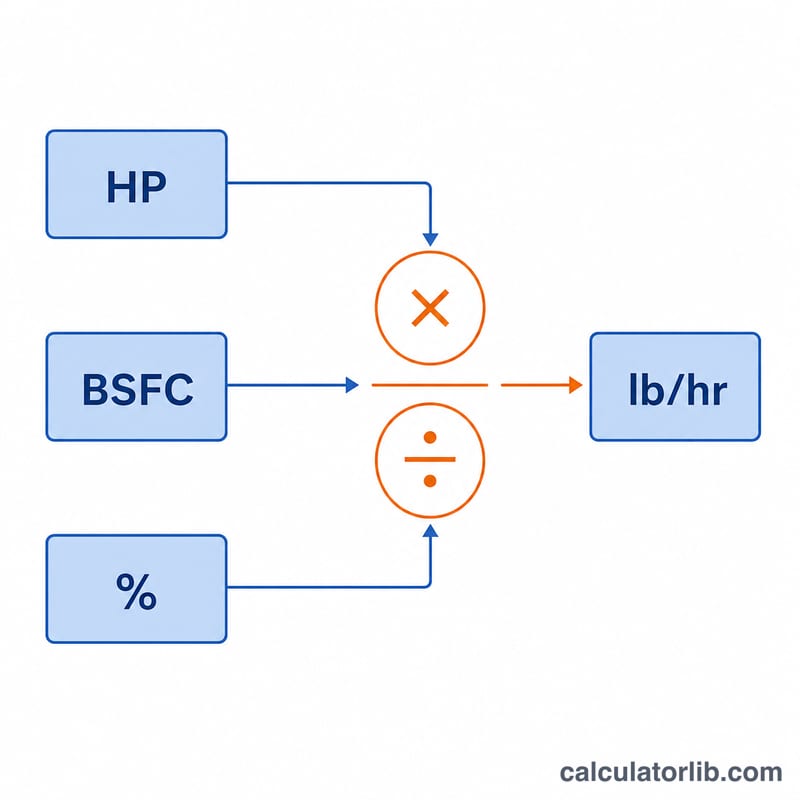
Worked Example
For a 500 HP naturally aspirated engine with BSFC 0.5 at 85% duty cycle: \((500 \times 0.5) \div 0.85 = 294.1\) lb/hr. Dividing by 6 gives 49.0 gal/hr, and multiplying by 3.78541 gives ≈185.6 LPH. So you'd want a pump rated near 200 LPH or higher.
FAQ
What BSFC should I use? Use ~0.5 for NA and ~0.6 for boosted gasoline engines. Verify against your tuner's data if available.
Does this work for E85? No — E85 needs roughly 30–40% more volume. Use a higher BSFC (≈0.65–0.75) as an approximation.
Why divide by duty cycle? Pumps lose flow with rising pressure and shouldn't run at 100%. Sizing for 80–85% builds in reliability headroom.