
What Is the Fuel Range Calculator?
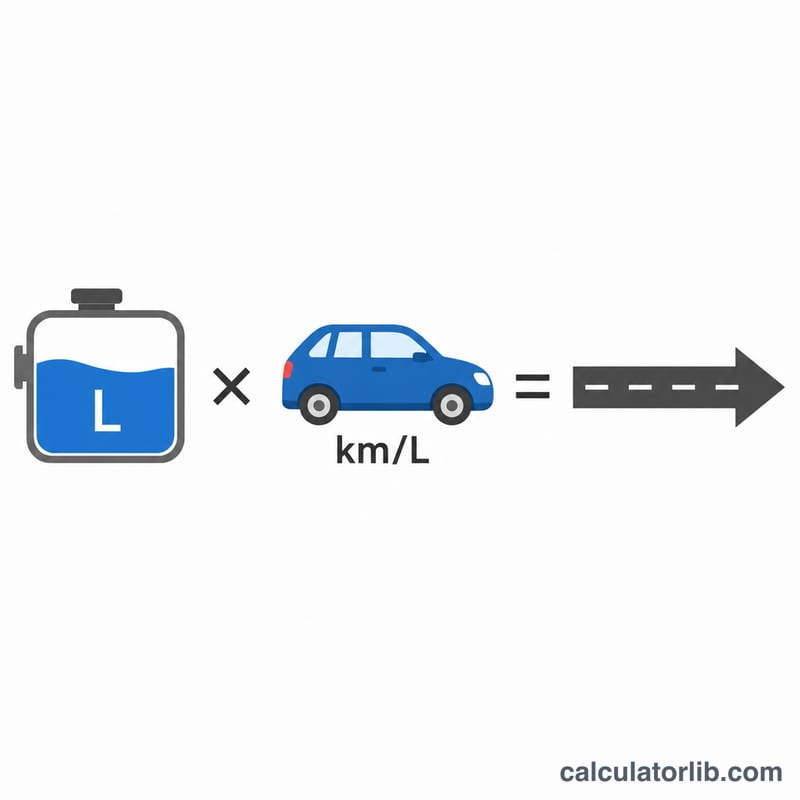
The Fuel Range Calculator estimates how far your vehicle can travel on the fuel currently in its tank. By multiplying the volume of fuel (in litres) by your vehicle's fuel economy (in kilometres per litre), you get a quick, practical estimate of your driving range. This is useful for trip planning, deciding whether you can reach the next fuel station, or simply understanding your car's efficiency.
How to Use It
Enter two values: the amount of fuel in your tank in litres, and your fuel economy expressed as kilometres per litre (km/L). If your economy is given as litres per 100 km (L/100km), convert it first by dividing 100 by that number — for example, 6.5 L/100km equals about 15.4 km/L. Press calculate to see your estimated range in kilometres.
The Formula Explained
The calculation is simple multiplication:
$$\text{Range (km)} = \text{Tank (litres)} \times \text{Economy (km per litre)}$$
The more fuel you carry and the more efficient your vehicle, the further you can travel. Real-world range varies with driving style, terrain, speed, air conditioning use, and load, so treat the result as an estimate and keep a safety margin.
Worked Example
Suppose your tank holds 45 litres and your car achieves 15 km per litre. \(\text{Range} = 45 \times 15 = 675\) km. So on a full tank you could expect to drive roughly 675 kilometres before refuelling.
FAQ
My economy is in MPG — can I use this? Convert MPG to km/L first. UK MPG \(\times 0.354 \approx\) km/L; US MPG \(\times 0.425 \approx\) km/L.
Why is my real range lower than the estimate? Highway speed, cold weather, heavy loads, and aggressive acceleration all reduce efficiency, lowering actual range.
Should I run my tank to empty? No. Always keep a reserve — refuel well before the gauge reads empty to avoid being stranded and to protect the fuel pump.