
What this calculator does
The Fuel CO₂ Emissions Calculator estimates how much carbon dioxide is released when you burn a given volume of fuel. Combustion of hydrocarbons turns the carbon in the fuel into CO₂, and the mass of CO₂ produced per litre is well characterised, so you only need to know the volume burned and the fuel type. This tool is universal and uses widely-cited emission factors.
How to use it
Enter the number of litres of fuel consumed, pick the fuel type (gasoline/petrol, diesel or LPG), and the calculator multiplies the volume by the matching emission factor. Choose "Custom factor" if you have a more precise figure for your fuel blend or region. The result is shown in kilograms of CO₂ and converted to metric tonnes.
The formula explained
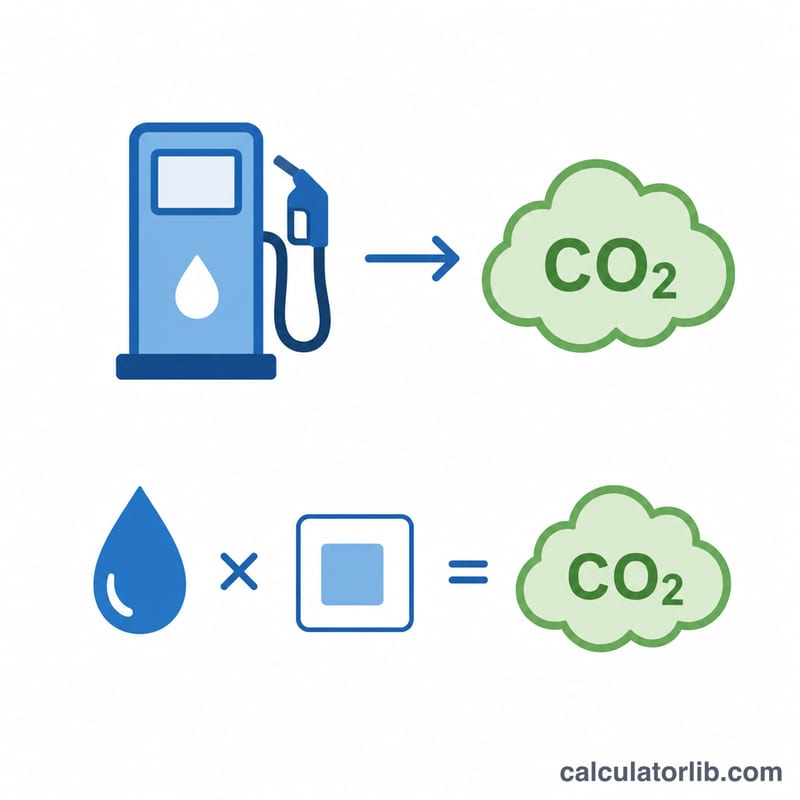
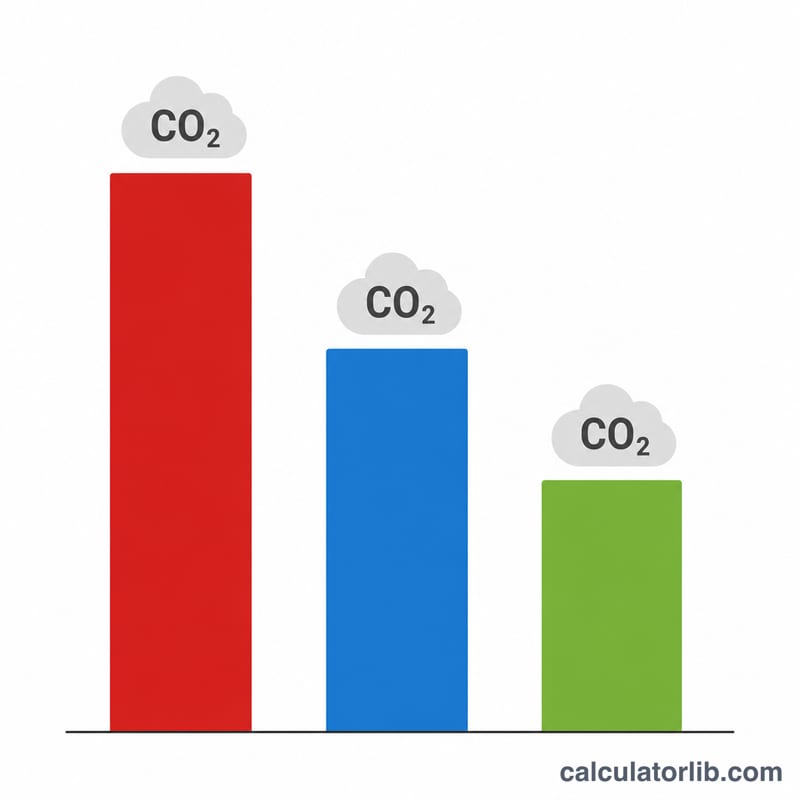
The core equation is simply $$\text{CO}_2\ (\text{kg}) = \text{Fuel (L)} \times \text{Emission Factor (kg/L)}$$ Typical factors are about \(2.31\ \text{kg/L}\) for gasoline, \(2.68\ \text{kg/L}\) for diesel and \(1.51\ \text{kg/L}\) for LPG. These reflect the carbon content and density of each fuel — diesel is denser and more carbon-rich per litre, so it emits more CO₂ per litre than gasoline even though it is more efficient per kilometre.
Worked example
Suppose you burn 50 litres of gasoline. Multiply $$50 \times 2.31 = 115.5\ \text{kg CO}_2,$$ which is 0.1155 tonnes. The same 50 litres of diesel would produce \(50 \times 2.68 = 134\ \text{kg CO}_2\).
FAQ
Why does diesel emit more CO₂ per litre than petrol? Diesel has a higher density and more carbon per litre, so a litre of diesel releases more CO₂ — but diesel engines often use fewer litres per kilometre.
Do these factors include upstream (well-to-tank) emissions? No. These are tailpipe (tank-to-wheel) combustion factors only and do not include extraction, refining or transport of the fuel.
Can I use this for heating oil or other fuels? Yes — select "Custom factor" and enter the kg CO₂ per litre value for your specific fuel.