
What is the Flight CO₂ Emissions Calculator?
This calculator estimates the carbon dioxide (CO₂) emissions produced by an air journey. Aviation is a significant and fast-growing source of greenhouse gases, and knowing your flight footprint helps you compare travel options, plan offsets, or simply understand the climate impact of your trips. The tool is universal — it works for any flight worldwide using standard per-kilometre emission factors.
How to use it
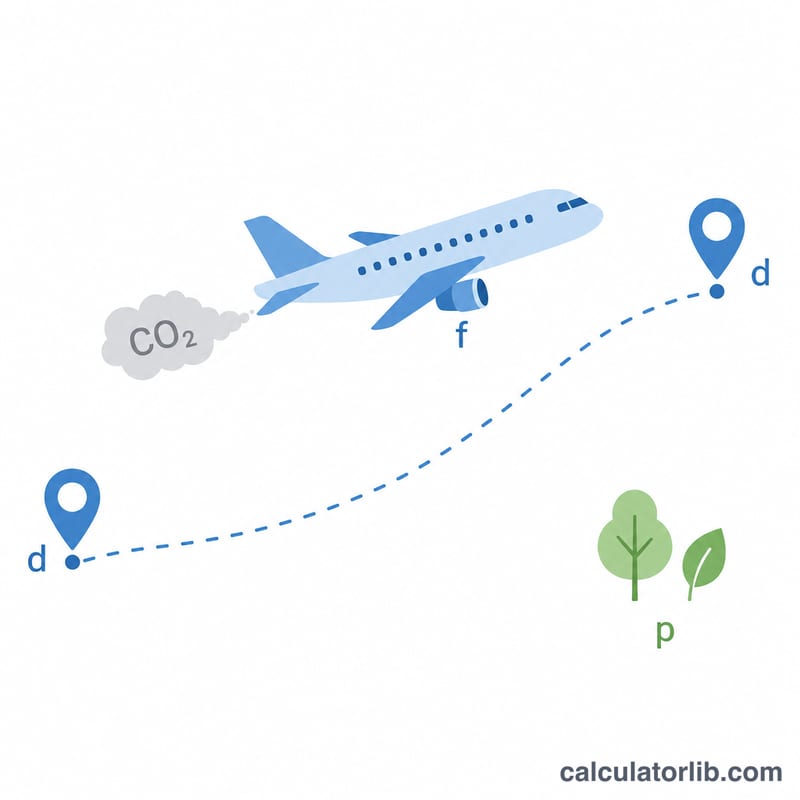
Enter the one-way flight distance in kilometres (use a flight-distance map for the great-circle distance between airports). Choose a flight type, which sets the emission factor: short-haul flights burn more fuel per kilometre during take-off and climb, while long-haul flights are more efficient per kilometre in cruise. Finally, enter the number of passengers travelling together. The calculator returns total emissions in kilograms and tonnes, per-passenger emissions, and an estimate of the number of trees needed to offset the carbon in a year.
The formula explained
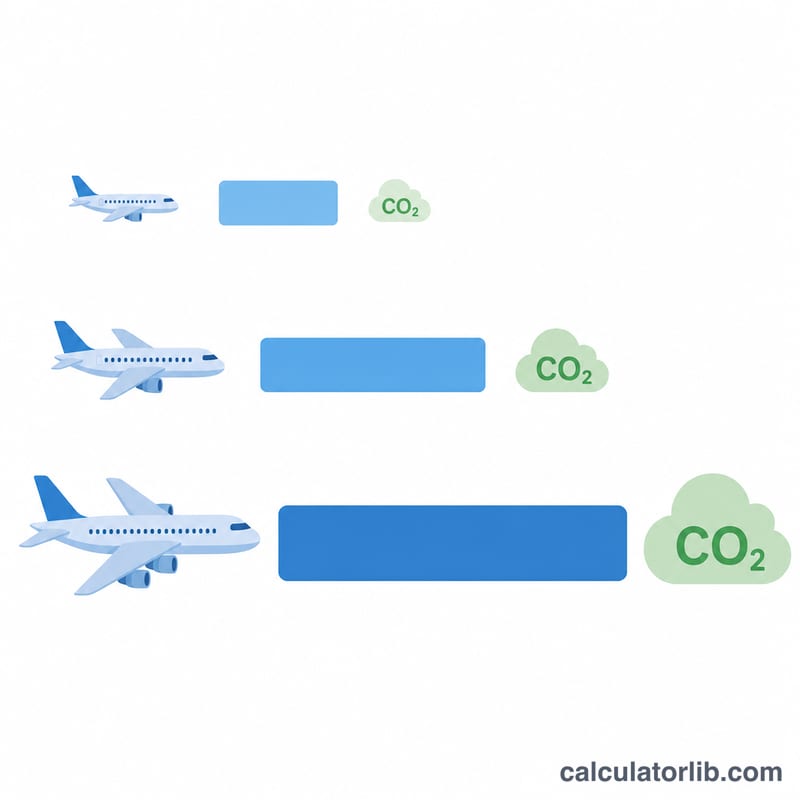
The core equation is $$\text{CO}_2\ (\text{kg}) = \text{distance} \times \text{emission factor} \times \text{passengers}$$ The emission factor expresses how many kilograms of CO₂ each passenger generates per kilometre flown. Typical values are around \(0.115\) kg/km for short-haul, \(0.105\) kg/km for long-haul, and roughly \(0.150\) kg/km for short domestic hops. These are averages; actual emissions vary by aircraft, load factor, and cabin class.
Worked example
A 2,000 km short-haul flight for 2 passengers: $$2{,}000 \times 0.115 \times 2 = 460 \text{ kg CO}_2$$ total, or 230 kg per passenger. That's 0.46 tonnes — about 21.9 trees' worth of annual carbon absorption.
FAQ
Is this round-trip or one-way? The distance you enter is treated as-is. For a round trip, double the distance.
Why do short-haul flights have a higher factor? Take-off and climb are the most fuel-intensive phases, so shorter flights spend a larger share of the trip in high-burn conditions.
How accurate is the trees estimate? It uses a common rough figure of ~21 kg CO₂ absorbed per mature tree per year. Real sequestration depends on species, age and climate, so treat it as an illustration.