
What Is the Flight Time Calculator?
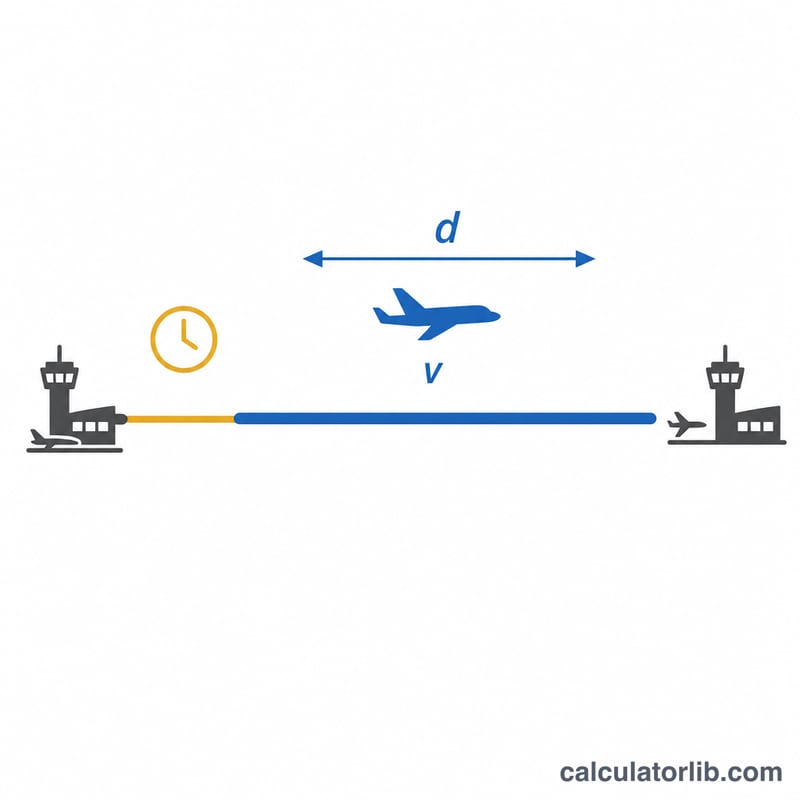
This Flight Time Calculator estimates how long a flight will take based on the distance traveled, the aircraft's average cruise speed, and a fixed overhead for taxi, take-off, climb, descent and landing. It works with any consistent units — kilometers with km/h, or miles/nautical miles with mph/knots — as long as distance and speed share the same distance unit.
How to Use It
Enter the total route distance, the typical cruise speed of the aircraft, and an overhead in minutes to account for ground and non-cruise phases of the flight. Commercial jets cruise around 800–950 km/h (about 500–590 mph), while turboprops fly closer to 500 km/h. A typical overhead of 25–40 minutes covers taxi, climb, and descent that happen below cruise speed.
The Formula Explained
The core relationship is $$T = \frac{\text{Distance (km)}}{\text{Cruise Speed (km/h)}} + \frac{\text{Overhead (min)}}{60}$$. The first term is the pure cruise time at constant speed. The second term adds a flat allowance because aircraft do not travel at cruise speed the entire trip. The total is then converted into a clean hours-and-minutes display.
Worked Example
For a 5,400 km route at a cruise speed of 900 km/h with a 30-minute overhead: cruise time = \(5400 \div 900 = 6\) hours. Overhead = \(30 \div 60 = 0.5\) hours. Total = 6.5 hours, or 6 hours and 30 minutes.
$$T = \frac{5400}{900} + \frac{30}{60} = 6 + 0.5 = 6.5 \text{ hours}$$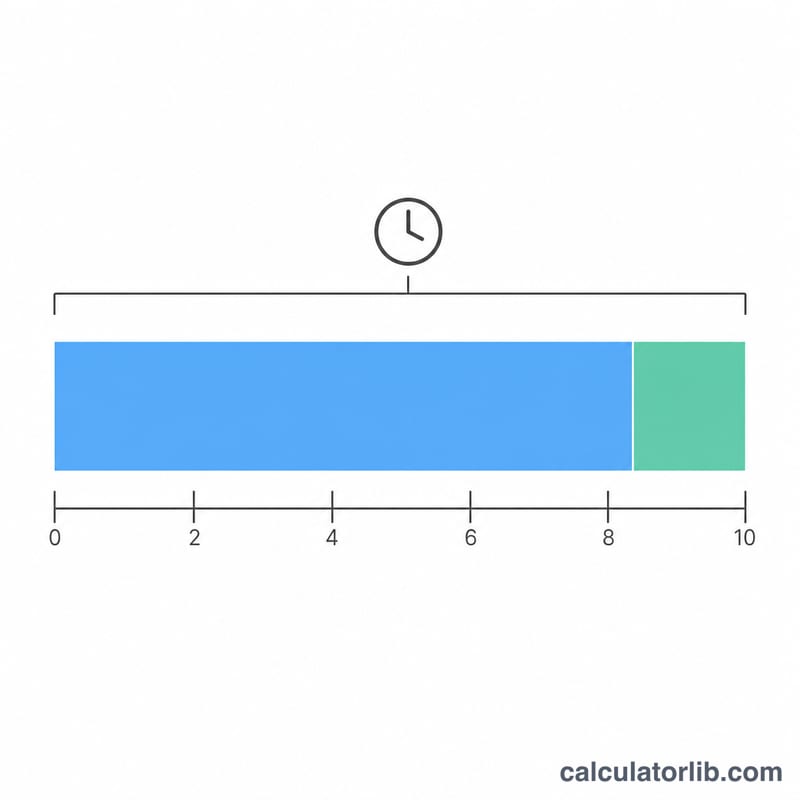
FAQ
Does this include time zones? No. It estimates flight duration only, not local arrival clock time, which depends on time-zone differences.
Why add an overhead? Planes taxi, climb, and descend below cruise speed, so distance ÷ speed alone underestimates real gate-to-gate time.
What about wind? Headwinds and tailwinds change ground speed. For a tailwind, raise the cruise speed; for a headwind, lower it to reflect the effective speed over the ground.