
What Is the Time of Flight?
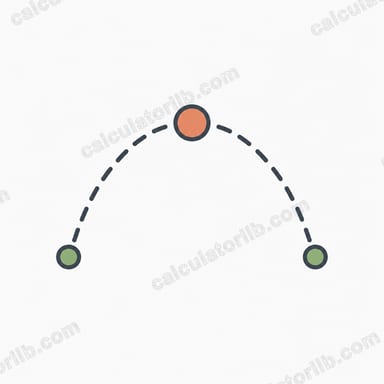
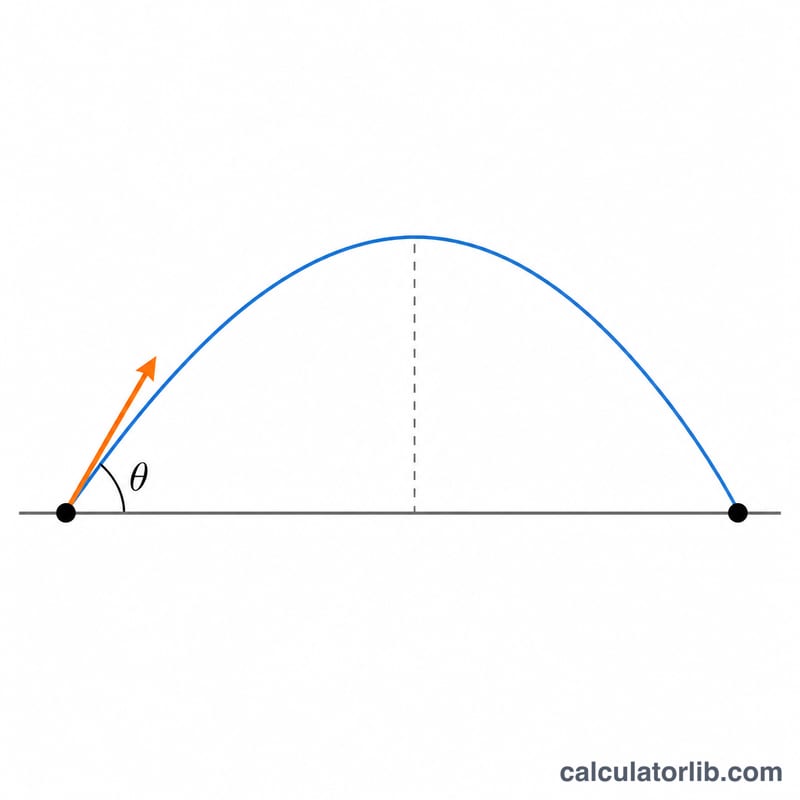
The time of flight of a projectile is the total duration it remains airborne, from the moment it is launched until it returns to the same vertical level. This calculator assumes idealized projectile motion: no air resistance, constant gravitational acceleration, and launch and landing at the same height. It is a staple of introductory physics and is useful for sports, ballistics, and engineering estimates.
How to Use It
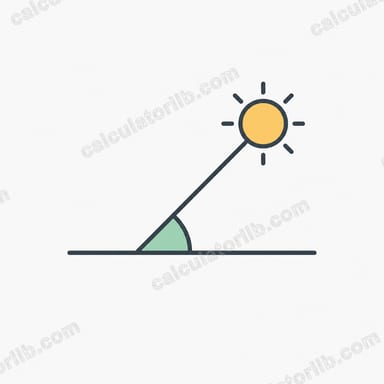
Enter the projectile's initial velocity in metres per second, the launch angle measured from the horizontal in degrees, and the acceleration due to gravity (default 9.81 m/s² for Earth — use 1.62 for the Moon or 3.71 for Mars). The calculator returns the time of flight in seconds, plus the maximum height and horizontal range as bonus outputs.
The Formula Explained
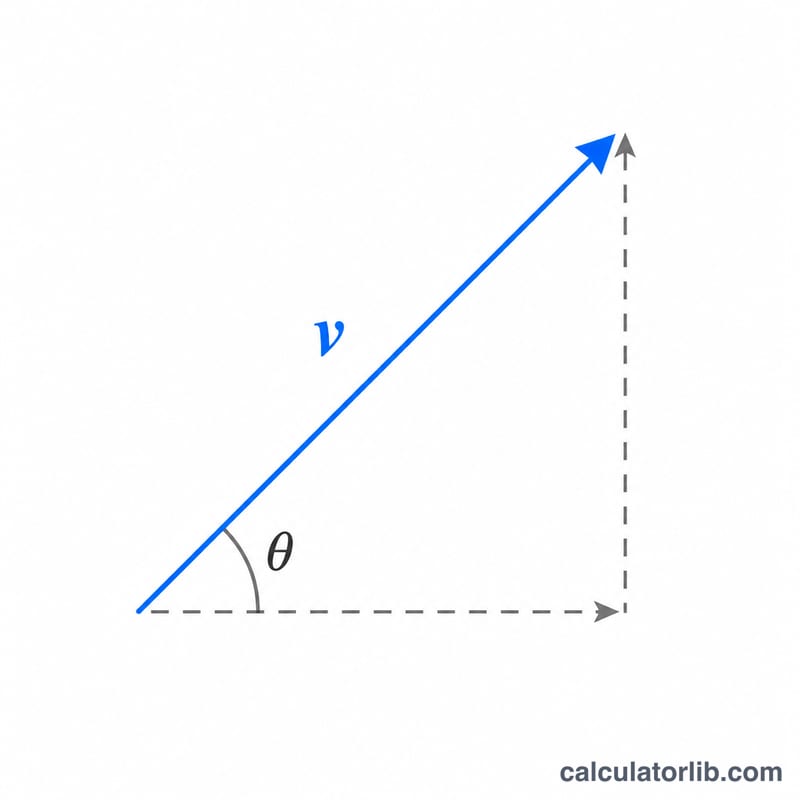
The vertical component of the launch velocity is \(v\cdot\sin\theta\). Under constant gravity, the projectile rises, stops, and falls back symmetrically, so the total flight time is $$t = \frac{2 \cdot v \cdot \sin\theta}{g}$$ Doubling the vertical velocity or halving gravity doubles the flight time. The angle that maximizes time of flight is 90° (straight up), while 45° maximizes horizontal range.
Worked Example
Launch a ball at 20 m/s at 45° on Earth (\(g = 9.81\)). The vertical velocity is \(20\cdot\sin 45° = 14.142\) m/s. Time of flight = $$\frac{2 \cdot 14.142}{9.81} \approx 2.883 \text{ seconds}$$ 2.883 seconds. Maximum height = \(\frac{(14.142)^2}{2 \cdot 9.81} \approx 10.19\) m, and range = \(20\cdot\cos 45° \cdot 2.883 \approx 40.77\) m.
FAQ
What launch angle gives the longest hang time? A vertical launch (90°) keeps the projectile in the air longest because all the speed goes into the vertical direction.
Does mass affect the time of flight? No — in the absence of air resistance, mass cancels out and only velocity, angle, and gravity matter.
Can I use it for other planets? Yes, just change the gravity value to that body's surface gravity.