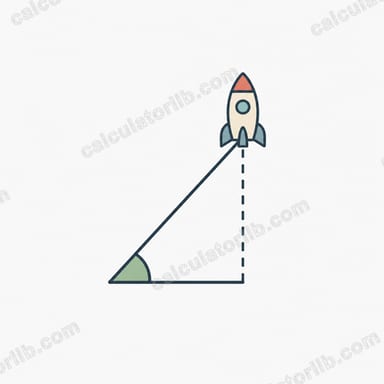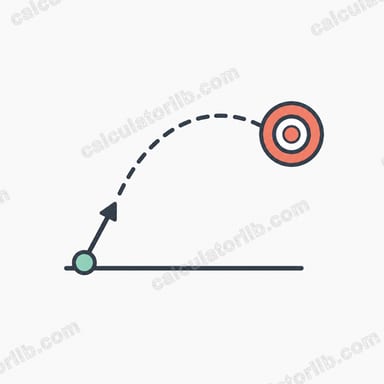

What this calculator does
This tool models ideal projectile motion with no air resistance, launched from and landing at the same height. Given the initial launch speed \(v\) and the total flight time \(t\) (time aloft), it computes the launch angle above horizontal, the maximum height reached, and the horizontal range (distance).
How to use it
Enter the initial speed and choose its unit (m/s or km/h). Enter the flight time in seconds and the gravitational acceleration in m/s^2 (default 9.80665, standard gravity). The calculator converts the speed to SI units, then derives the angle, height, and range. If the speed is too small to keep the object aloft for the given time, it reports that there is no real solution.
The formula explained
The total flight time depends only on the vertical motion. The time to reach the apex is \(t/2\), where the vertical velocity is zero, so the initial vertical component is \(v_y = g\cdot t/2\). The horizontal component is \(v_x = \sqrt{v^2 - v_y^2}\). The range is \(l = v_x\cdot t\), the maximum height is \(h = g\cdot t^2/8\), and the launch angle is \(\theta = \arctan(4h/l)\), converted to degrees.
$$\theta = \arctan\!\left(\frac{4H}{R}\right) \\[1.5em] \text{where}\quad \left\{ \begin{aligned} v &= \dfrac{\text{Speed}}{3.6} \\ v_y &= \dfrac{\text{g}\cdot\text{t}}{2} \\ v_x &= \sqrt{v^{2}-v_y^{2}} \\ R &= v_x\cdot\text{t} \\ H &= \dfrac{\text{g}\cdot\text{t}^{2}}{8} \end{aligned} \right.$$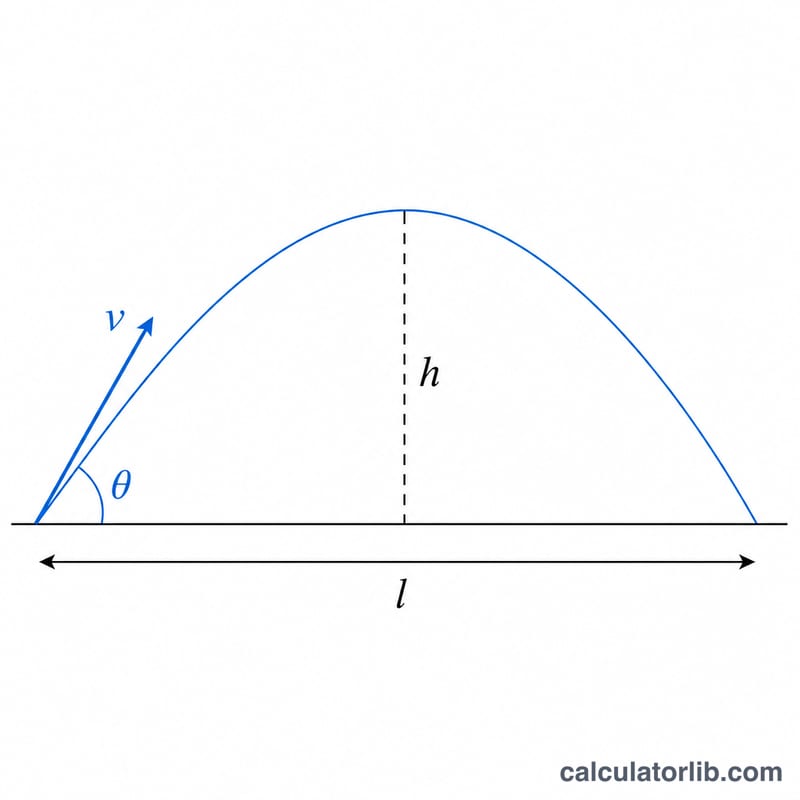
Worked example
For \(v = 90\ \text{km/h} = 25\ \text{m/s}\), \(t = 5\ \text{s}\), \(g = 9.80665\ \text{m/s}^2\):
$$v_y = \frac{9.80665\cdot 5}{2} = 24.5166\ \text{m/s}$$$$v_x = \sqrt{625 - 601.065} = 4.8923\ \text{m/s}$$so
$$l = 24.46\ \text{m}$$$$h = \frac{9.80665\cdot 25}{8} = 30.65\ \text{m}$$$$\theta = \arctan\!\left(\frac{4\cdot 30.65}{24.46}\right) = \arctan(5.011) \approx 78.72°$$FAQ
Why does it say no real solution? Physical validity requires \(v \ge g\cdot t/2\). If the speed is too low for the requested time aloft, the term under the square root becomes negative and no real launch exists.
What if the range is zero? When \(v\) exactly equals \(g\cdot t/2\) the horizontal component is zero, giving a straight vertical shot with a 90° launch angle.
Does it include air resistance? No. This is the idealized vacuum model; real-world ranges are shorter due to drag.