
What this calculator does
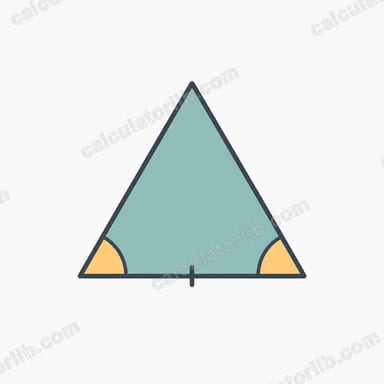
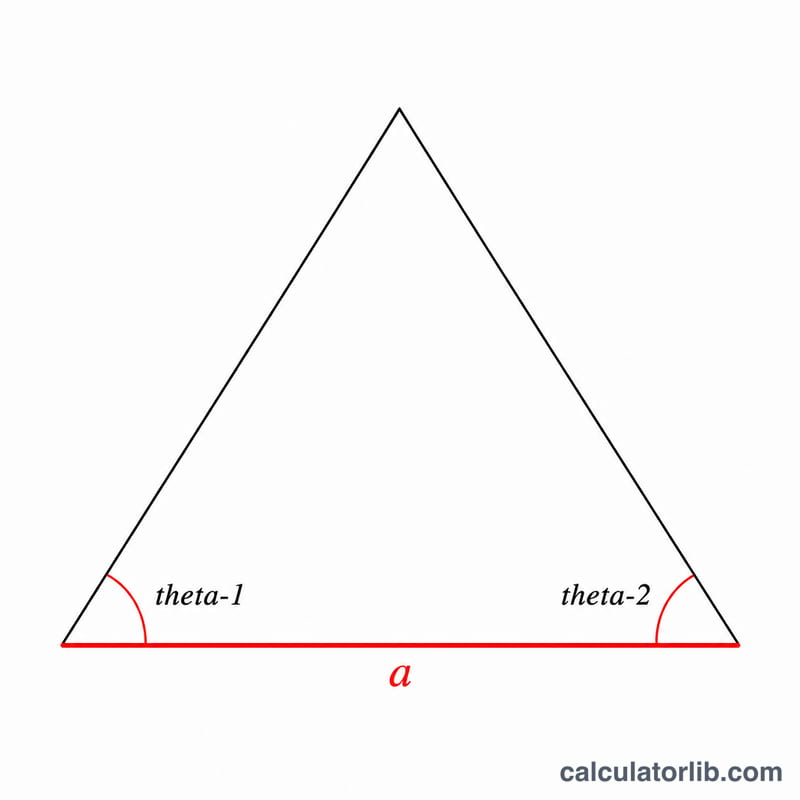
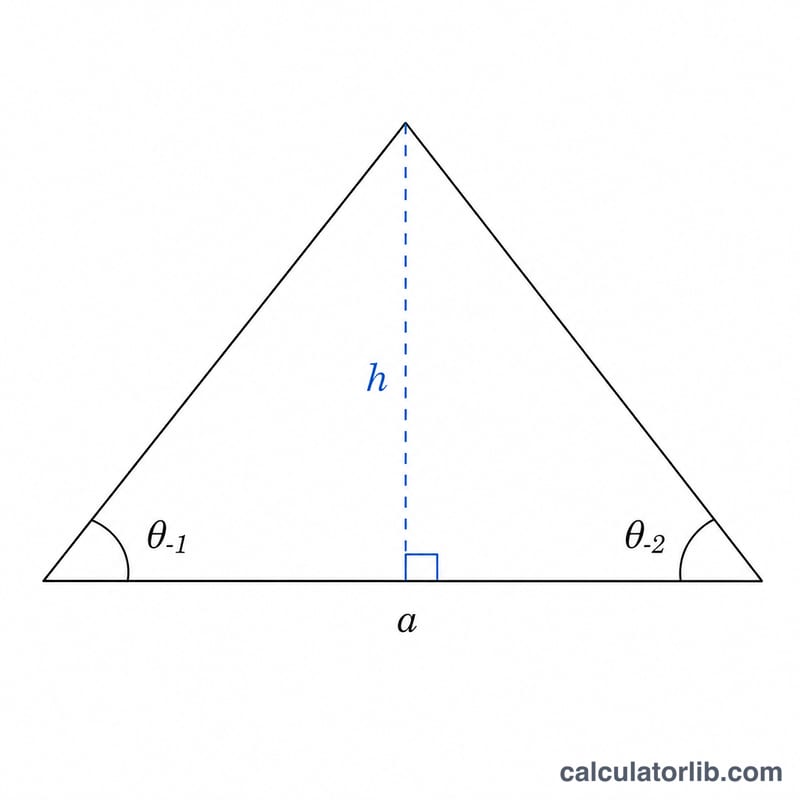
This tool solves the classic Angle-Side-Angle (ASA) triangle case. You supply one side of a triangle together with the two angles located at the endpoints of that side, and the calculator returns the triangle's area, perimeter, and the height (altitude) measured from the opposite vertex straight down to the given side. Angles can be entered in degrees or radians.
How to use it
Pick the angle unit (degrees or radians) — the same unit applies to both angles. Enter Angle θ1 (the angle at one end of the side), Angle θ2 (the angle at the other end), and the included side a. The two angles must each be positive and their sum must stay below 180° (π radians) so the triangle actually closes; otherwise the result is flagged invalid.
The formula explained
The third angle is \(\theta_3 = \pi - \theta_1 - \theta_2\), and because \(\sin(\pi - x) = \sin(x)\) we have \(\sin(\theta_3) = \sin(\theta_1 + \theta_2)\). By the law of sines the other two sides are \(b = a\cdot\sin\theta_2 / \sin(\theta_1+\theta_2)\) and \(c = a\cdot\sin\theta_1 / \sin(\theta_1+\theta_2)\). The area follows as $$S = \frac{a^{2}}{2}\cdot\frac{\sin\theta_1\cdot\sin\theta_2}{\sin\left(\theta_1+\theta_2\right)},$$ the perimeter is \(L = a + b + c\), and the height to side \(a\) is simply \(h = 2S / a\) (using the area avoids the tangent blowing up when an angle is 90°).
Worked example
With \(\theta_1 = 30\degree\), \(\theta_2 = 60\degree\), and \(a = 1\): \(\sin 30\degree = 0.5\), \(\sin 60\degree = 0.8660254\), and \(\theta_1+\theta_2 = 90\degree\) so \(\sin(\text{sum}) = 1\). Area $$S = \frac{1}{2}\left(\frac{0.5\cdot 0.8660254}{1}\right) = 0.2165064.$$ Height $$h = \frac{2\cdot 0.2165064}{1} = 0.4330127.$$ Sides \(b = 0.8660254\) and \(c = 0.5\) give perimeter $$L = 1 + 0.8660254 + 0.5 = 2.3660254.$$
FAQ
What does "included side" mean? It is the single side that touches both of the angles you entered — the side between \(\theta_1\) and \(\theta_2\).
Why is my triangle invalid? The two angles add to 180° or more, leaving no room for the third angle, or a non-positive side/angle was entered.
Can I use radians? Yes — select the radians option and enter both angles in radians; everything is converted internally before any trig function is evaluated.