
What this calculator does
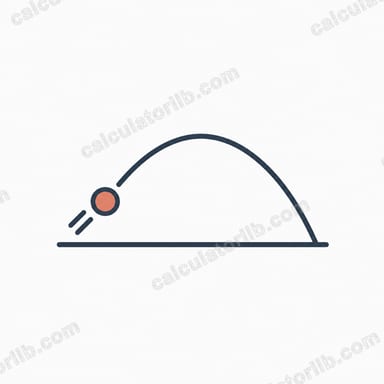
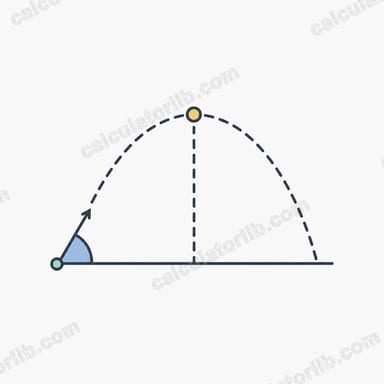
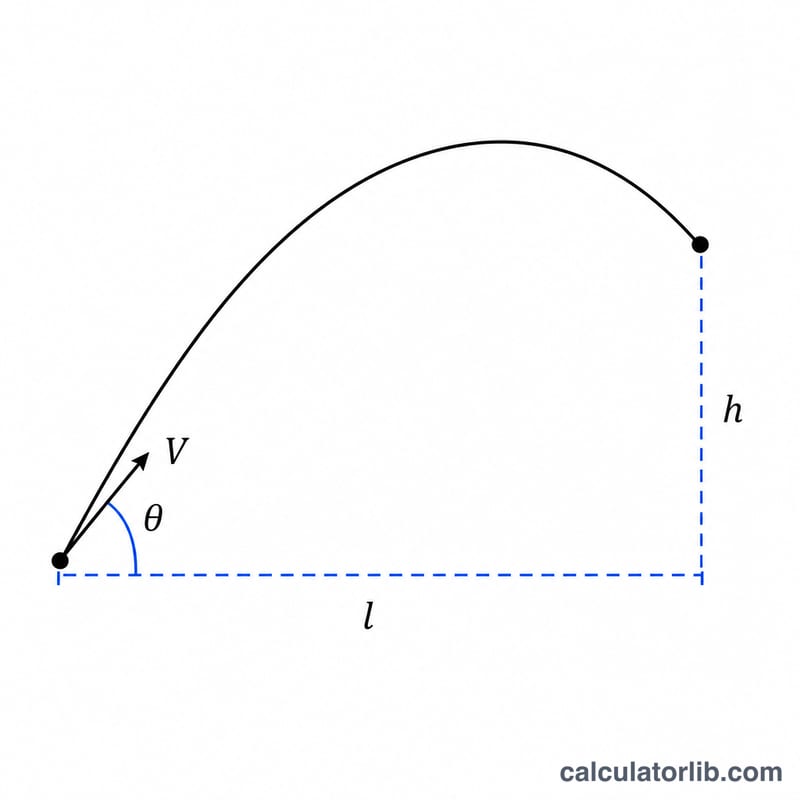
This tool solves the classic projectile problem: a body is launched (with no air resistance) and must reach a target located a horizontal distance l away and at a height h, while the launch point sits at height h0. Because infinitely many speed/angle pairs can hit the same point, this calculator returns the minimum-launch-speed trajectory — the canonical, lowest-energy solution that just reaches the target. It outputs the required initial speed (in m/s and km/h), the launch angle, and the flight (hang) time. The physics is universal and not tied to any country.
How to use it
Enter the arrival height h, the horizontal distance l (must be greater than 0), and the launch height h0. The vertical rise of the target relative to the launch point is \(y = h - h_0\). Per the convention of this model, if the target is HIGHER than the launch point you should enter h0 as a negative number, which correctly increases the required rise. Gravity g defaults to standard gravity 9.80665 m/s² but can be edited (for example to 1.62 for the Moon).
The formula explained
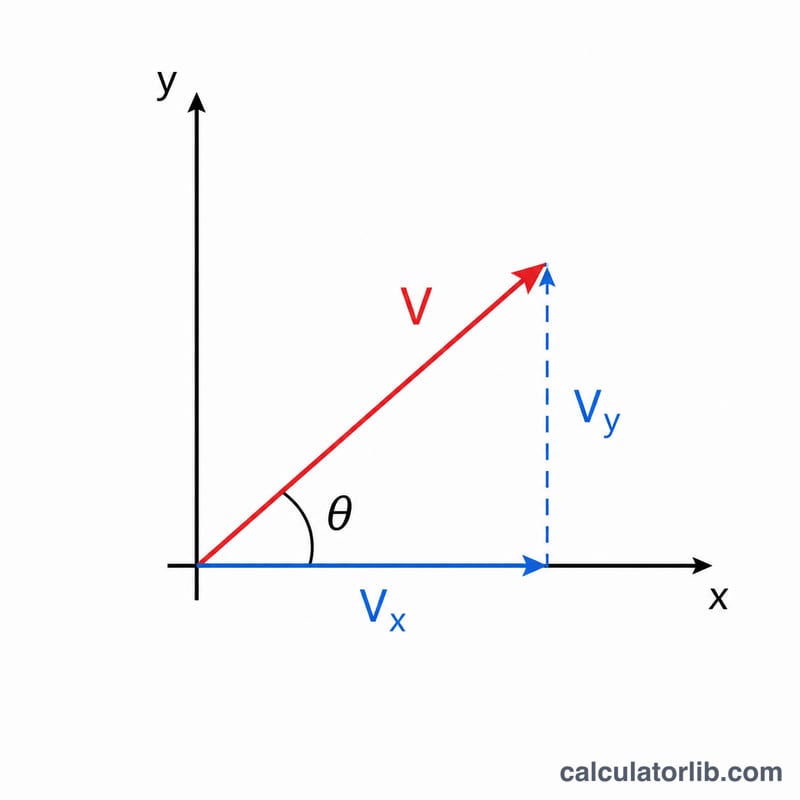
The trajectory passing through point (x, y) is $$y = x\cdot\tan\theta - \frac{g\cdot x^{2}}{2\cdot V_s^{2}\cdot\cos^{2}\theta}.$$ Minimizing the launch speed gives the closed form $$V_s = \sqrt{g\cdot(y + \sqrt{x^{2}+y^{2}})} \qquad \theta = \arctan\!\left(\frac{y + \sqrt{x^{2}+y^{2}}}{x}\right).$$ The angle conveniently bisects the vertical and the straight line to the target: $$\theta = 45^\circ + \tfrac{1}{2}\cdot\arctan\!\left(\frac{y}{x}\right).$$ Flight time follows from the constant horizontal velocity: $$t = \frac{x}{V_s\cdot\cos\theta}.$$
Worked example
With \(h = 50\) m, \(l = 100\) m, \(h_0 = 20\) m, \(g = 9.80665\): \(y = 30\) m, \(x = 100\) m, \(r = \sqrt{10000+900} = 104.403\) m. Then $$V_s = \sqrt{9.80665\times134.403} = 36.307\ \text{m/s} = 130.7\ \text{km/h},$$ $$\theta = \arctan(1.34403) = 53.35^\circ,$$ $$t = \frac{100}{36.307\times\cos 53.35^\circ} = 4.62\ \text{s}.$$
FAQ
Why minimum speed? A target can be hit by many trajectories; the minimum-speed solution is the unique, physically natural answer this class of tool reports.
What if the target is above the launcher? Enter h0 as negative so that \(y = h - h_0\) grows, matching the model's sign rule.
Does it include air resistance? No — this is ideal projectile motion under uniform gravity only.