
What Is Horizontal Projectile Motion?
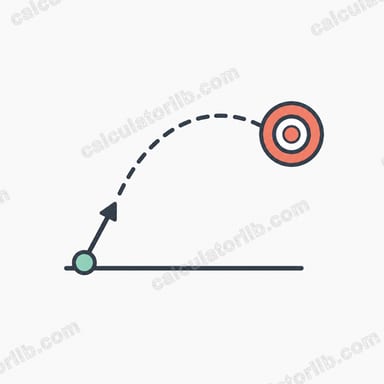
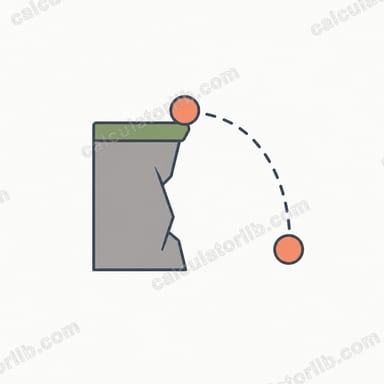
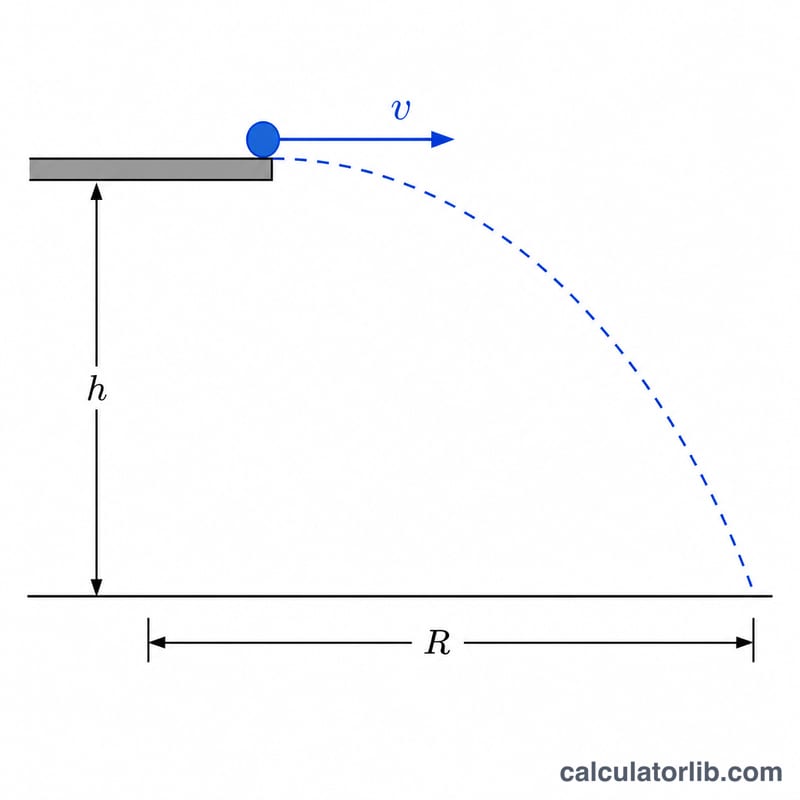
Horizontal projectile motion describes an object launched purely horizontally from some height and then allowed to fall freely under gravity. The motion separates cleanly into two independent parts: constant horizontal velocity and accelerating vertical fall. Because the launch has no vertical velocity component, the time the object spends in the air depends only on the drop height and gravity — not on how fast it was thrown.
How to Use This Calculator
Enter the launch height (the vertical distance the object will fall), the initial horizontal velocity, and the acceleration due to gravity (9.81 m/s² on Earth, but you can change it for the Moon or other planets). The calculator returns the time of flight, the horizontal range, the vertical velocity at impact, and the resultant impact speed.
The Formula Explained
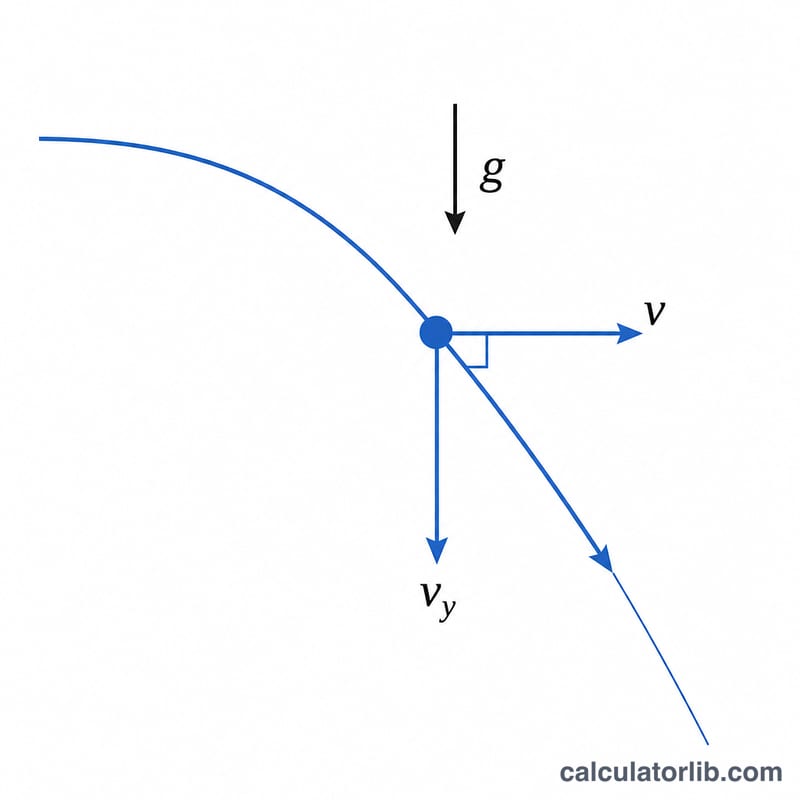
Since the vertical motion starts from rest, the fall time is $$t = \sqrt{\frac{2h}{g}}$$ The horizontal distance traveled is $$R = v \cdot t$$ because horizontal velocity stays constant (ignoring air resistance). The vertical velocity at impact is $$v_y = g \cdot t$$ and the total speed at landing combines both directions: $$v_f = \sqrt{v^2 + v_y^2}$$
Worked Example
A ball is thrown horizontally at 10 m/s from a 20 m cliff (g = 9.81 m/s²). Time of flight: $$t = \sqrt{\frac{2 \times 20}{9.81}} = \sqrt{4.077} \approx 2.019 \text{ s}$$ Range: $$R = 10 \times 2.019 \approx 20.19 \text{ m}$$ Vertical velocity at impact: $$v_y = 9.81 \times 2.019 \approx 19.81 \text{ m/s}$$ Resultant impact speed: $$\sqrt{10^2 + 19.81^2} \approx 22.19 \text{ m/s}$$
FAQ
Does the horizontal speed affect the fall time? No. In ideal projectile motion the time to hit the ground depends only on height and gravity; a faster throw simply travels farther horizontally.
Is air resistance included? No. This calculator assumes a vacuum (no drag), which is a good approximation for dense, slow objects over short distances.
Can I use it on other planets? Yes — just change the gravity value (e.g. 1.62 for the Moon, 3.71 for Mars).