
What this calculator does
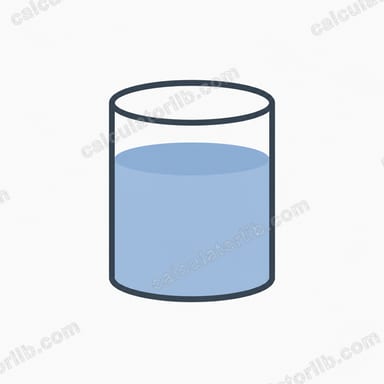
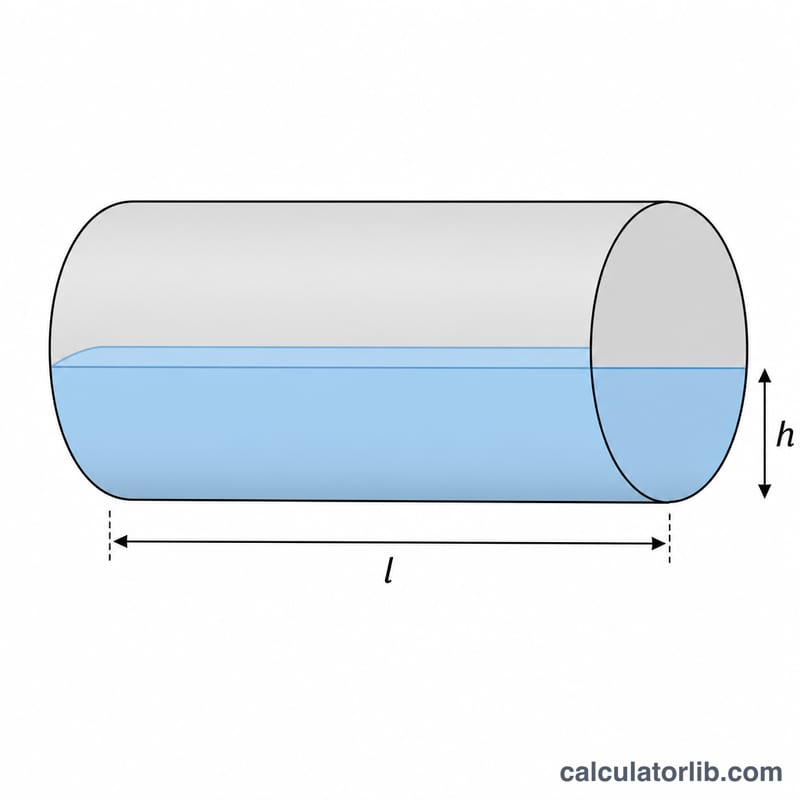
This tool computes the geometry of a cylindrical segment: the solid formed when a horizontal (lying-down) right circular cylinder is cut by a horizontal plane. It is exactly the shape of a liquid resting in a horizontal tank filled to a depth h. From the radius r, the fill height h (measured up from the lowest point of the circle), and the cylinder length l, it returns the volume V, the end cross-section area F, the curved bottom (arc) area S, and the flat top area T.
How to use it
Enter the radius, the fill height, and the axial length using any single length unit (all three must share the same unit). The height must lie between 0 and 2r — at h = 2r the cylinder is completely full. Areas are returned in unit² and the volume in unit³. No unit conversion is applied, so the outputs simply inherit whatever unit you used for the inputs.
The formula explained
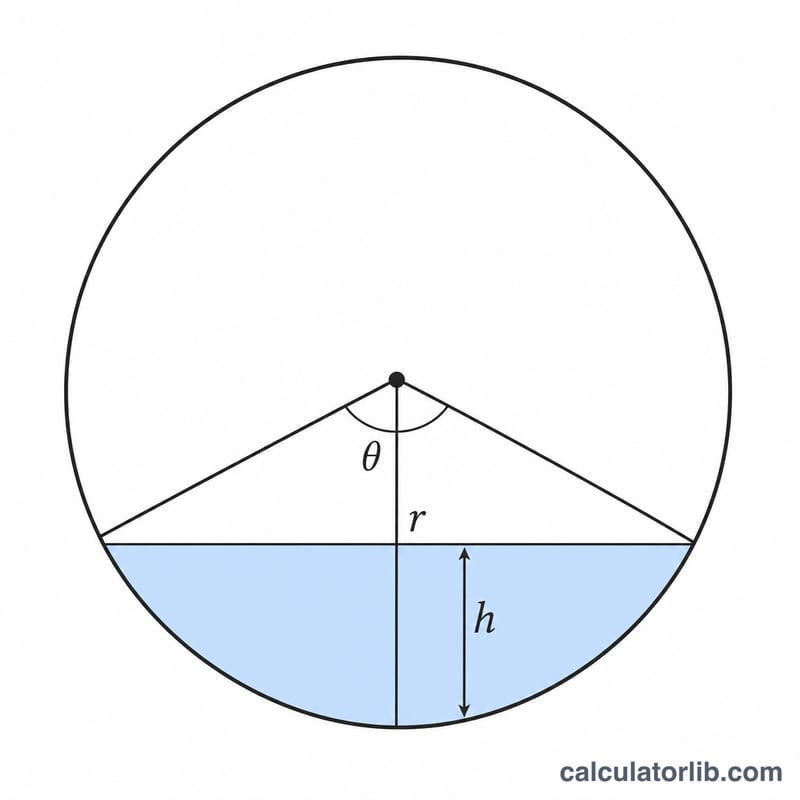
A horizontal chord cuts a circular segment of height h. The central angle is \(\theta = 2\cdot\arccos\!\left(1 - \frac{h}{r}\right)\). The half-chord length is \(\sqrt{h(2r-h)}\). The segment area is \(F = \frac{\theta}{2}r^{2} - (r-h)\sqrt{h(2r-h)}\) — the circular sector area minus the triangle. Extruding this over the length gives \(V = F\cdot l\). The curved bottom surface is the arc length \(r\theta\) times l, and the flat top is the chord \(2\sqrt{h(2r-h)}\) times l.
$$V = \left[ r^{2}\arccos\!\left(1 - \frac{h}{r}\right) - (r - h)\sqrt{h\,(2r - h)} \right] \cdot l$$ $$\text{where}\quad \left\{ \begin{aligned} r &= \text{Radius} \\ h &= \text{Fill Height} \\ l &= \text{Length} \end{aligned} \right.$$
Worked example
For r = 1, h = 0.5, l = 2: \(1 - h/r = 0.5\), so \(\theta = 2\cdot\arccos(0.5) = 2.0943951\) rad. The half-chord is \(\sqrt{0.75} = 0.8660254\). Then $$F = 1.0471976 - 0.5\cdot 0.8660254 = 0.6141848 \text{ unit}^2,$$ $$V = F\cdot 2 = 1.2283697 \text{ unit}^3,$$ $$S = 1\cdot 2.0943951\cdot 2 = 4.1887902 \text{ unit}^2,$$ $$T = 2\cdot 2\cdot 0.8660254 = 3.4641016 \text{ unit}^2.$$
FAQ
Is F the volume or an area? F is the 2D end cross-section (segment) area; multiply it by the length l to get the volume V.
What happens at h = 2r? The cylinder is full: \(\theta = 2\pi\), \(F = \pi r^{2}\), \(V = \pi r^{2} l\), \(S = 2\pi r l\), and T = 0 because the chord shrinks to a point.
Can I use inches, cm or metres? Yes — use any unit, just be consistent across all three inputs; outputs come back in that unit squared and cubed.