
What is the Truncated Cylinder Volume Calculator?
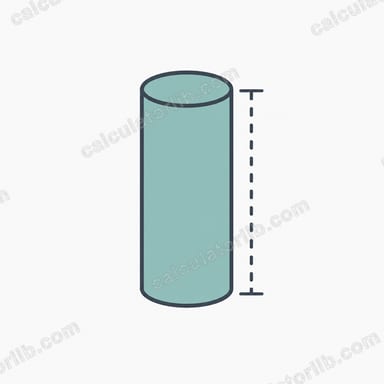
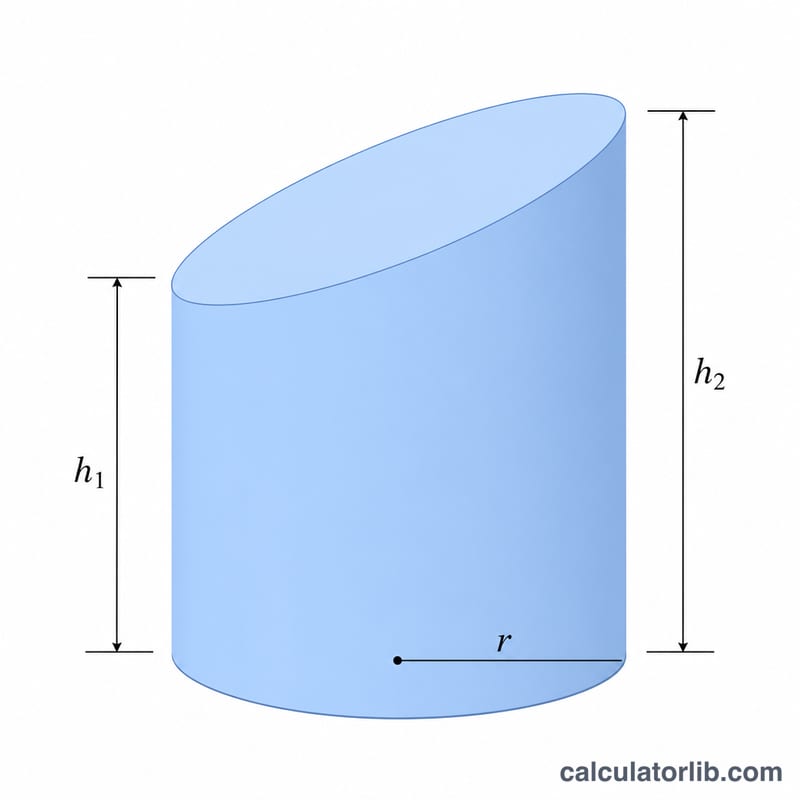
This tool computes the volume, lateral (side) surface area, and total surface area of a truncated right circular cylinder — a cylinder of radius r whose top is sliced by a single flat plane that is not parallel to the base. The cut produces a short side of vertical height h1 and a tall side of vertical height h2. The bottom is a flat circle and the top is an ellipse. All three inputs share the same length unit; volume comes out in unit cubed and areas in unit squared.
How to use it
Enter the radius r, the minimum (short side) height h1, and the maximum (tall side) height h2. Require \(r > 0\), \(h_1 \geq 0\), and \(h_2 \geq h_1\). If you accidentally enter h1 larger than h2 the calculator swaps them, since the geometry is symmetric in naming.
The formulas explained
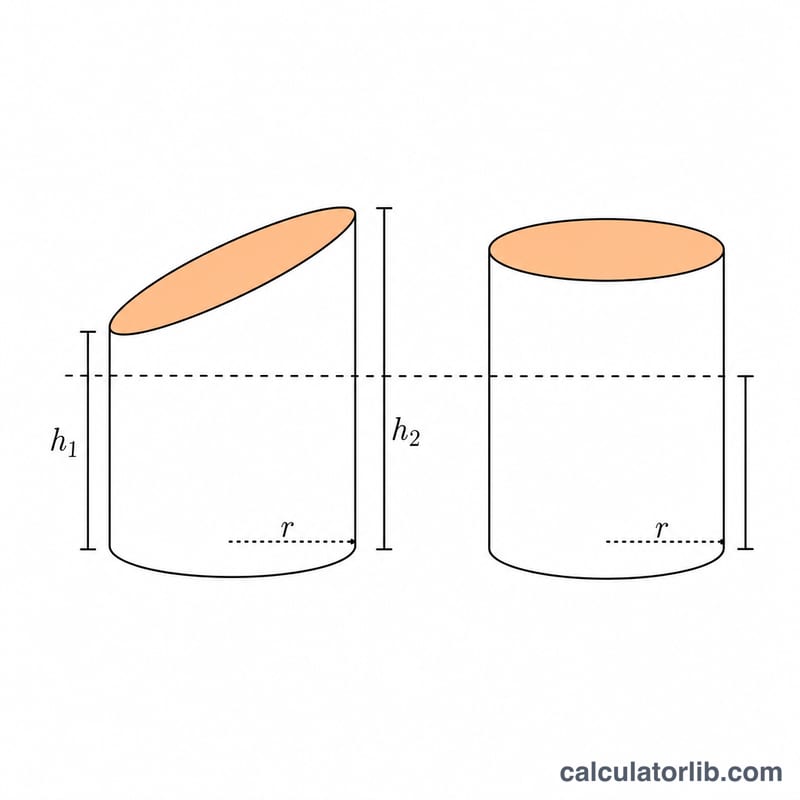
The slanted top passes through the centroid line, so the volume equals that of a plain cylinder whose height is the mean of the two sides: $$V = \pi \, r^2 \cdot \frac{h_1 + h_2}{2}.$$ The curved wall unrolls to give $$S_{\text{side}} = \pi \, r \, (h_1 + h_2).$$ The oblique cut is an ellipse with semi-minor axis \(r\) and semi-major axis \(r / \cos(\theta)\), where \(\tan(\theta) = (h_2 - h_1) / (2r)\); its area is $$A_{\text{top}} = \pi \, r^2 \sqrt{1 + \left(\frac{h_2 - h_1}{2r}\right)^2}.$$ Adding the flat base \(A_{\text{base}} = \pi \, r^2\) gives the total surface area $$S = S_{\text{side}} + A_{\text{top}} + A_{\text{base}}.$$
Worked example
For \(r = 5\), \(h_1 = 8\), \(h_2 = 12\): \(h_{\text{Mean}} = 10\), so $$V = \pi \cdot 25 \cdot 10 = 250\pi \approx 785.398.$$ Lateral area \(= \pi \cdot 5 \cdot 20 = 100\pi \approx 314.159\). Slope \(= (12 - 8)/(2 \cdot 5) = 0.4\), so \(A_{\text{top}} = \pi \cdot 25 \cdot \sqrt{1.16} \approx 84.590\). Base \(= 25\pi \approx 78.540\). Total surface area \(\approx 314.159 + 84.590 + 78.540 = 477.289\).
FAQ
What if h1 equals h2? The solid becomes an ordinary cylinder: the slope is 0, both ends are circles of area \(\pi r^2\), and the formulas reduce correctly.
Why is the top bigger than the base? A slanted plane cutting through a cylinder traces an ellipse, which is always larger in area than the perpendicular circular cross-section.
Do I need to convert units? Only that all three inputs use the same unit. Results then follow automatically in that unit cubed (volume) or squared (areas).