
What this calculator does
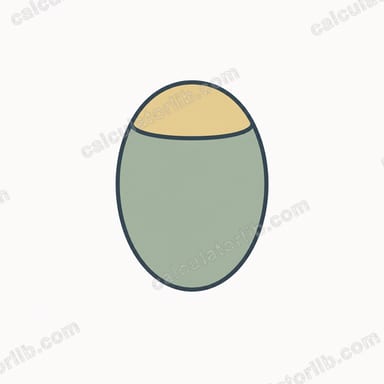
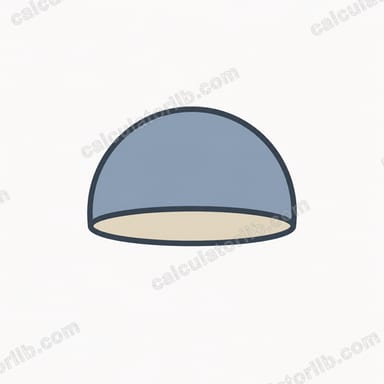
A spheroid is an ellipsoid of revolution — the solid formed by spinning an ellipse about one of its axes. This tool computes the geometry of a spheroidal segment: the piece left when you slice the spheroid with a flat plane perpendicular to its rotation axis. It returns the segment’s volume, the base area of the flat circular cut, and the curved (lateral) surface area of the wall.
How to use it
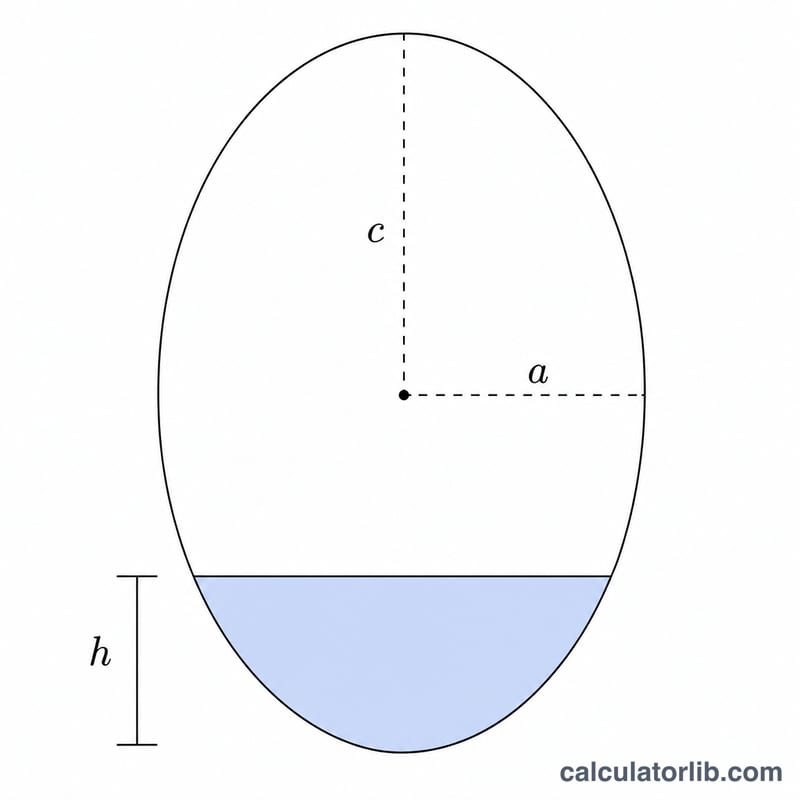
Enter the equatorial semi-axis a (the radius in the two directions perpendicular to the axis), the semi-axis c along the rotation axis, and the height h of the segment measured from the bottom tip. Keep all three values in the same length unit; the volume comes out in unit³ and the areas in unit². The height must satisfy \(0 < h \le 2c\); setting \(h = 2c\) returns the full spheroid.
The formulas explained
With the spheroid \(x^2/a^2 + z^2/c^2 = 1\), the disk radius at axial height \(z\) is \(r(z) = a\cdot\sqrt{1 - z^2/c^2}\). Integrating \(\pi r^2\) from the bottom (\(z = -c\)) up to the cut (\(z = h - c\)) gives $$V = \frac{\pi\,a^2\,h^2\left(3c - h\right)}{3c^2}.$$ The base area is \(\pi\) times the cut radius squared, $$A = \frac{\pi\,a^2\,h\left(2c - h\right)}{c^2}.$$ The curved wall is a surface of revolution, $$S = 2\pi\int r\sqrt{1 + \left(\frac{dr}{dz}\right)^2}\;dz,$$ evaluated here by fine numerical integration so it works for prolate, oblate, and spherical shapes alike.
Worked example
Take \(a = 2\), \(c = 4\), \(h = 3\) (prolate, since \(c > a\)). $$\text{Volume} = \frac{\pi\cdot 4\cdot 9\cdot(12 - 3)}{3\cdot 16} = \frac{\pi\cdot 324}{48} \approx 21.206\ \text{unit}^3.$$ $$\text{Base area} = \frac{\pi\cdot 4\cdot 3\cdot(8 - 3)}{16} = \pi\cdot 3.75 \approx 11.781\ \text{unit}^2.$$ The curved surface area integrates to about \(25.30\) unit².
FAQ
Is the base area included in the surface area? No — the surface area reported is only the curved spheroidal wall. Add the base area if you need the total surface of the closed segment.
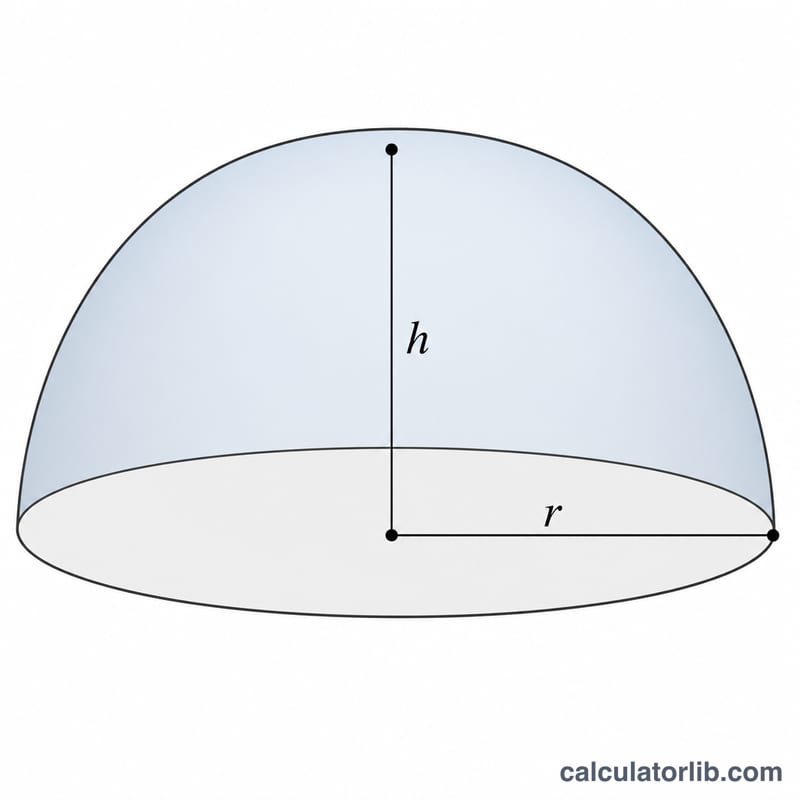
What if a equals c? The spheroid becomes a sphere of radius \(R = a = c\), and the results match the standard spherical-cap formulas \(V = \pi h^2(3R - h)/3\) and \(S = 2\pi R h\).
Prolate vs oblate? Prolate means \(c > a\) (egg-shaped along the axis); oblate means \(c < a\) (flattened). The numerical surface integral handles both without changing the formula.