
What This Calculator Does
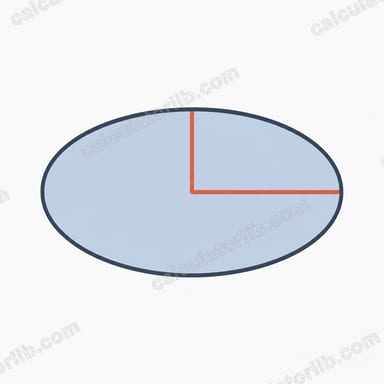
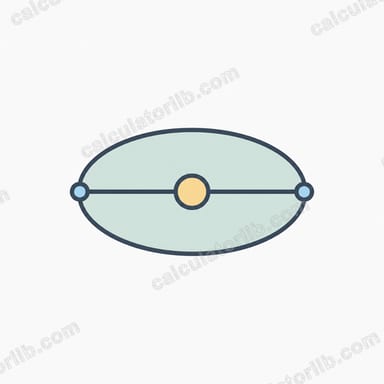
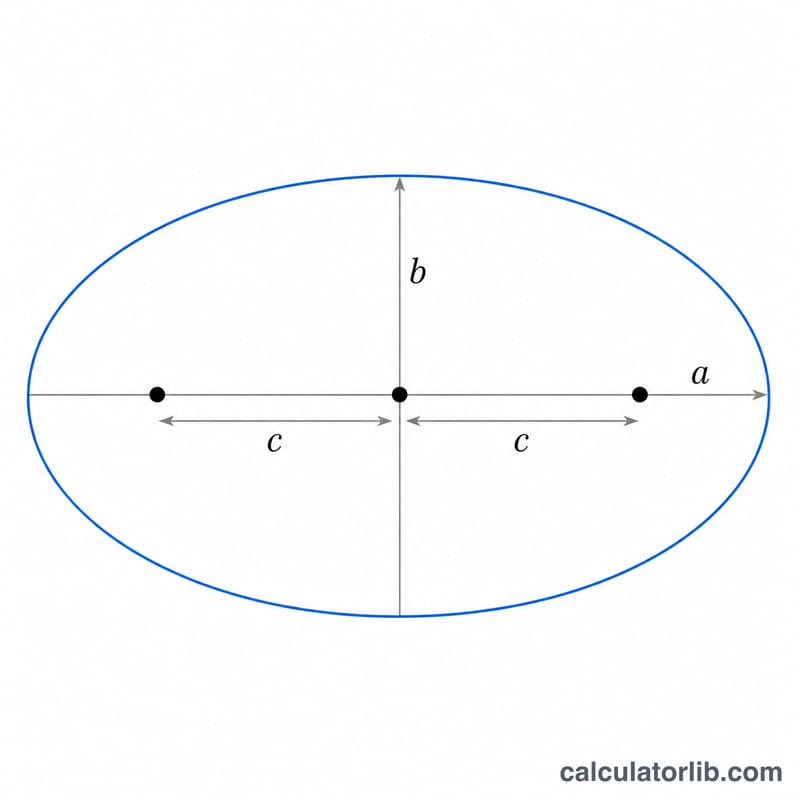
An ellipse has two special interior points called foci. For any point on the ellipse, the sum of the distances to the two foci is constant. This tool finds those foci from the ellipse's semi-axes a and b and its center (h, k), and also reports the focal distance c and the eccentricity.
How to Use It
Enter the semi-major and semi-minor axis lengths (a and b) and the center coordinates (h, k). The calculator automatically detects which axis is longer: if a \(\geq\) b the major axis is horizontal and the foci sit at \((h \pm c,\ k)\); otherwise the major axis is vertical and the foci sit at \((h,\ k \pm c)\). Center defaults to the origin (0, 0) if left blank.
The Formula Explained
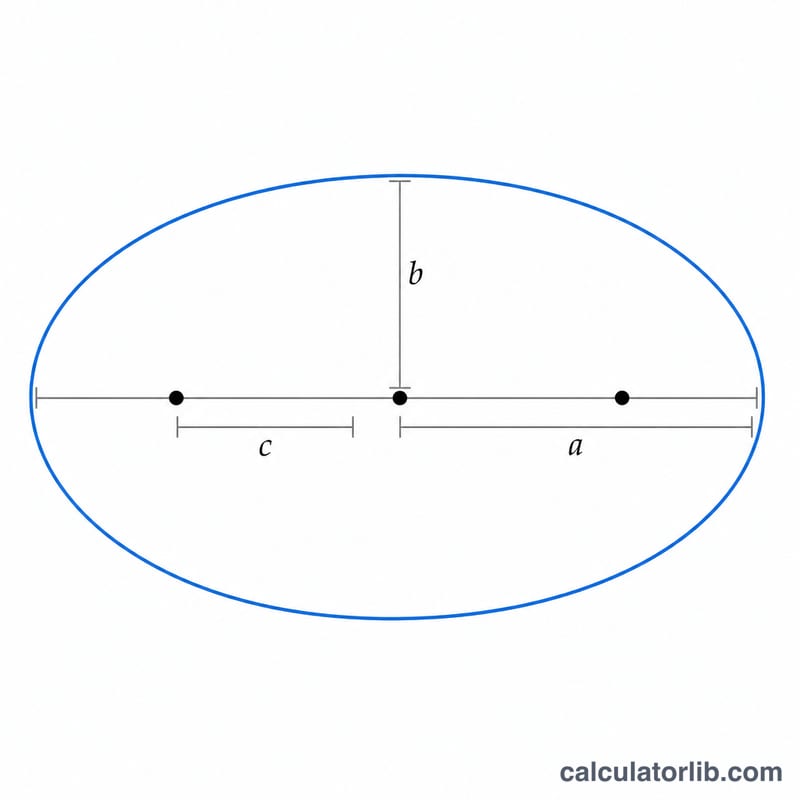
The focal distance is $$c = \sqrt{\left|\,a^{2} - b^{2}\,\right|}$$ The absolute value lets you enter the axes in either order — the result is always real and non-negative. The larger of the two semi-axes is the semi-major axis, and the foci always lie on the major axis, equidistant from the center. Eccentricity is \(e = c / (\text{major semi-axis})\), ranging from 0 (a circle) toward 1 (a very elongated ellipse).
Worked Example
For an ellipse with a = 5, b = 3, centered at the origin: $$c = \sqrt{\left|\,25 - 9\,\right|} = \sqrt{16} = 4$$ Since a > b, the major axis is horizontal, so the foci are at \((-4, 0)\) and \((4, 0)\). The eccentricity is \(4 / 5 = 0.8\).
FAQ
What if a equals b? Then \(c = 0\) and both foci collapse to the center — the ellipse is a circle.
Does input order matter? No. The calculator uses the absolute difference and picks the larger axis as the major one, so swapping a and b only changes the orientation of the foci.
What is eccentricity? A measure of how "stretched" the ellipse is. A value near 0 is nearly circular; values approaching 1 are highly elongated.