
What is the Ellipse Perimeter Calculator?
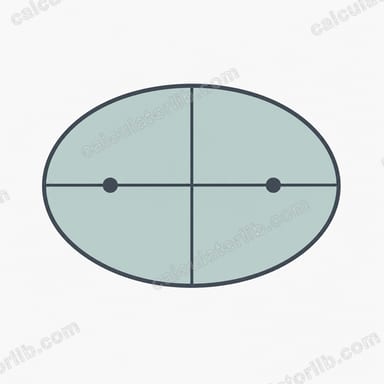
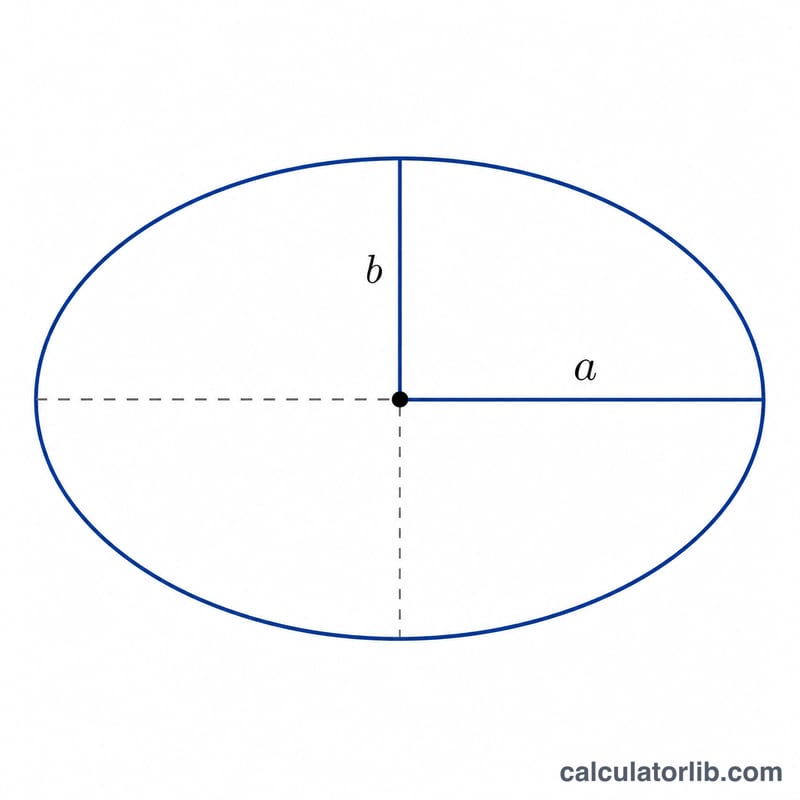
Unlike a circle, the perimeter (circumference) of an ellipse has no simple closed-form expression — it involves a complete elliptic integral of the second kind. This calculator uses Ramanujan's celebrated approximation, which is extremely accurate for most practical purposes, to find the perimeter from the ellipse's two semi-axes: the semi-major axis a and the semi-minor axis b.
How to use it
Enter the semi-major axis a (half the longest diameter) and the semi-minor axis b (half the shortest diameter) in the same units. The calculator returns the approximate perimeter and the exact area. Both inputs use the same length unit, and the result is expressed in those units.
The formula explained
Ramanujan's second approximation is:
$$P \approx \pi \left[ 3\left(a + b\right) - \sqrt{\left(3a + b\right)\left(a + 3b\right)} \right]$$
The area is the exact value \(A = \pi \cdot a \cdot b\). When \(a = b\), the ellipse becomes a circle of radius \(a\), and the formula reduces to \(P = 2\pi a\) as expected.
Worked example
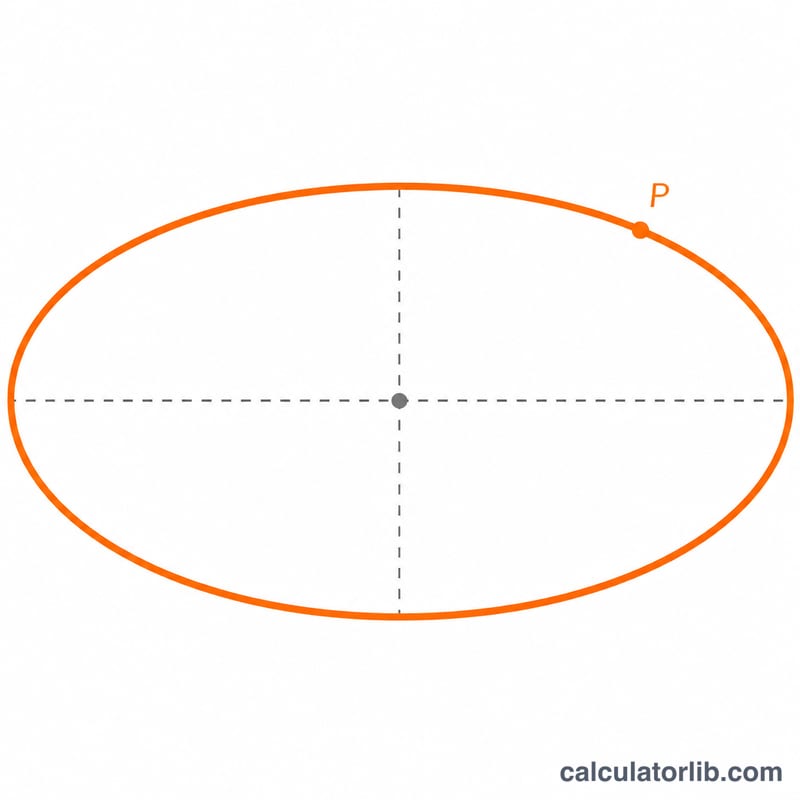
Suppose \(a = 5\) and \(b = 3\). Then \(3(a + b) = 3 \times 8 = 24\). Next, \((3a + b)(a + 3b) = (15 + 3)(5 + 9) = 18 \times 14 = 252\), and \(\sqrt{252} \approx 15.8745\). So $$P \approx \pi \times (24 - 15.8745) = \pi \times 8.1255 \approx 25.527 \text{ units}.$$ The area is \(\pi \times 5 \times 3 \approx 47.124\) square units.
FAQ
How accurate is Ramanujan's approximation? For most ellipses the relative error is tiny — often less than 0.001%. It only loses some accuracy for extremely elongated (high-eccentricity) ellipses.
What if a equals b? The ellipse is a circle and the formula gives the exact circumference \(2\pi a\).
Which axis is which? The semi-major axis is half of the longer diameter; the semi-minor axis is half of the shorter one. The order does not affect the result since the formula is symmetric in \(a\) and \(b\).