
What Are Double Angle Identities?
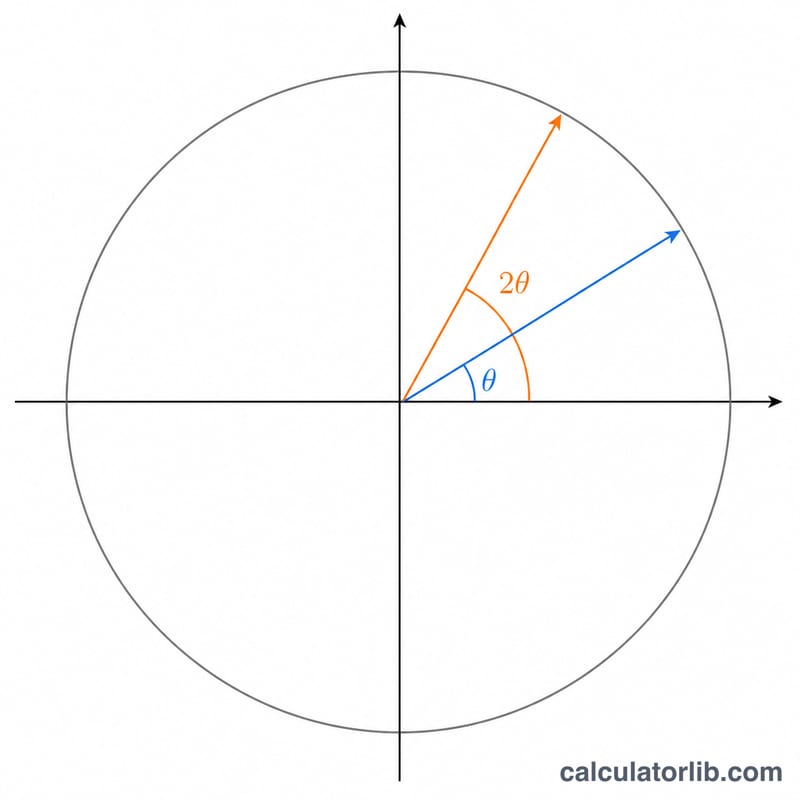
Double angle identities are trigonometric formulas that express the sine, cosine, and tangent of twice an angle (2θ) in terms of trigonometric functions of the original angle θ. They are fundamental tools in trigonometry, calculus, and physics — useful for simplifying expressions, solving equations, and integrating functions. This calculator evaluates all three identities for any angle you enter, in either degrees or radians.
How to Use This Calculator
Enter your angle θ in the input box, choose whether it is measured in degrees or radians, and the calculator instantly returns sin(2θ), cos(2θ), and tan(2θ). Because the tangent identity has the term \((1 - \tan^{2}\theta)\) in its denominator, the result for tan(2θ) is undefined at angles such as 45° (where \(\tan^{2}\theta = 1\)) and at 90° where the tangent itself blows up.
The Formulas Explained
The three core identities are:
$$\sin 2\theta = 2\sin\theta\cos\theta$$ — derived from the angle-addition formula sin(a+b) with a = b = θ.
$$\cos 2\theta = 1 - 2\sin^{2}\theta$$ — one of three equivalent forms (it also equals \(\cos^{2}\theta - \sin^{2}\theta\) and \(2\cos^{2}\theta - 1\)).
$$\tan 2\theta = \dfrac{2\tan\theta}{1 - \tan^{2}\theta}$$ — obtained by dividing the sine identity by the cosine identity.
Worked Example
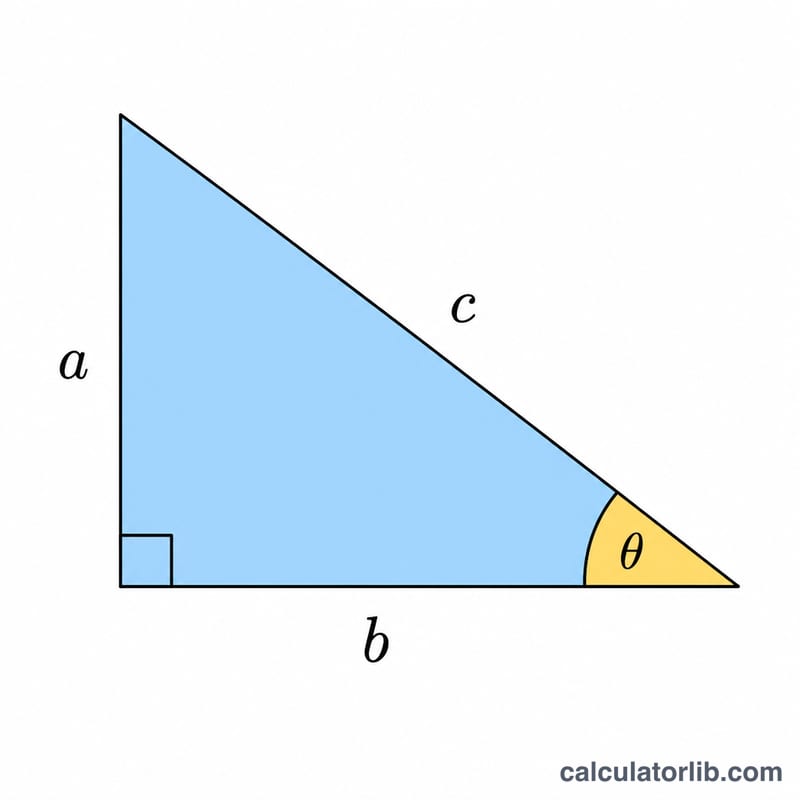
Let θ = 30°. Then \(\sin\theta = 0.5\) and \(\cos\theta = 0.8660\). So $$\sin 2\theta = 2 \times 0.5 \times 0.8660 = 0.8660,$$ which matches sin(60°). Likewise $$\cos 2\theta = 1 - 2(0.5)^{2} = 1 - 0.5 = 0.5 = \cos 60°,$$ and $$\tan 2\theta = \frac{2(0.5774)}{1 - 0.3333} = \frac{1.1547}{0.6667} = 1.7321 = \tan 60°.$$
FAQ
Why is tan(2θ) sometimes undefined? When \(1 - \tan^{2}\theta = 0\) (at θ = 45°, 135°, …) the denominator is zero, so tan(2θ) has a vertical asymptote and no finite value.
Can I use negative angles? Yes. The identities hold for all real angles, positive or negative.
Which cosine form does this use? It uses \(\cos 2\theta = 1 - 2\sin^{2}\theta\), but all three forms give identical numerical results.