
What is the Fifth Root?
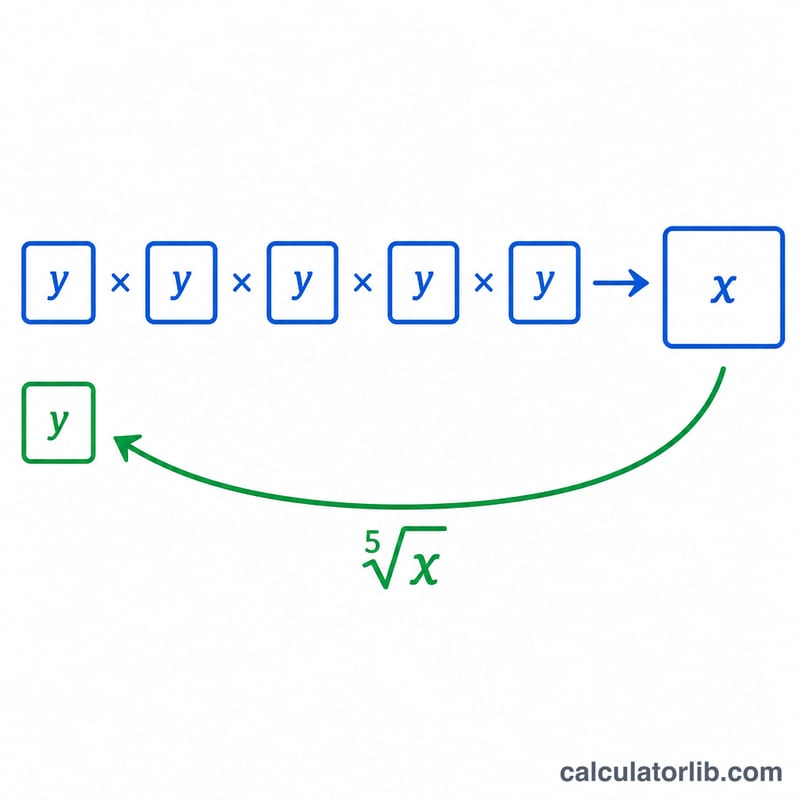
The fifth root of a number x is the value y that, when multiplied by itself five times, gives x. In symbols, \(y^5 = x\), or equivalently \(y = x^{\frac{1}{5}}\). It is the inverse of raising a number to the fifth power. Because 5 is an odd number, every real number — positive, negative, or zero — has exactly one real fifth root.
How to Use This Calculator
Enter any number into the field and the calculator returns its fifth root. You can use whole numbers, decimals, or negative values. For example, the fifth root of 32 is 2, and the fifth root of -243 is -3.
The Formula Explained
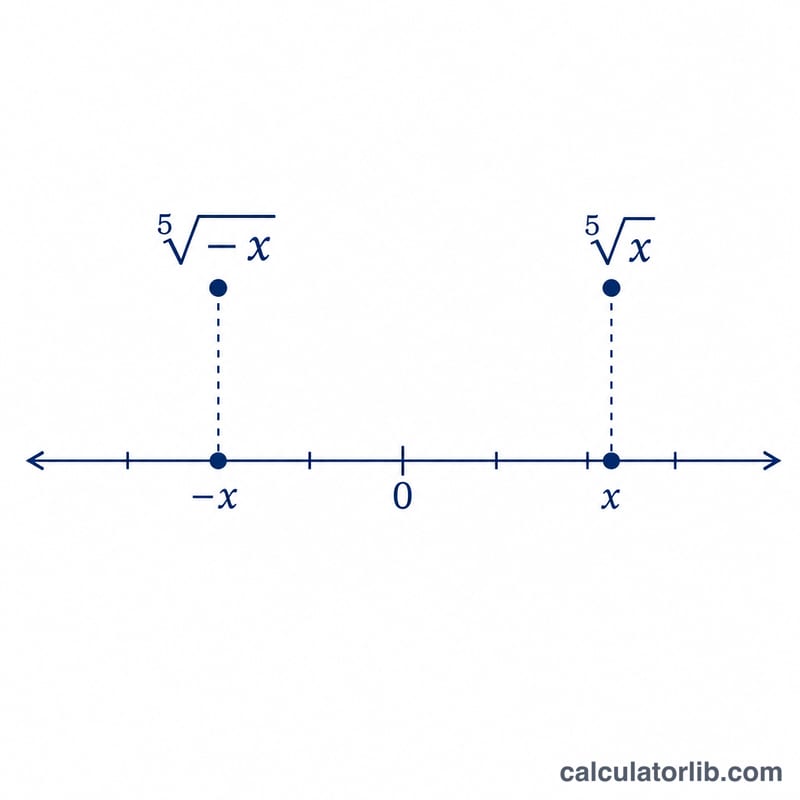
The core relationship is \(y = x^{\frac{1}{5}}\). A root is just a fractional exponent: taking the fifth root is the same as raising to the power one-fifth. For negative inputs we use the identity \(\sqrt[5]{-x} = -\sqrt[5]{x}\), computing the root of the absolute value and then re-applying the sign. This keeps the result a real number rather than a complex one.
Worked Example
Suppose \(x = 1024\). We want y such that \(y^5 = 1024\). Since $$4^5 = 4\times4\times4\times4\times4 = 1024,$$ the fifth root is \(y = 4\). The calculator computes \(1024^{0.2} = 4\) directly.
FAQ
Can I take the fifth root of a negative number? Yes. Because 5 is odd, negative numbers have a real negative fifth root, e.g. \(\sqrt[5]{-32} = -2\).
What is the fifth root of 1? It is 1, since \(1^5 = 1\). Likewise the fifth root of 0 is 0.
How is the fifth root different from the square root? A square root uses exponent \(\frac{1}{2}\) and is undefined for negatives in real numbers; the fifth root uses exponent \(\frac{1}{5}\) and works for all real numbers.