
What is the Complex Root Calculator?
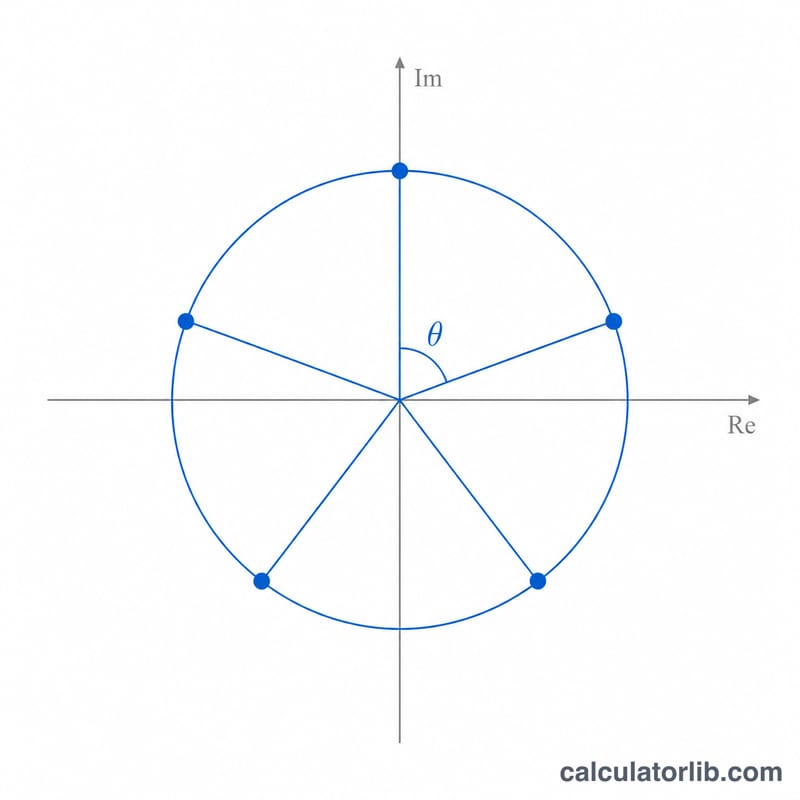
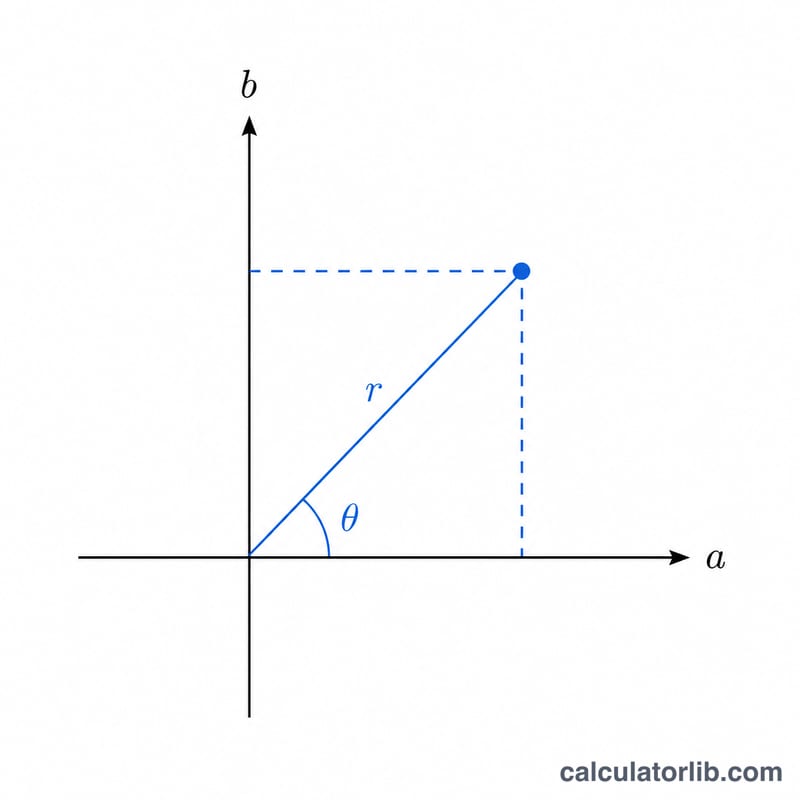
Every nonzero complex number \(z = a + bi\) has exactly n distinct n-th roots. This calculator finds all of them. It converts \(z\) to polar form (modulus \(r\) and argument \(\theta\)), then applies De Moivre's theorem to list each root in rectangular \(a + bi\) form, together with its angle. The roots are evenly distributed around a circle of radius \(r^{1/n}\) in the complex plane, separated by \(360^\circ/n\).
How to use it
Enter the real part \((a)\) and imaginary part \((b)\) of your complex number, then choose the root degree \(n\) (for example, 2 for square roots, 3 for cube roots). The tool returns the modulus \(|z|\), the argument \(\theta\) in degrees, the root modulus \(r^{1/n}\), and a full table of all \(n\) roots. The principal root \((k = 0)\) is highlighted at the top.
The formula explained
First write \(z\) in polar form: \(r = \sqrt{a^2 + b^2}\) and \(\theta = \operatorname{atan2}(b, a)\). The n-th roots are then:
$$w_k = r^{1/n}\left[\cos\!\left(\frac{\theta + 2\pi k}{n}\right) + i\cdot\sin\!\left(\frac{\theta + 2\pi k}{n}\right)\right],\quad k = 0, 1, \dots, n-1.$$
Each root shares the same modulus \(r^{1/n}\); only the angle changes, increasing by \(2\pi/n\) with each step.
Worked example
Find the square roots of \(z = -1\) (\(a = -1\), \(b = 0\), \(n = 2\)). Here \(r = 1\) and \(\theta = 180^\circ\). The root modulus is \(1^{1/2} = 1\). The angles are \(180^\circ/2 = 90^\circ\) and \((180^\circ + 360^\circ)/2 = 270^\circ\). So the roots are \(\cos 90^\circ + i\cdot\sin 90^\circ =\) i and \(\cos 270^\circ + i\cdot\sin 270^\circ =\) −i. These are exactly the two square roots of \(-1\).
FAQ
Why are there n roots? Because adding any multiple of \(2\pi\) to the argument gives the same number, dividing by \(n\) produces \(n\) distinct angles before they repeat.
What about z = 0? Zero has a single root: 0. The calculator returns \(0 + 0i\).
Is the angle in degrees or radians? Results are displayed in degrees for readability; the underlying math uses radians.