
What is the Ohm's Law Resistance Calculator?
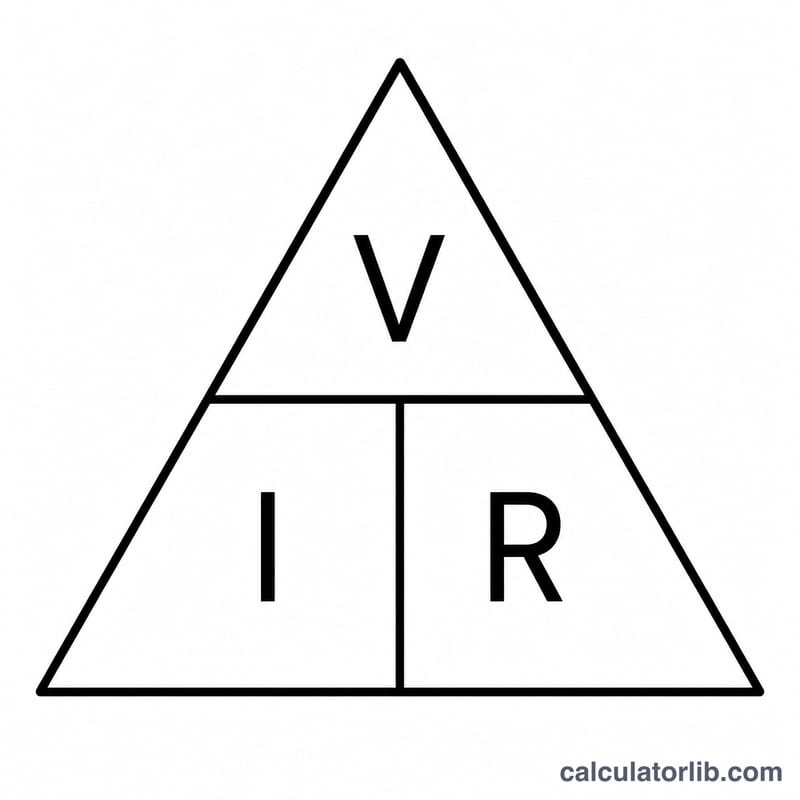
This calculator solves Ohm's Law for resistance. Given a voltage V and a current I, it computes the resistance R using the relationship \(R = V / I\). Ohm's Law is a universal physics principle, so this tool involves no country-specific assumptions. The result is reported simultaneously in five resistance units: megaohms, kiloohms, ohms, milliohms and microohms.
How to use it
Enter the voltage value and pick its unit (MV, kV, V, mV, microvolt or nanovolt). Enter the current value and pick its unit (kA, A, mA, microampere, nanoampere or picoampere). The calculator converts both inputs to SI base units (volts and amperes), divides to get ohms, and then expresses that result across the full unit range so you can read it conveniently for both very small and very large resistances.
The formula explained
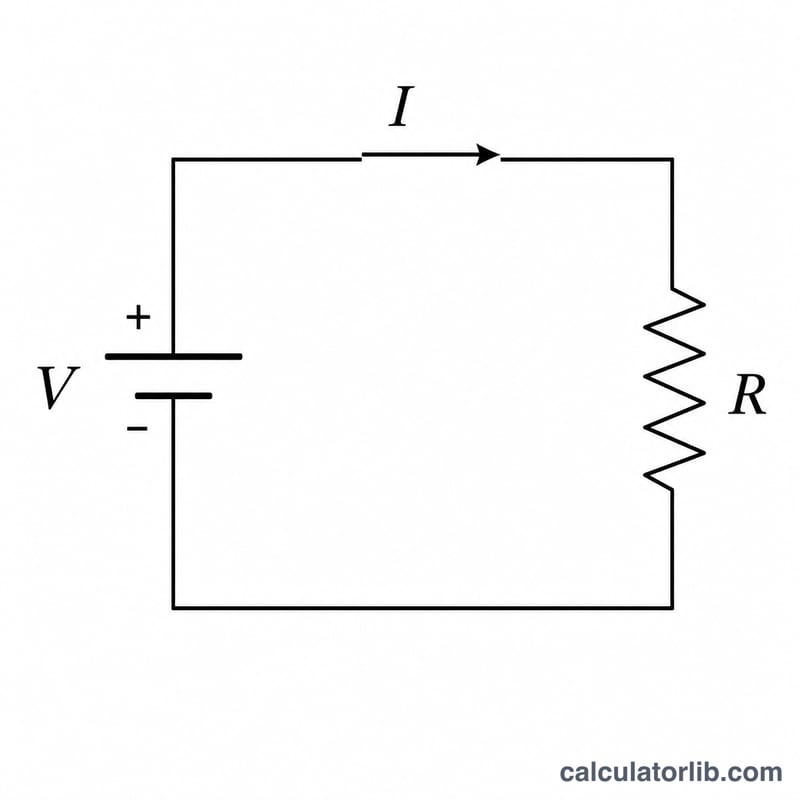
Ohm's Law states that the voltage across a conductor is proportional to the current through it: \(V = I \times R\). Rearranging for resistance gives \(R = V / I\). Internally we first normalize: $$V_{SI} = \text{voltage} \times (\text{voltage unit factor}) \quad \text{and} \quad I_{SI} = \text{current} \times (\text{current unit factor})$$ Then \(R = V_{SI} / I_{SI}\) in ohms, with conversions \(R(\text{k}\Omega) = R/1000\) and \(R(\text{m}\Omega) = R \times 1000\), and so on.
Worked example
Suppose \(V = 5\,\text{mV}\) and \(I = 2\,\mu\text{A}\). Convert: \(V_{SI} = 0.005\,\text{V}\), \(I_{SI} = 0.000002\,\text{A}\). Then $$R = \frac{0.005}{0.000002} = 2500\ \Omega$$ That is \(2.5\,\text{k}\Omega\), \(0.0025\,\text{M}\Omega\), \(2{,}500{,}000\,\text{m}\Omega\), and \(2{,}500{,}000{,}000\,\mu\Omega\).
FAQ
What if the current is zero? Resistance is undefined (it tends to infinity) when current is zero, so the calculator shows an error instead of dividing by zero.
Can I enter negative values? Yes. Mathematically \(R = V / I\) still computes, and the sign follows the ratio, though in normal practice both are entered as positive magnitudes.
Does this also do V = I·R or power? This page only solves for resistance. Related rearrangements include \(V = I \cdot R\), \(I = V/R\), and power \(P = V \cdot I = I^2 R = V^2/R\).