
What is the Ohm's Law Current Calculator?
This tool solves for electric current I using Ohm's Law, \(I = V / R\), given a voltage V and a resistance R. Ohm's Law is a universal relationship in electrical circuits, so this calculator applies identically everywhere with no country-specific assumptions. You enter voltage and resistance, pick the unit prefix for each, and get the resulting current expressed in five common scales from kiloamps down to nanoamps.
How to use it
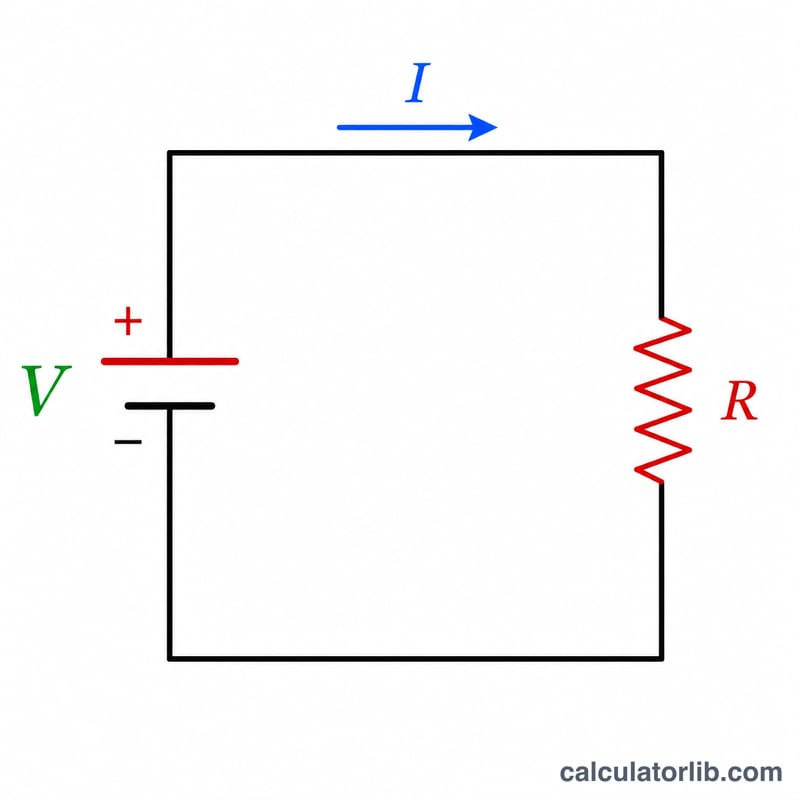
Enter the Voltage V and choose its unit (megavolt MV through nanovolt nV; default volts). Enter the Resistance R and choose its unit (gigaohm through microohm; default ohm). The calculator multiplies each value by its prefix factor to get SI volts and ohms, divides, and reports the current. Negative voltage is allowed and simply reverses the current direction. Resistance must be greater than zero.
The formula explained
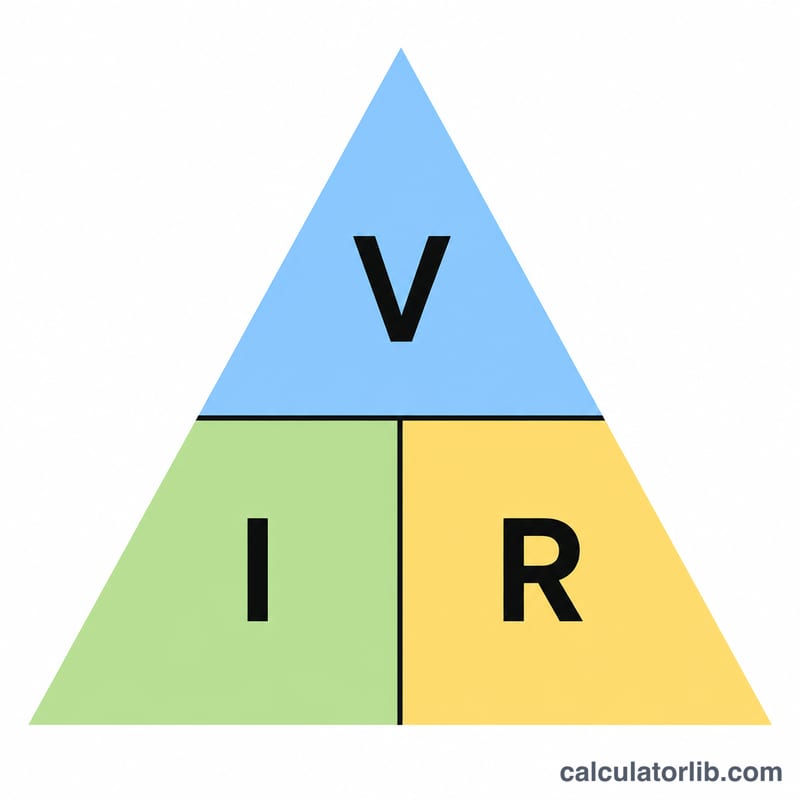
Ohm's Law states that current is directly proportional to voltage and inversely proportional to resistance: $$I = \frac{V}{R}$$ Internally we normalize: \(V_{SI} = V \times \text{voltage factor}\) and \(R_{SI} = R \times \text{resistance factor}\), then \(I_{SI} = V_{SI} / R_{SI}\) in amperes. The same amperage is then re-expressed by dividing by each output unit's SI factor (e.g. milliamps = \(I_{SI} \times 1000\)).
Worked example
With V = 200 V and R = 100 ohm: $$I = \frac{200}{100} = 2\ \text{A}$$ That equals 0.002 kA, 2 A, 2000 mA, 2,000,000 uA, and 2,000,000,000 nA. Scaling the inputs (5 kV across 2 kohm) gives \(5000 / 2000 = 2.5\ \text{A}\).
FAQ
What happens if resistance is zero? Division by zero is undefined - physically a zero-resistance short would drive current toward infinity, so the calculator shows an error instead of a number.
Can I enter a negative voltage? Yes. A negative voltage yields a negative current, indicating the conventional current flows in the opposite direction.
Does Ohm's Law always hold? It holds exactly for ideal ohmic (linear) resistors. Real components like diodes or filament bulbs are non-ohmic, so use this as an idealized estimate.