
What is the Ohm's Law Voltage Calculator?
This calculator finds electrical voltage (V) from current (I) and resistance (R) using Ohm's Law, \(V = I \times R\). It is pure physics and applies identically everywhere, so there is no country-specific scope. Enter a current and a resistance, choose convenient units for each, and the tool returns the resulting voltage in five scales at once: kilovolts, volts, millivolts, microvolts and nanovolts.
How to use it
Type the current value and pick its unit (kA, A, mA, microA, nA, pA). Type the resistance value and pick its unit (gigaohm, megaohm, kiloohm, ohm, milliohm, microohm). The calculator converts both inputs to SI base units, multiplies them, and displays the voltage. Because it only multiplies, there is no division-by-zero risk; a zero current or zero resistance simply gives zero volts.
The formula explained
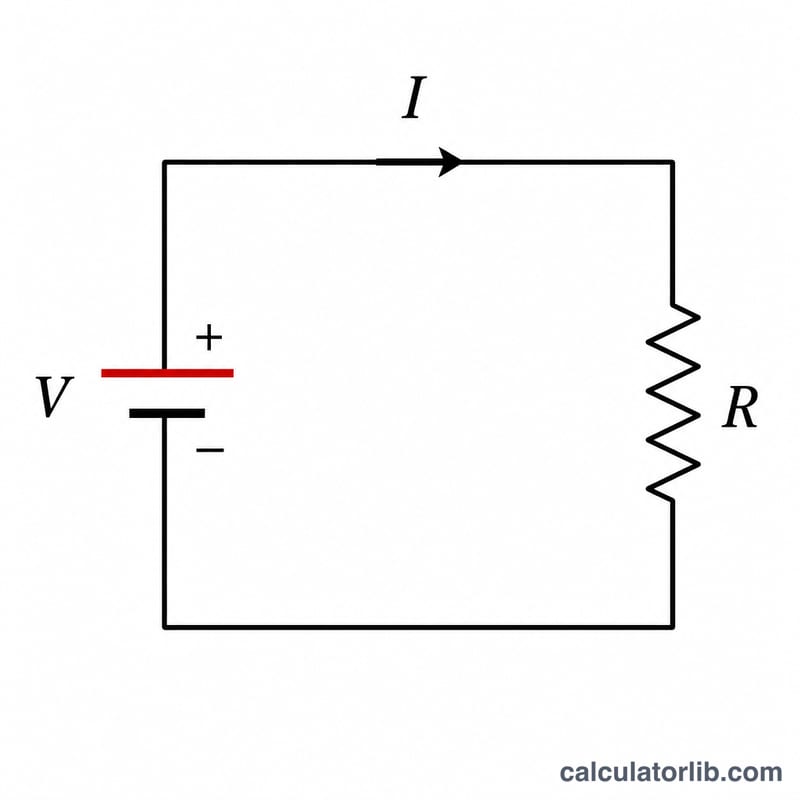
Ohm's Law states \(V = I \times R\), where V is in volts, I in amperes and R in ohms. Each input is first converted to SI: \(I_{SI} = \text{current} \times (\text{current unit factor})\) and \(R_{SI} = \text{resistance} \times (\text{resistance unit factor})\). Then $$V_{SI} = I_{SI} \times R_{SI}.$$ Other scales are simple conversions: \(1\,\text{kV} = 1000\,\text{V}\), \(1\,\text{V} = 1000\,\text{mV}\), and so on down to nanovolts.
Worked example
Suppose current = 50 mA and resistance = 4.7 kiloohm. Convert: \(I_{SI} = 0.05\,\text{A}\), \(R_{SI} = 4700\,\text{ohm}\). Then $$V = 0.05 \times 4700 = 235\,\text{V}.$$ Expressed in other scales that is 0.235 kV, 235 V, 235000 mV, 235000000 microV and 235000000000 nV.
FAQ
Does the sign matter? Yes. The output voltage tracks the sign of \(I \times R\), so a negative current with a positive resistance yields a negative voltage.
What if resistance is zero? A zero-ohm path (an ideal wire or short) produces no voltage drop, so \(V = 0\).
How do I solve for current or resistance instead? Rearrange Ohm's Law: \(I = V / R\) and \(R = V / I\). This particular tool solves only for voltage.