
What is Ohm's Law?
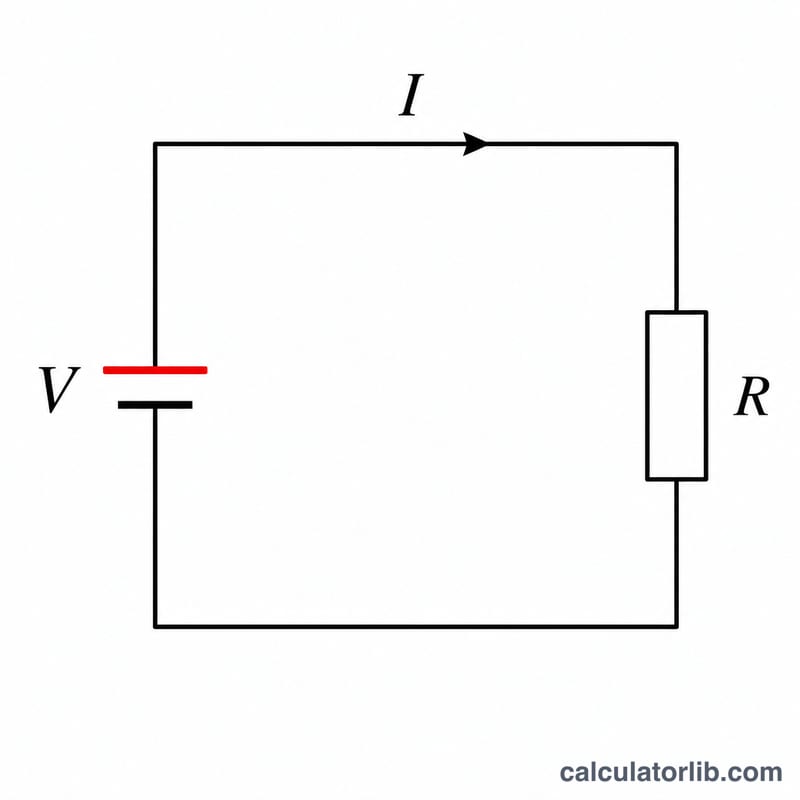
Ohm's Law is the fundamental relationship in electrical circuits, stating that the voltage (V) across a resistor equals the current (I) flowing through it multiplied by its resistance (R): \(V = I \times R\). This single equation links the three core quantities of any simple DC circuit and is the starting point for nearly all electronics calculations. This solver is universal — it applies to any region or standard.
How to use this calculator
Choose which quantity you want to solve for — voltage, current, or resistance — then enter the other two known values. The calculator rearranges Ohm's Law automatically and also reports the power dissipated, computed as \(P = V \times I\).
The formula explained
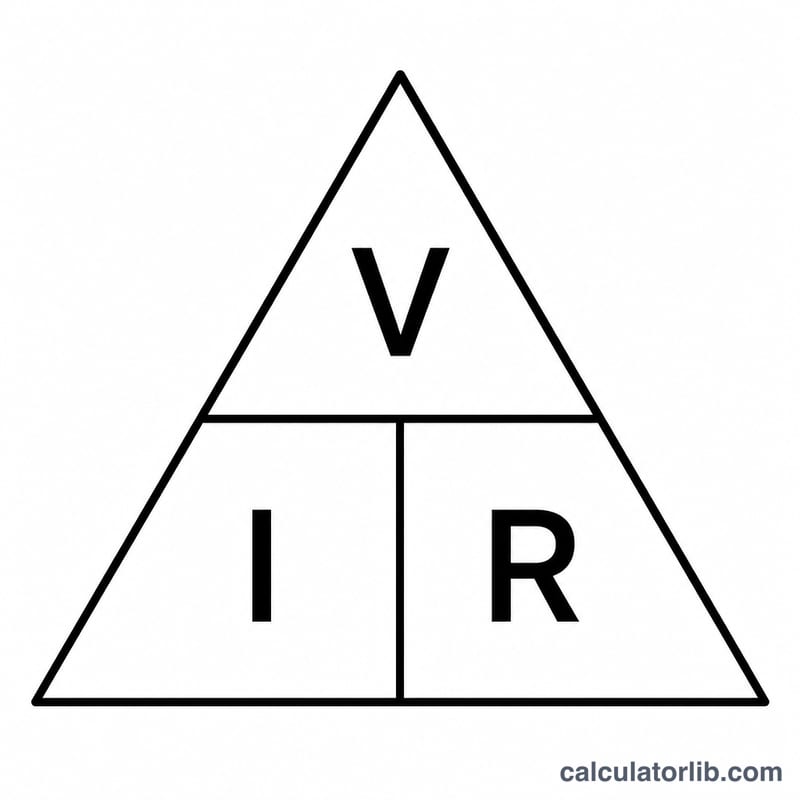
Starting from \(V = I \times R\), simple algebra gives the two rearranged forms:
\(I = V / R\) (current is voltage divided by resistance)
\(R = V / I\) (resistance is voltage divided by current)
Power can then be found with \(P = V \times I\), or the equivalent forms \(P = I^2 R\) and \(P = V^2 / R\).
Worked example
Suppose a current of 2 A flows through a 6 Ω resistor. Solving for voltage: $$V = I \times R = 2 \times 6 = 12\ \text{V}$$ The power dissipated is $$P = V \times I = 12 \times 2 = 24\ \text{W}$$
FAQ
What units should I use? Use volts for voltage, amps for current, and ohms for resistance. Mixing units (e.g. milliamps) will give incorrect results unless converted first.
Does Ohm's Law work for AC circuits? For purely resistive AC circuits it works with RMS values. With capacitors or inductors you must use impedance instead of plain resistance.
Why does it show power too? Power dissipation is one of the most common follow-up calculations, so it is included automatically using \(P = V \times I\).