
What is the Y-Intercept?
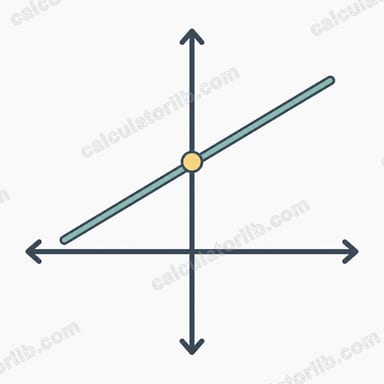
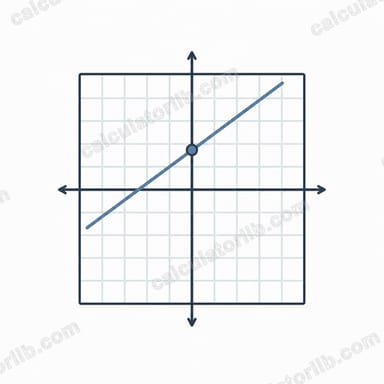
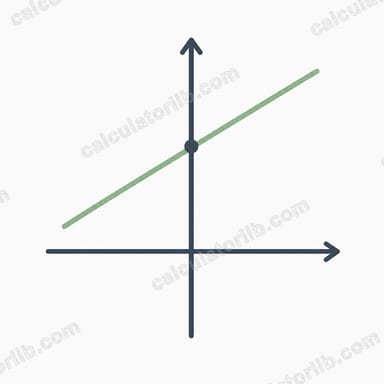
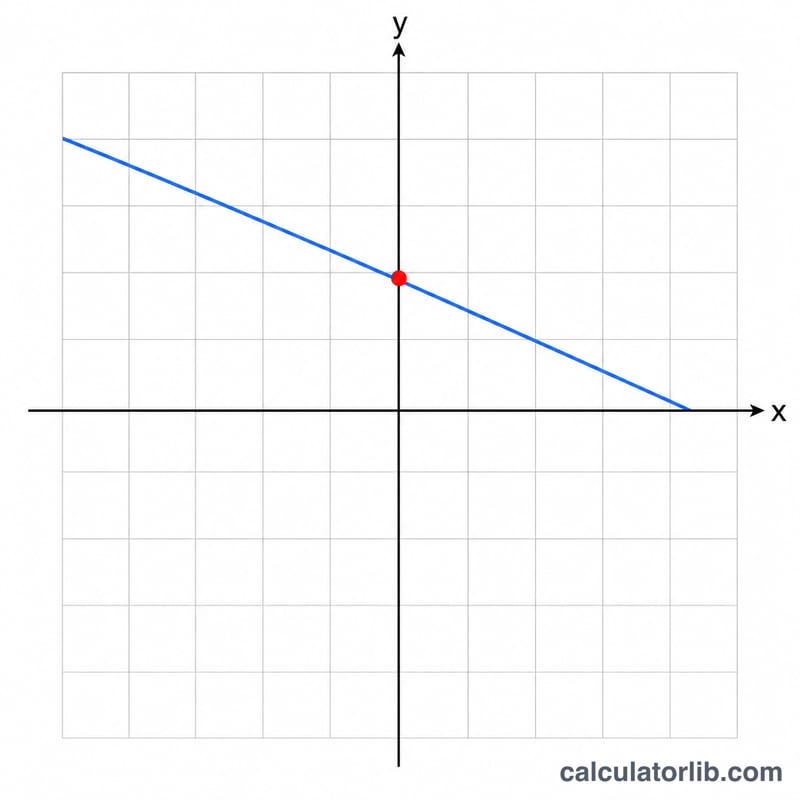
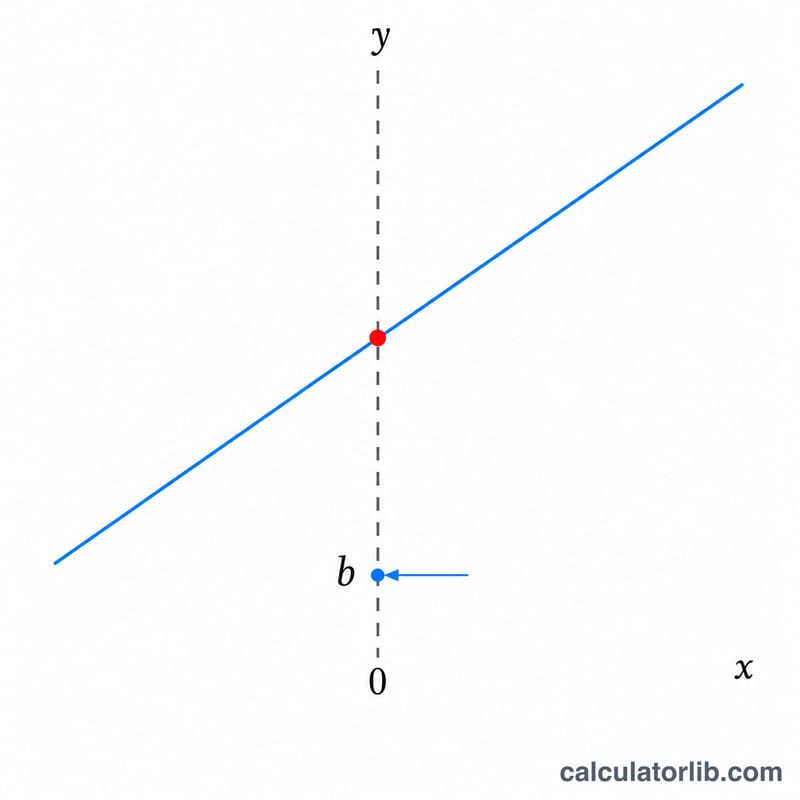
The y-intercept of a line is the point where the line crosses the y-axis. At that point the x-coordinate is always zero, so the y-intercept is the value of y when \(x = 0\). It is written as the point \((0, b)\). This calculator finds the y-intercept directly from a linear equation, whether it is written in slope-intercept form or standard form.
How to Use This Calculator
Choose the form your equation is in. For slope-intercept form (\(y = mx + b\)), just enter the slope \(m\) and the constant \(b\) — the y-intercept equals \(b\). For standard form (\(Ax + By = C\)), enter A, B, and C, and the calculator computes \(C \div B\). The result is shown both as a number and as the point \((0, y)\).
The Formula Explained
To find any y-intercept you substitute \(x = 0\) into the equation and solve for y. In slope-intercept form the mx term vanishes (\(m \times 0 = 0\)), leaving the following:
$$y\text{-intercept} = \text{b}$$In standard form, setting \(x = 0\) gives \(By = C\), so:
$$y\text{-intercept} = \frac{\text{C}}{\text{B}}$$This only works when B is not zero; if \(B = 0\) the line is vertical and has no y-intercept (unless it is the y-axis itself).
Worked Example
Take the standard-form equation \(2x + 4y = 8\). Set \(x = 0\): \(4y = 8\), so:
$$y = 8 \div 4 = 2$$The y-intercept is 2 and the line crosses the y-axis at the point \((0, 2)\). For the slope-intercept equation \(y = 2x + 3\), the y-intercept is simply 3.
FAQ
Can a line have more than one y-intercept? No. A non-vertical line crosses the y-axis at exactly one point.
What if B = 0 in standard form? The line is vertical (\(x = C/A\)) and has no y-intercept. This calculator returns 0 in that case as a safeguard.
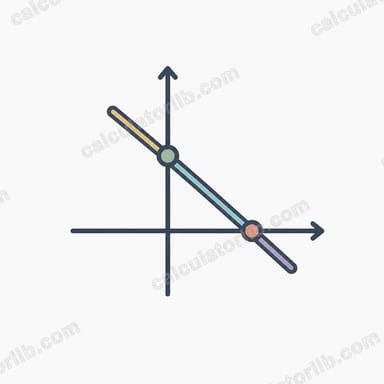
How is this different from the x-intercept? The x-intercept is where \(y = 0\) (the line crosses the x-axis); the y-intercept is where \(x = 0\).