
What this calculator does
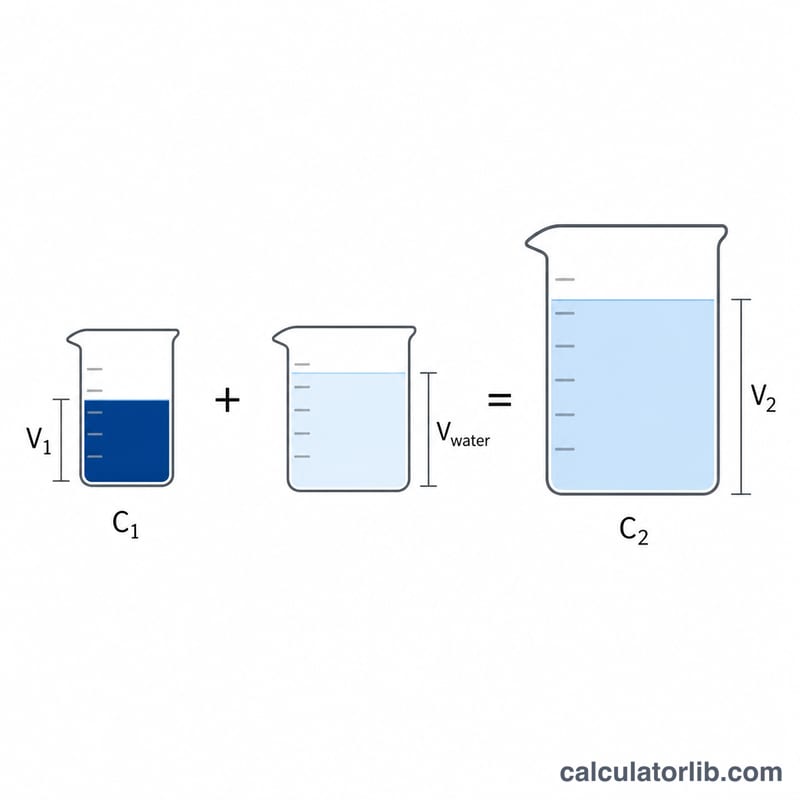
This tool tells you exactly how much concentrated stock solution to measure out, and how much water (or other diluent) to add, in order to dilute a solution down to a desired target percent concentration. It applies the standard dilution relationship \(\text{C}_1 \cdot \text{V}_1 = \text{C}_2 \cdot \text{V}_2\), where C is concentration and V is volume.
How to use it
Enter the concentration of your starting stock solution (C1, in %), the concentration you want to end up with (C2, in %), and the final volume you need (V2, in mL). The calculator returns V1, the volume of stock to use, and the amount of water to add to reach V2.
The formula explained
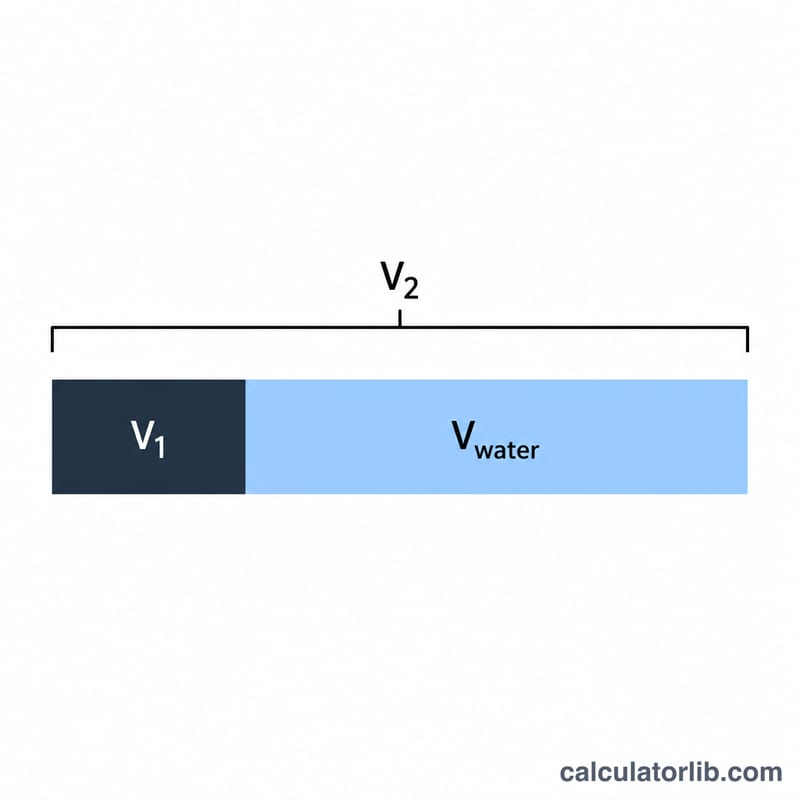
Because the amount of solute is conserved during dilution, \(\text{C}_1 \cdot \text{V}_1 = \text{C}_2 \cdot \text{V}_2\). Solving for the stock volume gives $$\text{V}_1 = \frac{\text{C}_2 \times \text{V}_2}{\text{C}_1}$$ Since the final volume is fixed, the diluent you must add is simply \(\text{V}_2 - \text{V}_1\). The percent units cancel as long as C1 and C2 use the same scale, so the result depends only on their ratio.
Worked example
You have a 10% stock and want 500 mL of a 2% solution. $$\text{V}_1 = \frac{2 \times 500}{10} = 100 \text{ mL of stock}$$ Water to add $$= 500 - 100 = 400 \text{ mL}$$ Measure 100 mL of stock and top up to 500 mL with water.
FAQ
Can I use any volume unit? Yes — mL, L, or oz all work, as long as V2 and the resulting V1 share the same unit.
Do C1 and C2 have to be in percent? They can be any matching concentration unit (%, mg/mL, M); only the ratio matters.
What if my target is higher than the stock? You cannot dilute up. If C2 is greater than C1 the result V1 will exceed V2, signaling that the stock is not strong enough.