
What Is This Calculator?
This tool converts alcohol proof into ABV (alcohol by volume, expressed as a percentage). It uses the United States standard, in which proof equals exactly twice the ABV. Other countries historically used different proof definitions (for example, the UK degrees proof system), so this calculator is scoped to the US convention.
How to Use It
Enter the proof number printed on the bottle (for example, 80) and the calculator instantly returns the equivalent ABV percentage. Most US spirits list both figures, so you can use this to verify a label or to convert a recipe that only states proof.
The Formula Explained
The relationship is simple and exact under the US system:
$$\text{ABV}\% = \dfrac{\text{Proof}}{2}$$
Because proof is defined as double the alcohol-by-volume percentage, every proof point equals half a percentage point of alcohol. To go the other way, multiply ABV by 2 to get proof.
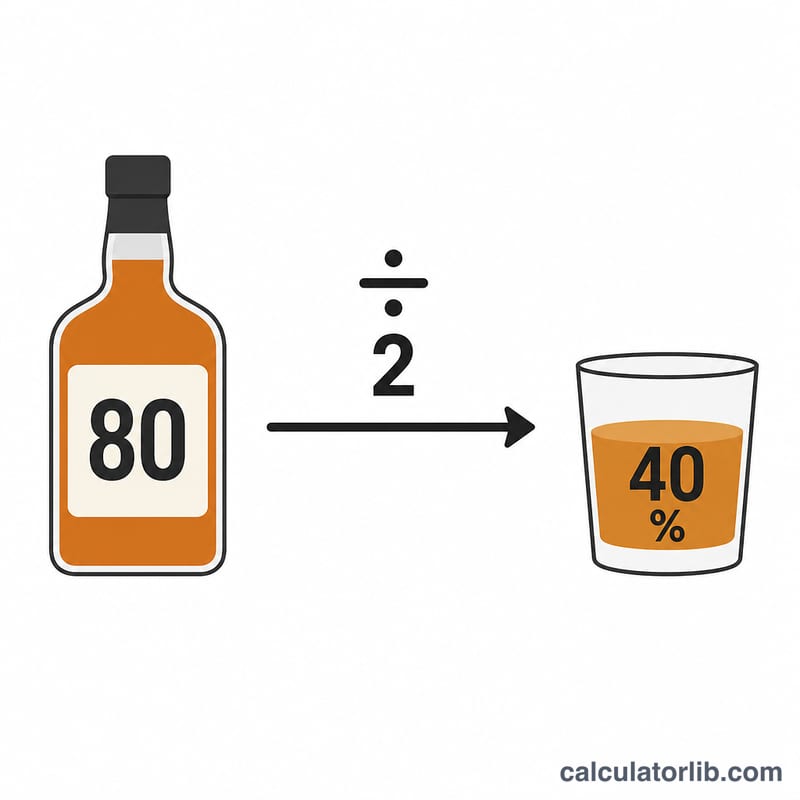
Worked Example
A bottle of vodka is labeled 80 proof. Dividing by two gives $$80 \div 2 = 40\% \text{ ABV}.$$ A high-proof bourbon at 120 proof works out to \(120 \div 2 = 60\%\) ABV.
Proof to ABV Conversion Table
In the United States, alcohol proof is exactly twice the alcohol by volume (ABV), so the conversion is simply \(\text{ABV} = \frac{\text{Proof}}{2}\). The table below lists common proof values, their corresponding ABV percentage, and the typical spirit associated with each strength.
| Proof (°) | ABV (%) | Typical Spirit / Notes |
|---|---|---|
| 60 | 30% | Many flavored liqueurs and lower-strength spirits |
| 70 | 35% | Flavored whiskeys, some schnapps and liqueurs |
| 80 | 40% | Most vodka, whiskey, gin, rum and tequila (standard strength) |
| 86 | 43% | Some bourbons and Scotch whiskies |
| 90 | 45% | Higher-strength whiskeys and bonded-style spirits |
| 100 | 50% | Bottled-in-bond whiskey (US legal minimum is 100 proof) |
| 101 | 50.5% | Wild Turkey 101 and similar high-proof bourbons |
| 120 | 60% | Cask-strength / barrel-proof whiskeys |
| 151 | 75.5% | Overproof rum (e.g. 151 rum), often used in flaming cocktails |
| 190 | 95% | Everclear and other neutral grain spirits (near the practical distillation limit) |
| 200 | 100% | Pure (absolute) ethanol — no water content |
For example, a 151-proof overproof rum has an ABV of \(151 \div 2 = 75.5\%\), while the theoretical maximum of 200 proof corresponds to 100% pure ethanol.
FAQ
Is proof always double the ABV? In the US, yes. The British "degrees proof" system used a different ratio (100 UK proof ≈ 57.1% ABV), so this calculator follows the simpler US standard.
What is the maximum proof? Pure ethanol is 200 proof (100% ABV), the theoretical upper limit.
Why does proof exist at all? "Proof" originated as a way to test ("prove") whether spirits had enough alcohol to ignite gunpowder, and the term stuck as a labeling standard.