What is the ABV Calculator?
This calculator estimates the alcohol by volume (ABV) of fermented beverages — wine, beer, mead, cider or kombucha — from two hydrometer readings: the original gravity (OG) measured before fermentation and the final gravity (FG) measured after fermentation. As yeast converts sugar into alcohol and CO₂, the liquid becomes less dense, so the drop in gravity is directly proportional to the amount of alcohol produced.

How to use it
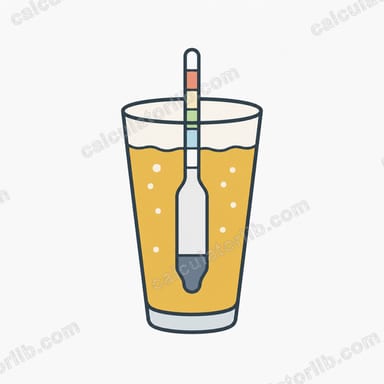
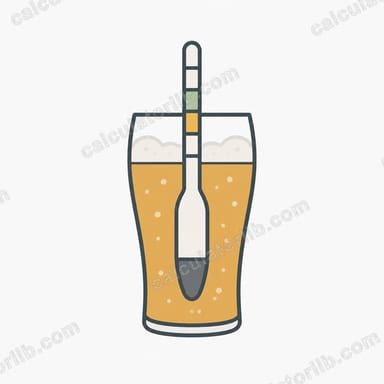
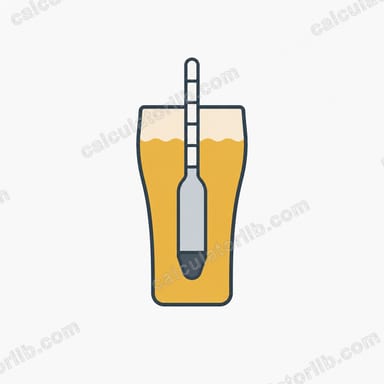
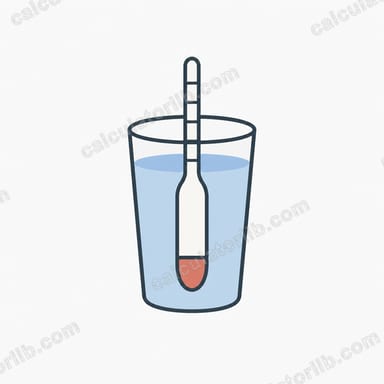
Float a calibrated hydrometer in your unfermented must or wort and record the reading — that is your OG (e.g. 1.050). When fermentation finishes, take a second reading for your FG (e.g. 1.010). Enter both numbers above and the calculator returns the estimated ABV plus the apparent attenuation, which tells you how much of the sugar the yeast consumed.
The formula explained
The widely used homebrew estimate is $$\text{ABV\%} = \left( \text{OG} - \text{FG} \right) \times 131.25$$ The constant 131.25 converts the specific-gravity difference into a percentage of alcohol by volume. It is accurate for typical beers and wines up to roughly 6–7% ABV and slightly overestimates for very strong brews; more complex formulas exist but this one is the standard quick reference.
Apparent attenuation, \(( \text{OG} - \text{FG} ) \div ( \text{OG} - 1 ) \times 100\), shows the fraction of fermentable sugar the yeast actually fermented.
Worked example
A wine starts at OG = 1.090 and finishes at FG = 1.000. The difference is 0.090. Multiply by 131.25: $$0.090 \times 131.25 = 11.81\% \text{ ABV}$$ The attenuation is \(( 0.090 \div 0.090 ) \times 100 = 100\%\), meaning the yeast fermented all available sugar.
Typical ABV and Gravity Ranges by Beverage Style
The table below lists approximate ranges commonly seen in homebrewing and home winemaking. They are general guidelines (loosely based on BJCP style guidelines for beer and cider and on common winemaking practice), not strict rules. Individual recipes and styles vary.
| Beverage | Typical OG | Typical FG | Finished ABV |
|---|---|---|---|
| Light beer (e.g. light lager) | 1.028–1.040 | 0.998–1.008 | about 2.8–4.2% |
| Standard ale (pale ale, bitter, etc.) | 1.040–1.060 | 1.008–1.016 | about 4–6% |
| Strong ale / barleywine | 1.080–1.120 | 1.016–1.030 | about 8–12% |
| Cider | 1.045–1.065 | 0.998–1.015 | about 5–8% |
| Light table wine | 1.070–1.085 | 0.992–1.000 | about 9–12% |
| Standard wine | 1.085–1.100 | 0.990–0.998 | about 11.5–14% |
| Mead, dry | 1.080–1.110 | 0.990–1.006 | about 10–14% |
| Mead, sweet | 1.110–1.150 | 1.015–1.030 | about 11–16% |
Yeast alcohol tolerance
Yeast strains stop fermenting when the alcohol level becomes toxic to them or when they run out of fermentable sugar or nutrients. Published tolerances run from roughly 8% ABV for some low-tolerance strains up to about 18% for the most tolerant wine and distilling strains. Many ale yeasts sit around 8–12%, while many wine and mead yeasts are rated about 12–18%. Treat a strain's rated tolerance as an approximate ceiling, because nutrition, temperature and yeast health all affect it.
Gravity Conversion: SG, Brix and Plato
Specific gravity (SG) can be expressed in degrees Plato (°P) or degrees Brix (°Bx). For brewing and winemaking the two scales are practically interchangeable. The approximate relationship is:
$$\text{SG} \approx 1 + \frac{\text{Brix}}{258.6 - \left(\frac{\text{Brix}}{258.2} \times 227.1\right)}$$
The last column is the potential ABV if the wort or must fermented fully down to FG 1.000, using \((\text{SG} - 1.000) \times 131.25\).
| Specific gravity | Approx. °Plato / °Brix | Potential ABV (to FG 1.000) |
|---|---|---|
| 1.040 | 10.0 | 5.3% |
| 1.050 | 12.4 | 6.6% |
| 1.060 | 14.7 | 7.9% |
| 1.070 | 17.1 | 9.2% |
| 1.080 | 19.3 | 10.5% |
| 1.090 | 21.6 | 11.8% |
| 1.100 | 23.8 | 13.1% |
| 1.110 | 25.9 | 14.4% |
| 1.120 | 28.1 | 15.8% |
Refractometer caution
A refractometer gives a reliable original gravity reading on unfermented liquid. Once fermentation begins, alcohol changes how light bends in the sample, so the Brix reading no longer reflects sugar alone. Readings taken during or after fermentation must be corrected with a refractometer-correction formula or calculator before they are used as FG. A hydrometer reading (temperature-corrected) does not need this correction. Values above 7% ABV in the last column are also affected by the formula's over-estimation at high gravity.
Interpreting Your Attenuation and ABV Result
Apparent attenuation shows how much of the original gravity the yeast consumed:
$$\text{Apparent attenuation} = \frac{\text{OG} - \text{FG}}{\text{OG} - 1} \times 100\%$$
Example: OG 1.060 and FG 1.012 give a gravity drop of 0.048, so ABV = 0.048 × 131.25 = 6.3% and apparent attenuation = 0.048 ÷ 0.060 × 100 = 80%.
| Apparent attenuation | Typical meaning |
|---|---|
| Below about 65% | Low; may indicate a stuck or incomplete fermentation, an underpitched or stressed yeast, or a very high-mashing-temperature (dextrin-rich) wort |
| About 65–70% | Lower-than-typical; common with low-attenuating strains or full-bodied recipes |
| About 70–80% | Typical for most ale yeasts |
| About 80–100% | Typical for wine, champagne and many mead yeasts, which ferment most or all available sugar |
What FG tells you
- Higher FG means more unfermented sugar and dextrins, which gives more residual sweetness and a fuller body. Sweet meads and ciders often finish around 1.010–1.030.
- FG at or below 1.000 (alcohol is less dense than water) indicates a fully dry result, common in dry wines, dry meads and ciders, where FG values such as 0.990–0.998 are normal.
Confirming fermentation is finished
One low reading is not proof. A stable FG across several days (for example, identical hydrometer readings 2–3 days apart) confirms that fermentation has finished. A gravity that is still dropping means the yeast is still working.
Accuracy limits
The factor 131.25 is a simple approximation calibrated mainly for beer-strength liquids. It tends to over-estimate ABV above roughly 7%, so for strong ales, wines and meads treat the result as an estimate, typically within a fraction of a percent to about one percent. Hydrometer calibration, sample temperature, and dissolved CO₂ or suspended solids also affect the reading.
FAQ
Why is my reading temperature dependent? Hydrometers are usually calibrated at 20°C/68°F. If your sample is much warmer or cooler, apply a temperature correction before entering values.
Is this exact? No — it is a reliable estimate. Actual ABV can vary with yeast strain, sugar type and measurement precision. Expect accuracy within a few tenths of a percent for normal-strength drinks.
Can I use this for spirits? No. Distillation concentrates alcohol, so gravity readings no longer reflect ABV after distilling.