What this calculator does
This tool estimates the fenbendazole (commonly sold as Panacur) deworming dose for a dog based on its body weight. The widely cited canine rate is 50 mg per kilogram of body weight, given once daily for 3 days in a row (the Panacur C label course). Enter your dog's weight in kilograms or pounds and the calculator returns the daily milligram dose plus the total dose across the whole treatment course. This information is educational only — dosing, product choice and treatment length should always be confirmed by your veterinarian.
How to use it
Weigh your dog as accurately as you can. Choose kilograms or pounds (pounds are converted using \(1\text{ lb} = 0.4536\text{ kg}\)). Keep the dose rate at 50 mg/kg and the treatment days at 3, as on the Panacur C label; the calculator does not work out other rates or course lengths. The result shows the mg of active fenbendazole needed each day and for the full course.
The formula explained
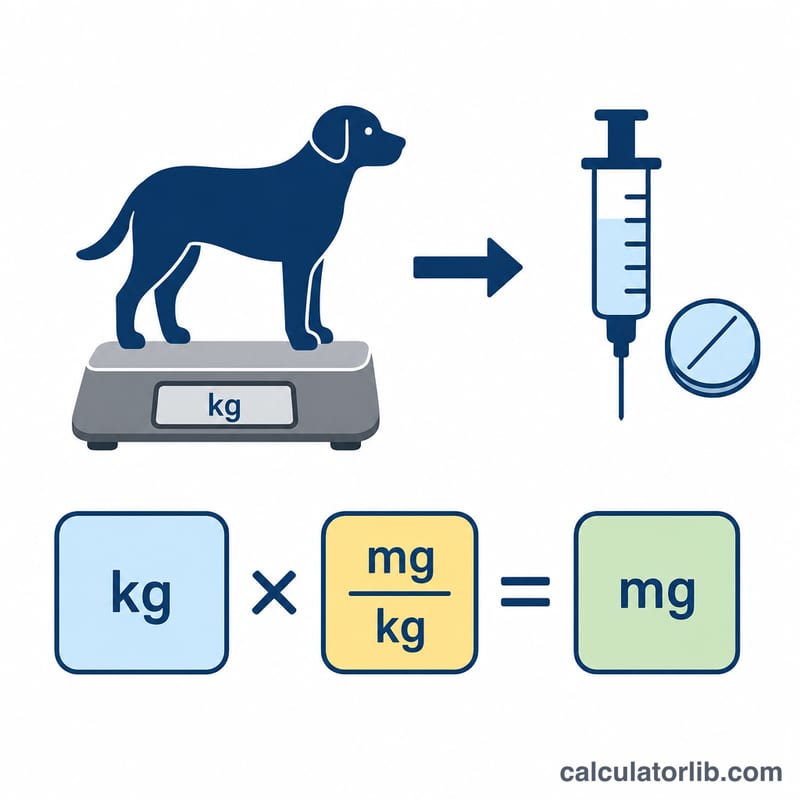
The daily dose is simply the dose rate multiplied by weight: $$\text{Daily dose (mg)} = 50\text{ mg/kg} \times \text{weight (kg)}$$ The total course dose multiplies that by the number of days. Note this gives milligrams of active fenbendazole, not millilitres of a particular suspension or grams of a paste — concentration varies by product, so always read the label.
Worked example
A 10 kg dog at 50 mg/kg needs $$50 \times 10 = 500\text{ mg per day}$$ Over a 3-day course that is $$500 \times 3 = 1{,}500\text{ mg total}$$ A 22 lb dog converts to about 9.98 kg, giving roughly 499 mg/day.
Fenbendazole Dose by Dog Weight and Course Length
The table below uses a rate of 50 mg/kg of body weight once daily, calculated as \(\text{Total mg} = 50 \times \text{kg} \times \text{days}\). Pounds are converted with 1 kg ≈ 2.2046 lb. These figures are arithmetic illustrations, not prescriptions. The right dose, rate and course length depend on the parasite being treated and on your dog, so confirm them with a veterinarian.
| Dog weight (kg) | Approx. weight (lb) | Daily dose (mg) | 3-day course total (mg) |
|---|---|---|---|
| 5 | 11.0 | 250 | 750 |
| 10 | 22.0 | 500 | 1,500 |
| 20 | 44.1 | 1,000 | 3,000 |
| 30 | 66.1 | 1,500 | 4,500 |
| 40 | 88.2 | 2,000 | 6,000 |
Worked example: a 20 kg dog at 50 mg/kg per day for 3 days gives \(50 \times 20 \times 3 = 3{,}000\) mg in total, or 1,000 mg per day.
Common Fenbendazole Product Concentrations
To turn a daily mg dose into an amount of product, divide by the concentration: \(\text{Amount} = \text{Dose (mg)} \div \text{Concentration (mg per g or mL)}\).
| Product form | Strength | Concentration | Notes |
|---|---|---|---|
| Panacur C granules | 22.2% | 222 mg/g | Packets of 1 g (222 mg), 2 g (444 mg) and 4 g (888 mg) |
Worked example: for a daily dose of 1,000 mg, granules at 222 mg/g need \(1000 \div 222 \approx 4.5\) g.
Always check the actual product label. Formulations, strengths, packet sizes and approved uses differ by region and brand, so confirm the concentration on your package. This is general information, not veterinary advice, so consult a veterinarian before giving any dewormer.
FAQ
Is 50 mg/kg correct for all dogs? It is the common reference rate, but puppies, pregnant dogs and specific parasites may need different protocols — ask your vet.
How do I convert mg to mL or grams? Divide the mg by the product's concentration (e.g. Panacur C granules at 222 mg/g mean a 2 g packet holds \(444\text{ mg}\)). Check your product label.
Can I give the whole course in one dose? No. Fenbendazole is given once daily across consecutive days for full effect; do not combine days into one dose.