What this calculator does
This tool estimates how much famotidine (brand name Pepcid) a dog may need based on its body weight. Famotidine is an H2-receptor antagonist commonly used to reduce stomach acid and help manage conditions such as acid reflux, gastritis, and stomach ulcers in dogs. The standard canine reference dose is about 0.5 mg per kilogram of body weight, given once every 24 hours. This calculator is for educational reference only and does not replace veterinary advice.
How to use it
Enter your dog's weight and choose pounds or kilograms. The default dose rate is 0.5 mg/kg, but your vet may recommend a value within roughly 0.5–1.0 mg/kg depending on the condition. The calculator returns the dose in milligrams for a single administration, which is given once daily (every 24 hours) as directed.
The formula explained
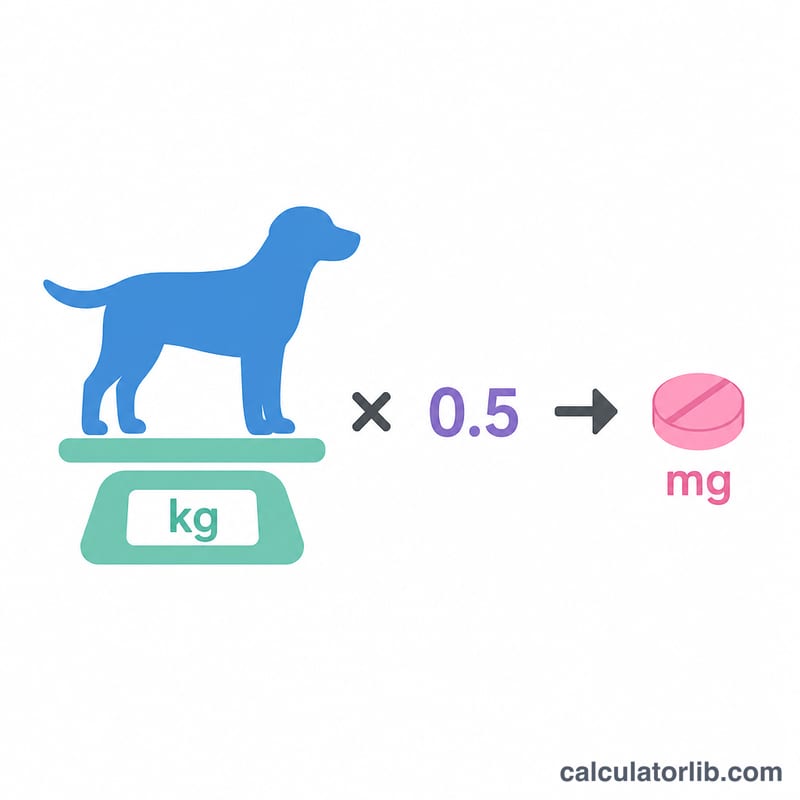
The math is simple: $$\text{Dose (mg)} = \text{Dose Rate (mg/kg)} \times \text{Weight (kg)}$$. If you enter weight in pounds, it is first converted to kilograms by multiplying by 0.4536. For example, a 22 lb dog is \(22 \times 0.4536 \approx 9.98\) kg.
Worked example
Suppose you have a 10 kg dog and use the standard 0.5 mg/kg rate: $$0.5 \times 10 = 5 \text{ mg}$$ per dose, given once every 24 hours. Pepcid tablets are commonly sold in 10 mg and 20 mg strengths, so your vet may advise splitting a tablet to reach the correct amount.
Famotidine Dose by Dog Weight
The table below applies the calculator's formula at a dose rate of 0.5 mg/kg: \(\text{Dose (mg)} = 0.5 \times \text{Weight (kg)}\). Doses are rounded to 0.1 mg. The last two columns show what fraction of a 10 mg or 20 mg tablet that dose represents. These are illustrative figures only, to be confirmed with your veterinarian.
| Dog weight | Dose at 0.5 mg/kg | Fraction of 10 mg tablet | Fraction of 20 mg tablet |
|---|---|---|---|
| 5 lb / 2.3 kg | 1.2 mg (1.15 before rounding) | about 0.12 (too small to split accurately) | about 0.06 (too small to split accurately) |
| 10 lb / 4.5 kg | 2.3 mg (2.25 before rounding) | about 0.23 | about 0.11 |
| 22 lb / 10 kg | 5.0 mg | 1/2 tablet | 1/4 tablet |
| 44 lb / 20 kg | 10.0 mg | 1 tablet | 1/2 tablet |
| 66 lb / 30 kg | 15.0 mg | 1.5 tablets | 3/4 tablet |
| 88 lb / 40 kg | 20.0 mg | 2 tablets | 1 tablet |
Worked example (20 kg dog): \(0.5\ \text{mg/kg} \times 20\ \text{kg} = 10\ \text{mg}\), which equals one 10 mg tablet or half a 20 mg tablet. For very small dogs the calculated dose is a small fraction of a tablet, so accurate dosing may not be possible with tablets as sold. Your vet can advise on a suitable formulation.
These figures are examples, not prescriptions. Always confirm the dose and frequency with your veterinarian.
Pounds to Kilograms Quick Conversion
The calculator's formula uses kilograms. To convert pounds to kilograms, multiply by 0.4536: \(\text{kg} = \text{lb} \times 0.4536\). For example, \(50 \times 0.4536 = 22.68\) kg.
| Weight (lb) | Weight (kg) |
|---|---|
| 5 lb | 2.27 kg |
| 10 lb | 4.54 kg |
| 20 lb | 9.07 kg |
| 30 lb | 13.61 kg |
| 40 lb | 18.14 kg |
| 50 lb | 22.68 kg |
| 75 lb | 34.02 kg |
| 100 lb | 45.36 kg |
Use a recent, accurate weight. A dog's weight can change over time, and a small error matters more in small dogs.
Interpreting Your Result
The result is a single dose, not a daily total. The calculator multiplies dose rate by body weight, so the answer is the amount of famotidine for one administration. With the once-every-24-hours schedule in the Merck Veterinary Manual, the daily total is the same as this single dose.
Dose rate. The calculator defaults to 0.5 mg/kg. Veterinary references commonly describe a range of about 0.5 to 1.0 mg/kg. The Merck Veterinary Manual gives 1 mg/kg once every 24 hours as the upper end, and the calculator does not accept a higher rate. Entering 1.0 doubles the result compared with 0.5. For a 20 kg dog, 0.5 mg/kg gives 10 mg and 1.0 mg/kg gives 20 mg. Which rate and frequency suit a particular dog is a decision for the vet.
Tablet strengths. Famotidine tablets are commonly sold in 10 mg and 20 mg strengths. Compare your result with these to see how many tablets or what fraction it represents. Small doses may be impractical to split, and not every tablet can be divided evenly. Check that the product contains only famotidine, because some heartburn products combine it with other ingredients such as antacids that are not meant for dogs unless your vet says otherwise.
This is a reference estimate, not a prescription. Kidney disease, liver disease, age (very young or senior dogs), pregnancy or nursing, and other medications can all change whether and how famotidine should be used. Your veterinarian determines the final dose, frequency and duration after assessing your dog. This is general information, not professional veterinary advice. If your dog is vomiting repeatedly, has black stools, or seems unwell, contact a vet promptly rather than relying on a calculator.
FAQ
Is Pepcid safe for dogs? Famotidine is widely used in dogs, but you should always confirm the dose, product (avoid combination formulas with extra active ingredients), and duration with your veterinarian.
How often can it be given? Once every 24 hours, per the Merck Veterinary Manual. Your vet will set the exact frequency based on your dog's condition.
What if my dog is very small or very large? Always verify with a vet, especially for tiny breeds, puppies, pregnant dogs, or dogs with kidney or liver problems where dosing may need adjustment.