What This Calculator Does
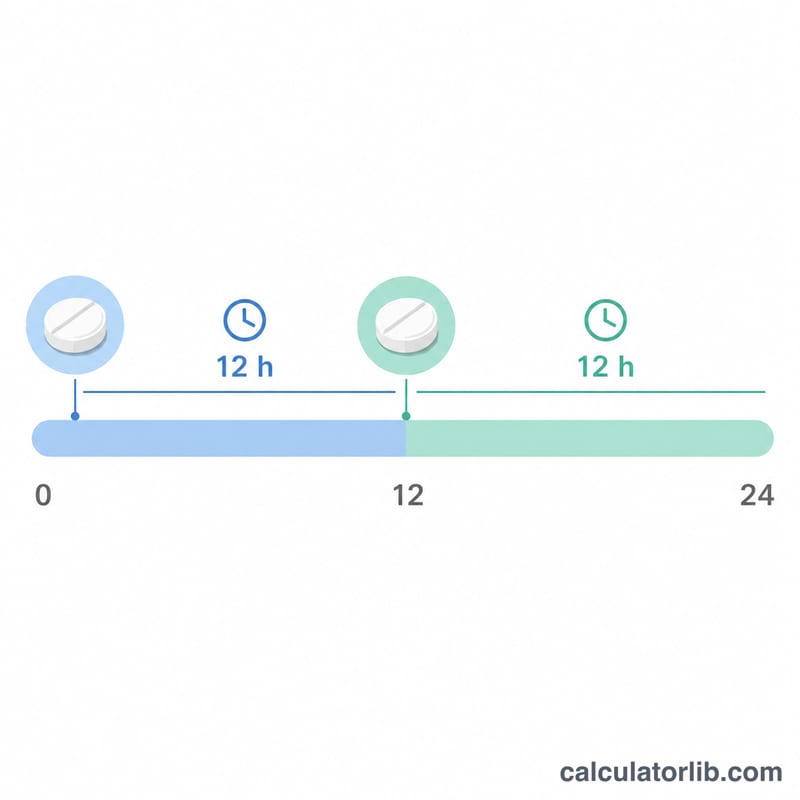
This tool estimates an aspirin (acetylsalicylic acid) dose for a dog based on its body weight, using a common reference rate of about 10 mg per kilogram given every 12 hours. It accepts weight in kilograms or pounds and lets you adjust the dose rate. This is an educational estimate, not veterinary advice. Aspirin can cause serious side effects in dogs and is dangerous or fatal for cats. Always speak to your veterinarian before dosing.
How to Use It
Enter your dog's weight and choose kg or lb. The default dose rate is 10 mg/kg, the low end of the 10–40 mg/kg range in the Merck Veterinary Manual; your vet may recommend a different rate. The calculator converts pounds to kilograms (\(1 \text{ lb} = 0.4536 \text{ kg}\)), multiplies by the dose rate for a single dose, and doubles it for the 24-hour total assuming every-12-hour dosing.
The Formula Explained
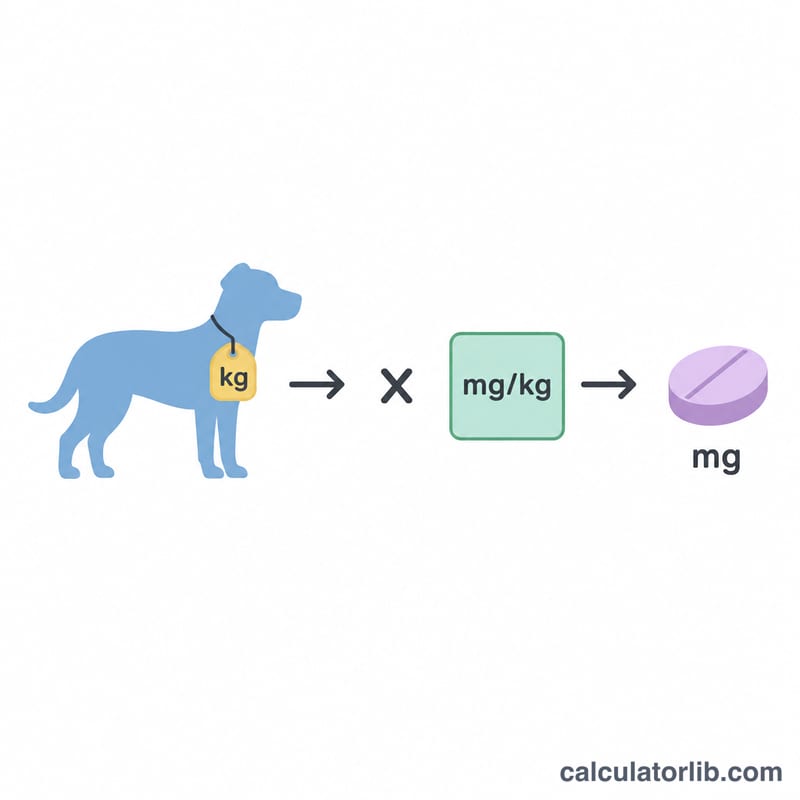
The core equation is $$\text{Dose (mg)} = \text{Rate (mg/kg)} \times \text{Weight (kg)}$$. With the default 10 mg/kg, a 20 kg dog would get \(10 \times 20 = 200\) mg per dose, or 400 mg per day across two doses. Buffered or enteric-coated aspirin and the exact product strength matter, so round to a practical tablet size only under veterinary guidance.
Worked Example
A 44 lb dog converts to \(44 \times 0.4536 \approx 19.96\) kg. At 10 mg/kg that is about 199.6 mg per dose, and roughly 399.2 mg per day given twice daily.
Aspirin Dose Estimates by Dog Weight
The table applies the calculator's formula, \(\text{Dose} = \text{Dose Rate (mg/kg)} \times \text{Weight (kg)}\), at the default rate of 10 mg/kg per dose, given every 12 hours (two doses per 24 hours). Pound weights are converted with 1 kg ≈ 2.205 lb.
| Dog weight (kg) | Approx. weight (lb) | mg per dose (10 mg/kg) | mg per 24 hours (2 doses) |
|---|---|---|---|
| 5 | 11.0 | 50 | 100 |
| 10 | 22.0 | 100 | 200 |
| 20 | 44.1 | 200 | 400 |
| 30 | 66.1 | 300 | 600 |
| 40 | 88.2 | 400 | 800 |
Example: a 20 kg dog at 10 mg/kg gives \(10 \times 20 = \) 200 mg per dose, or 400 mg over 24 hours with two doses.
Important: these figures are arithmetic illustrations of the formula, not veterinary recommendations. Whether aspirin is appropriate for a particular dog, and at what dose, is a decision for a veterinarian.
Interpreting Your Result
The number produced is a reference-rate estimate, not a prescription. It simply multiplies body weight by a chosen mg/kg rate. The Merck Veterinary Manual lists 10–40 mg/kg by mouth every 8–12 hours for dogs and notes that aspirin is not approved for veterinary use; this calculator accepts only 10–20 mg/kg because 25 mg/kg every 8 hours caused stomach erosions in half of dogs within 2 days. Frequency and duration also differ between sources. This is why the result should be treated as a starting point for a conversation with a veterinarian, not as an instruction.
Tablet strength matters
Aspirin is sold in different strengths, most commonly 81 mg (low-dose) and 325 mg (adult). The calculated dose often does not divide evenly into whole tablets. For example, 50 mg is well under one 81 mg tablet, and a 325 mg tablet is far larger than the dose a small dog would be calculated to need. Tablets also come in coated or enteric-coated forms, and the absorption of enteric-coated products in dogs is considered unreliable. Accurate measurement is therefore harder than the arithmetic suggests.
Known risks
- Gastrointestinal ulceration and stomach irritation.
- Bleeding, because aspirin affects platelet function.
- Kidney effects, especially in dehydrated dogs or those with existing kidney disease.
- Drug interactions: combining aspirin with other NSAIDs or with corticosteroids greatly increases the risk of GI ulcers and bleeding.
Sensitive animals and warning signs
Cats and puppies are especially sensitive to aspirin. Cats process salicylates very slowly, and this calculator's dog rate does not apply to them. Signs of possible toxicity include vomiting, black or tarry stools, lethargy, loss of appetite, and abdominal pain. If any of these occur, or if too much may have been swallowed, contact a veterinarian or an animal poison control service promptly.
This is general information only and not veterinary or medical advice for any individual animal.
FAQ
Is aspirin safe for dogs? Only short-term and only when a vet approves it. Long-term use risks stomach ulcers and bleeding.
Can I give it to my cat? No. Cats metabolize aspirin very slowly and can be poisoned by small amounts.
How often can it be given? The common schedule is every 12 hours, but frequency and duration should be set by your veterinarian.